
How CIO Peer Networks and AI Are Reshaping Enterprise Tech Strategy


Emmet Keeffe III, Managing Director at Insight Partners and Founder of Insight Partners for Enterprise, has spent decades helping organizations navigate digital transformation and enterprise technology challenges.
In this candid conversation with CTO Magazine, he opens up about his career journey, the evolution of CIO roles, the AI-driven shift in enterprise IT, and how the CIO Council is creating a collaborative platform for tech leaders and founders to exchange insights, solve problems, and accelerate innovation.
Emmet, you’ve been in the industry for quite some time. We’d love to hear your journey, from your early days to your current role. How did it all begin?
Emmet: I’m a founder and CEO by background. The first big segment of my career was building a B2B SaaS software company. We were in the software delivery space, and I spent 17 years building that business. While we were growing, we also created a digital thought leadership program for CIOs and CTOs from 2004 up until the pandemic in 2020. The aim was to bring together thought leadership around digital change and transformation globally.

Emmet Keeffe III
In 2015, I joined Insight as an operating partner and founded Insight Ignite, which we later rebranded as Insight Partners for Enterprise. Over the past 11 years, we’ve been working with large corporations to understand their IT strategies, identify their core problems, and curate our portfolio and thought leadership to help accelerate the solution to those problems.
Four years ago, we launched the CIO Council, which we’ve been building steadily. The program has reached a strong critical mass. I’ve always been entrepreneurial, even within the firm, looking to build the next thing that can make an impact for large global companies.
That’s fascinating. You mentioned these thought leadership programs. What inspired you to start something like that?
Emmet: It was really about bringing a different approach to the market. What makes Insight unique is our investment thesis. We invest at the center of market timing, here and now. CIOs and CTOs want to know what’s coming three or five years ahead, but we focus on the present, which positions us as strategic partners for large corporations. By understanding the problems these companies face, we provide targeted advice and visibility into solutions that matter today.
Over the years, with Gen Z entering the workforce and AI becoming central to enterprise strategy, what changes have you observed in thought leadership and IT leadership itself?
Emmet: Post the Internet, there were 25 years of digital transformation, but it wasn’t truly disruptive.
Large companies just needed websites, apps, or improved consumer interactions; they didn’t have to transform their entire enterprise. Now, with AI, we’re at the outset of another massive transformation, which will be far more fundamental and disruptive than the digital era.
It’s exciting, but the full impact is still unfolding, and its full extent is not yet clear.
This year marks the fourth cohort of the CIO Council. Can you share what’s new or exciting about this iteration compared to the previous ones?
Emmet: The program is gaining momentum. The fourth cohort included companies such as PPG, Stellantis, Adobe, Lincoln Financial, Eaton, Wendy’s, Liberty Mutual, CIBC, and Procter & Gamble. Each cohort has about 15 global CIOs and CTOs.
Subscribe to our bi-weekly newsletter
Get the latest trends, insights, and strategies delivered straight to your inbox.

They join for two main reasons. First, they gain fantastic visibility into emerging technology trends, such as agentic AI, and the investments we’re making in these areas.
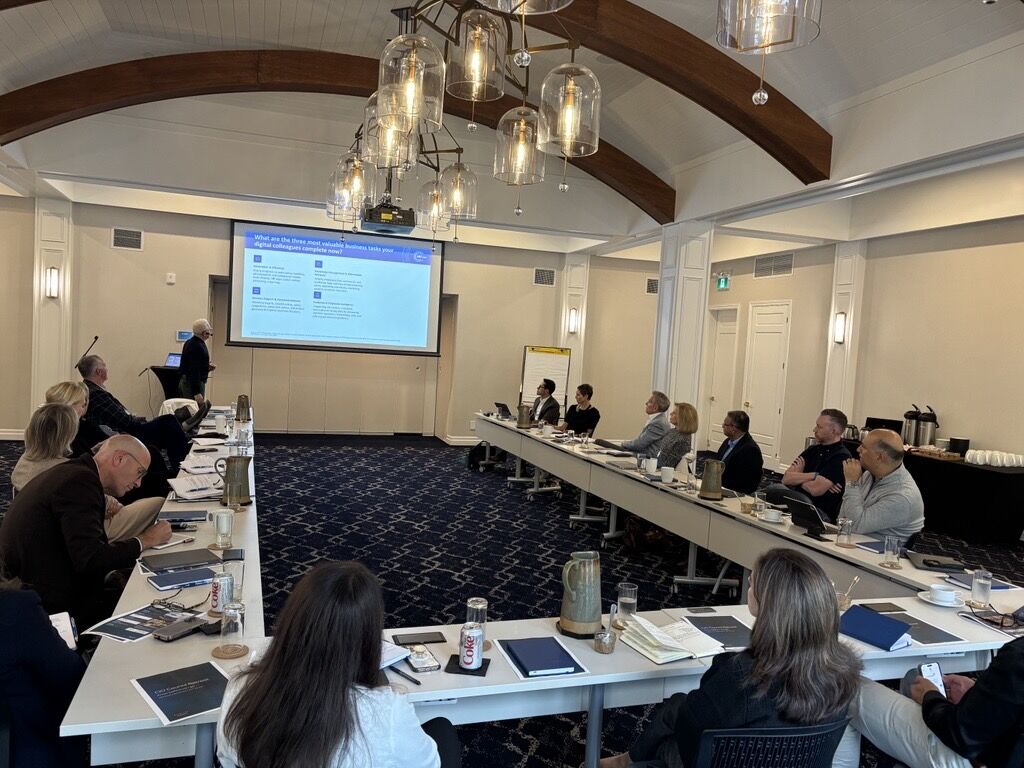
Second, it presents an opportunity to develop deep relationships with peers from diverse industries. As we enter the AI era, these peer networks are becoming more critical than ever. Members are constantly exchanging ideas and learning from one another about how to navigate this transformative period.
In the past three years, what kind of outcomes have you seen from the Council? How has it benefited founders and tech executives?
Emmet: From Insight’s perspective, the Council provides advice and guidance for our investment team, helping us stay close to the enterprise mindset.
Our portfolio companies also present to the Council, receiving feedback that helps refine problem statements, solutions, and value messaging.
One example is a fast-growing Gen AI company with a “Gen AI in a box” solution. By presenting to the Council, the founder received invaluable feedback on infrastructure, deployment, and messaging, which accelerated their growth.
That’s impressive. How have you seen the role of CIOs evolve through these years?
Emmet: During the digital era, many corporations separated the Chief Digital Officer and CIO roles. Over time, merging them proved more effective, resulting in titles like CIDO or CITO. Today, AI is the top priority. The challenge lies not just in technology, but in managing people and processes. It’s a significant shift, and the full implications are still unfolding.
How does the Council assist CIOs and tech executives in addressing challenges such as AI adoption or enterprise-wide deployment?
Emmet: Before Insight Partners for Enterprise, IT leaders had to travel extensively to discover innovative technology. We now work closely with them to understand their challenges and present curated solutions, thereby accelerating their access to innovation. The program has been very successful in bridging this gap.
Can you share an example where the Council made a real impact for a founder or tech executive?
Emmet: The Council operates under Chatham House rules, so specifics are confidential. However, generally, founders receive actionable feedback on how large corporations approach AI, infrastructure, and deployment. This feedback helps them fine-tune messaging, strategy, and execution—accelerating growth significantly.
Networking appears to be central to the Council. How critical is it for founders to build these relationships?
Emmet: It’s crucial. Early guidance from IT leaders helps founders refine problem statements, shape product features, and craft value messaging. The Council allows founders to test ideas, understand enterprise needs, and accelerate adoption in a way that wouldn’t be possible in isolation.
Looking ahead, how do you plan to evolve the Council in the coming years?
Emmet: Each year, we welcome 15 new members on an 18-month journey, which includes quarterly virtual discussions, an in-person summit, and regional dinners. After graduation, members join the broader CIO Council community, comprising approximately 50 leaders. Recruitment for the 2026 cohort is already underway.
How does the wider CIO community engage beyond their cohorts?
Emmet: We host events like our Scale Up AI conference in New York, which includes enterprise-focused sessions. We also organize regional dinners and networking events to foster cross-cohort relationships, enabling members to exchange ideas and experiences continuously.
Those gatherings create an ongoing dialogue across cohorts. Against that backdrop, AI and cybersecurity continue to emerge as top concerns for technology leaders. When everything feels urgent at once, how do CIOs decide where to focus first,and what deserves sustained attention rather than quick experimentation?
Emmet: AI and resilience are the two top issues for IT leaders, and this extends to the boardroom. We also create specialized communities for CSOs and CDAOs to offer peer learning, thought leadership, and guidance on implementation and cybersecurity best practices. For instance, we recently connected a CIO with our cyber community to help them prepare for the adoption of agentic AI.
Many tech leaders focus so intensely on execution that they overlook how they’re perceived beyond their organizations. How can they approach that thoughtfully without it feeling forced?
Emmet: Start early and be intentional. Build relationships with venture firms, founders, peers, and strategic vendors.
Engage a personal branding and positioning agency if possible. Think about what to publish, where to speak, and how to communicate your expertise. It’s about building a sustainable personal ecosystem over time.
Thinking about your own learning journey, are there podcasts, books, or voices you’ve turned to that you’d recommend for other tech leaders?
Emmet: Pay close attention to what venture firms publish. Insight Partners, for example, offers excellent thought leadership. For books, I recently read Designing Your Life. It’s about applying design thinking to plan your career and long-term goals. It’s very useful for both professional growth and life planning.
Curious about what’s next in enterprise tech and AI? Explore more insights.