
John Ternus and What Apple’s Leadership Transition Tells Tech Leaders

Major leadership changes at Apple rarely come as a surprise, even when they make industry headlines.
This is partly because Apple has built a reputation for careful planning over many years. Products launch on time, supply chains remain stable, and leadership changes are usually prepared well before the public finds out.
When news broke that Tim Cook would step down as CEO and John Ternus would take over later this year, the tech industry reacted quickly. Investors focused on continuity, employees on stability, and industry watchers wondered how this might shape Apple’s direction in the AI era.
At the same time, another conversation began quietly in the background.
People started to discuss John Ternus’s leadership style and why Apple chose an executive with a strong engineering background for its next phase. For CTOs and founders, this aspect may be even more interesting than the announcement of the new CEO.
Apple is changing leadership without disrupting the machine
Many companies struggle with executive transitions because too much decision-making remains tied to a single person.
Over time, this can become risky. Apple appears committed to avoiding this issue.
Rather than treating this as a dramatic change, Apple is presenting the transition as more of an operational handoff. Tim Cook will remain as executive chairman, current product plans will continue, and Apple’s overall strategy does not seem to be changing suddenly. From the outside, this feels more like a continuation than a replacement. This is important because companies as large as Apple cannot afford instability during a leadership change.
Regarding this leadership transition, Sandy Carter, Chief Business Officer, Adweek AI Trailblazer Power 100 Chief AI Officer shared on LinkedIn, “Apple announced its first CEO transition in 15 years today. And almost everyone is writing about the wrong person. Tim Cook will hand the keys to John Ternus on September 1. That headline deserves its moment. Cook grew Apple past $4 trillion, and Ternus is a respected engineer who has earned the promotion. But the announcement nobody is talking about is the one that actually tells you where the company is headed with AI.
Carter further added, “3 signals most analysts missed today: Apple created a new role called 𝐂𝐡𝐢𝐞𝐟 𝐇𝐚𝐫𝐝𝐰𝐚𝐫𝐞 𝐎𝐟𝐟𝐢𝐜𝐞𝐫 and handed it to Johny Srouji. This role did not exist yesterday. Every frontier AI company rents compute. Apple builds its own, from M-series to Private Cloud Compute. Srouji is the architect of all of it. Gartner projects 33% of enterprise software will include agentic AI by 2028. The companies that control the silicon will capture the most value.Apple is the only Magnificent Seven company without a frontier model. Most see this as a weakness. I see it as a strategy: the agentic AI race will be won at the silicon layer. Watch the second promotion in any major succession. The strategic signal is almost never in the headline.”
Tim Cook built a company that runs on discipline
Tim Cook’s leadership style was quite different from Steve Jobs’s, and early comparisons between them often missed the main point. Jobs was known for product breakthroughs and creative energy. Cook became recognized for his focus on operations, supply chain efficiency, and reliable execution.
At first, some critics did not realize how important this would become.
It turned into one of the most operationally consistent businesses in the world. During Cook’s tenure, the company expanded massively in market value while also strengthening manufacturing systems, services revenue, ecosystem retention, and global logistics.
Growth like this does not come from product launches alone.
It also requires strong processes and discipline. Within the tech industry, Cook’s time as CEO changed how many leaders think about growth. Reliability became just as important as innovation.
Justin Harris shared, Apple is entering a new era shaped by AI, spatial computing, and next-gen hardware. This transition signals a move from operational excellence → product-led innovation. It also reinforces something important about leadership: The best companies don’t wait for disruption. They re-architect leadership before it’s needed. Cook didn’t just run Apple. He prepared it for what comes next. Now the question is: Can Apple redefine itself again with a hardware, software, and business focus with John’s leadership? We’re about to find out. John officially takes over September 1, 2026. Tim Cook will enter an Executive Chairman role.
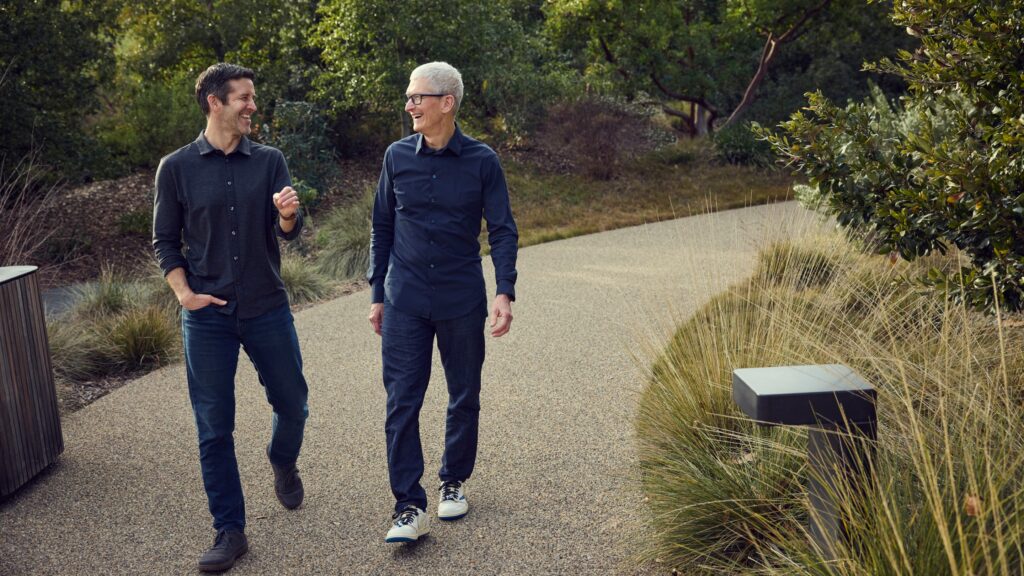
Why is John Ternus’ leadership style getting attention?
The interest in John Ternus’ leadership style comes from the fact that he represents a different kind of successor than many people expected.
Apple could have chosen a leader with a finance background or a high-profile executive. Instead, they picked someone with deep experience in hardware engineering and product development. Ternus has worked at Apple for over twenty years and has been closely involved in major hardware projects like the iPhone, Mac, AirPods, and iPad.
His background speaks for itself. Apple seems to believe that future competition will rely on product integration and strong engineering, especially as AI becomes more important in consumer devices. John Ternus leadership style as relatively measured, and collaborative compared to the louder executive personalities often seen across Silicon Valley.
This approach may actually suit Apple’s culture better than a more aggressive, public-facing leadership style.
Apple’s next challenge may look very different
The company Ternus is inheriting is not the same as Tim Cook. The smartphone market is now more mature. Supply chains face geopolitical challenges. At the same time, AI is quickly changing what people expect from devices and software. Almost simultaneously.
All of this makes the business environment more complex. Apple’s next phase of growth may rely less on launching brand new product categories and more on improving how hardware, software, and AI work together throughout its ecosystem.
This is another reason why people are paying more attention to John Ternus’s leadership style. The industry increasingly values leaders who understand engineering trade-offs, platform integration, and execution realities, not just market positioning.
What other tech companies can learn from this transition?
There is a bigger management lesson here as well. Many growing companies put off serious succession planning until a leadership change is unavoidable. Apple seems to have started planning much earlier and with more structure.
This reduces uncertainty inside the company. It also helps maintain momentum with partners and customers. Here are a few practical lessons to consider:
- Internal leadership development compounds over time
- Engineering leaders can scale into enterprise leadership roles
- Stability matters during executive transitions
- Operational systems should outlast individual executives
- Long-term succession planning reduces organizational risk
For growing companies, these lessons are becoming more important.
Markets will watch Apple closely over the next year
Even with a smooth transition, expectations for Apple’s next chapter will stay very high. Several areas will probably shape how investors and industry leaders evaluate the company under new leadership.
The pressure is high because Apple is now judged not just against competitors, but also against its own track record.
The larger reason this transition matters. What makes this leadership change important is not just who becomes CEO. It is also about what this decision says regarding where big tech companies believe the industry is going next. For years, many companies focused on rapid growth and aggressive expansion. Now, there is a renewed focus on operational strength, technical expertise, and long-term execution. That shift is visible in how people are discussing John Ternus leadership style.
The attention is not really about personality. It is about capability.
Companies entering the next AI-driven technology cycle may increasingly prefer leaders who deeply understand systems and can connect engineering, operations, product development, and organizational stability.
In brief
Apple’s CEO transition is ultimately a story about continuity during change. Tim Cook leaves behind a company built around operational precision and disciplined execution.
John Ternus steps into leadership during a period where AI, hardware evolution, and supply chain complexity are reshaping the technology sector. The growing focus on John Ternus’ leadership style reflects a broader industry shift as well.
Technical leadership, organizational stability, and product execution are becoming just as valuable as vision and market storytelling.