

Physical AI: What CTOs Must Rearchitect for Robotics-first Enterprises
Physical AI is moving from concept to infrastructure. Physical AI is no longer something we talk about next. It is already starting to show up in real operations. Over the last couple of years, we have moved from AI that understands language to systems that can perceive, decide, and act in the physical world.
For CTOs, this is not just another wave of AI infrastructure investments. It is a deeper shift that touches architecture, data, and how the business actually runs day to day.
There is also a practical difference here that is easy to overlook. In software, delays are usually tolerable. In a physical system, a delay can disrupt operations or create risk.
That is what makes this moment feel different.
Why physical AI changes enterprise architecture?
Most enterprise systems today were built for transactions and workflows. Robotics in enterprise changes that model. Systems now have to deal with environments that are constantly changing.
That means handling things like:
- real-time perception and response
- continuous streams of sensor data
- decision-making without human input
- actions that play out in the real world
In that context, real-time AI systems are not an upgrade. They are the baseline.
We are also seeing a shift away from heavily centralized systems toward distributed AI systems that can operate closer to where decisions need to happen.
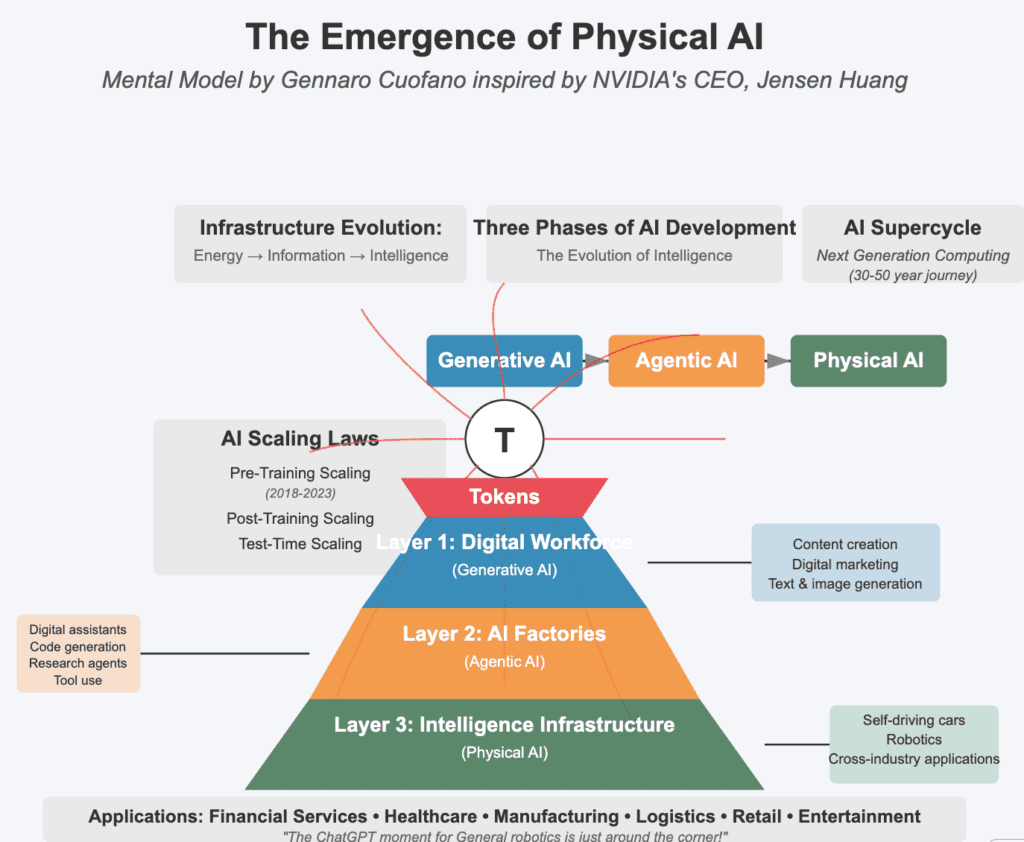
From cloud first to edge first thinking
For a long time, cloud-first was the default answer. With edge AI for robotics, that thinking needs to evolve. Robots and autonomous systems cannot afford to wait for a round trip to the cloud. Whether it is navigation or safety, decisions have to be made instantly.
That is where edge computing for robotics becomes important.
In practice, most CTOs will need to think in layers:
- edge for immediate decisions
- cloud for training and coordination
- integration layers that connect everything back to enterprise systems
It is less about replacing the cloud and more about using it differently.
AI for robotics is a data problem first
It is easy to assume AI for robotics is mainly about hardware or models. In reality, most of the complexity sits in the data. Physical environments are unpredictable. Data coming from sensors is often messy, incomplete, and context-heavy. To make industrial AI systems work reliably, teams need to focus on:
- building strong data pipelines
- combining different data types through sensor fusion
- using simulation and digital twins
- constantly learning from real-world feedback
The quality of decisions will only ever be as good as the data behind them.
Autonomous systems architecture requires new design principles
Designing an autonomous system’s architecture is a different mindset altogether.These systems need to operate in conditions that are not always predictable. They need to recover from mistakes and keep functioning without constant human oversight.
One shift that stands out is moving toward validation-driven systems. Instead of assuming things will work, systems are built to constantly check themselves. That usually means:
- built-in validation layers
- continuous monitoring
- feedback loops that improve performance over time
The goal is not perfection. It is reliability under real conditions.
Robotics in enterprise is redefining workflows
Robots in future for enterprise architecture are not just improving existing processes. They are changing how those processes are designed in the first place.
In warehouses, factories, and field operations, we are already seeing workflows move from linear to coordinated systems of machines and software.
This has a ripple effect on:
- How processes are structured
- How teams interact with systems
- How different platforms integrate with each other
Physical AI reduces friction in some areas, but it also requires tighter coordination across the board.
Real-time AI systems and the cost of delay
In traditional systems, latency is something teams try to optimize. In real-time AI systems, it becomes a business concern.
Even small delays can lead to inefficiencies or safety issues.
That is why CTOs are putting more focus on:
- low-latency infrastructure
- high availability
- predictable system behavior
When AI starts interacting with the physical world, timing becomes critical.
Distributed AI systems as the new default
Distributed AI systems are quickly becoming the practical choice for robotics environments. They enable local decision-making, reduce reliance on a central system, and make operations more resilient.
For CTOs, this means rethinking how systems are monitored, updated, and governed across multiple locations and devices. It adds complexity, but it also unlocks scale.
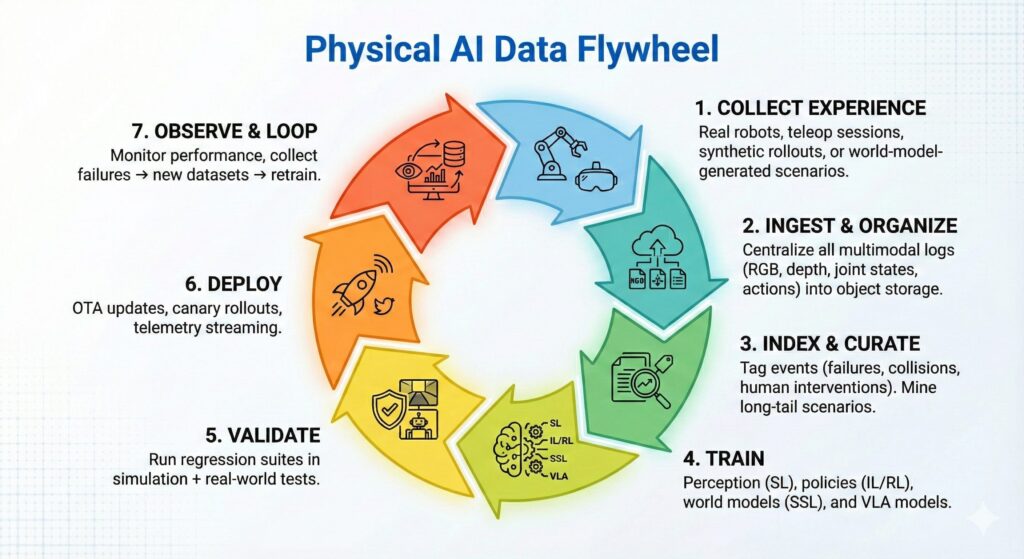
Analysis of the new operating model for physical AI
If you step back and look at what is changing, this is less about adopting new tools and more about shifting the operating model.
One thing that stands out is the expanding role of the CTO. Technology leaders are now closer to operations than ever before. When AI systems drive physical processes, the line between IT and operations blurs.
Another shift is in how investments are made. AI infrastructure investments are moving from experimental budgets into core operational spending. Robotics, edge systems, and real-time platforms are becoming long-term assets.
Risk is also evolving. It is no longer just about data breaches or downtime. It now includes how systems behave in real environments. That brings in new considerations around safety, reliability, and governance.
For many CTOs, this means spending more time thinking about how systems perform outside controlled conditions.
Oana Andreea Jinga from Dexory shared on LinkedIn, Physical AI is AI that can perceive, understand, and act in the physical world. Not just processing information but interacting with reality. This technology is already growing across multiple industries, and it’s estimated that the global market size of physical AI will reach over USD 960 billion by 2033.
Operating model for physical AI: Framework for CTOs
| Focus area | Key shift with physical AI | CTO action | ROI lever | Expected impact |
|---|---|---|---|---|
| Decision speed | From delayed to real-time AI systems | Deploy low-latency inference at edge | Cycle time reduction | 30–70% faster operations |
| Infrastructure | From cloud-only to edge + cloud | Invest in edge computing for robotics | Cost per decision | Lower compute and response costs |
| Data strategy | From batch to continuous multimodal data | Build real-time data pipelines | Accuracy uplift | Better risk and operational decisions |
| System design | From fixed workflows to adaptive systems | Implement autonomous systems architecture | Error reduction | Fewer failures, higher uptime |
| Operations | From manual to robotics in enterprise workflows | Redesign processes around automation | Productivity gain | 20–40% efficiency improvement |
| Risk management | From IT risk to physical + system risk | Add monitoring and validation layers | Loss prevention | Reduced operational incidents |
| Scaling | From centralized to distributed AI systems | Architect for distributed intelligence | Scalability efficiency | Growth without linear cost increase |
| Cost control | From capex heavy to usage-driven | Track cost per action and model usage | Margin expansion | Sustainable cost optimization |
Maltbook and the rise of autonomous agent ecosystems
There are also early signals of how AI systems might evolve beyond individual use cases. One interesting example is Maltbook, a platform where AI agents interact with each other rather than with humans.
These agents can hold discussions, form communities, and pursue goals like building a reputation. While there are still open questions about how autonomous the activity really is, the idea itself is worth paying attention to.
It points to a future where systems are not just responding to humans, but interacting with other systems.
For CTOs, that raises a few practical questions:
- how do multiple autonomous systems coordinate
- how do you govern interactions between AI agents
- how do you validate outcomes in these environments
In a physical AI setting, this could translate into fleets of robots and systems working together. Coordination becomes just as important as intelligence.
The execution gap in industrial AI systems
A lot of organizations have already experimented with AI, but many have struggled to see real impact. The issue is usually not the technology itself. It is the gap between models and real-world execution. Physical AI helps close that gap by embedding intelligence directly into operations. But it only works when:
- Systems are connected end to end
- workflows are redesigned, not just automated
- outcomes are clearly measured
Without that, even advanced industrial AI systems remain isolated efforts.
What CTOs must rearchitect now?
For CTOs thinking about next steps, a few priorities are becoming clear:
- Build infrastructure that supports edge computing for robotics
- Rethink data architecture for real-time and multimodal inputs
- Define guardrails for autonomous systems architecture
- Integrate AI directly into workflows
- Prepare for distributed AI systems operating across environments
These are not quick fixes. They are longer-term shifts that need deliberate planning.
In brief
Physical AI is changing how enterprises operate at a fundamental level. It is not just about automation. It is about systems that can act in the real world with a level of independence.
For CTOs, the focus now is on building systems that are fast, reliable, and adaptable. Real-time AI systems, edge capabilities, and distributed architectures all play a role here. The organizations that get this right will not just adopt robotics. They will rethink how work gets done across the enterprise.