

Best Coding Bootcamps 2026 for Tech Teams
Hiring managers don’t need more developers who can just follow a tutorial; they need people who can join an existing codebase, understand the reasons for its behavior, test a change, explain a trade-off, and then fix the parts that break after deployment.
The criterion that we would apply when assessing the best coding bootcamps in 2026 is whether graduates can join a modern engineering team without having to have someone else pick up the pieces afterward. It is not the school’s rating, not the length of the sales page, and not the fact that the curriculum name contains AI.
The 2026 list from Course Report has 25 bootcamps on it, but the entries are arranged alphabetically not ranked. The group designated as “top-rated” is determined by a review threshold, not by a comparison of the audited employment outcomes.
While it can therefore be a useful tool for discovering courses, it cannot on its own be the basis for a hiring decision or an enrollment decision.
The skills CTOs should screen for
Although AI has altered the way that junior developers work, it has not eliminated the need for judgment. A developer may ask the model to generate a function, but a person still has to decide if the function should be included in the codebase, if it deals with failure appropriately, if it poses a security problem, and whether the tests in fact prove anything.
The survey carried out by CoderPad in its 2026 State of Tech Hiring report covered more than 650 developers, recruiters, and hiring managers from around the world. It showed that 82 percent of developers think that generative AI is useful in their work, and 54 percent expect at least a 10 percent decrease in productivity if they lose access to AI tools.
The report also mentions a move towards evaluating candidates on the basis of actual work, this involving debugging code that has been generated by AI, explaining the design decisions and improving on AI output.
For CTOs, this means that a simple criterion when hiring should be to ask candidates to work with an imperfect codebase rather than just producing a new feature from a blank file.
A strong bootcamp should therefore teach:
- The basics of programming, together with data structures, APIs, and databases.
- Rather than beginning from scratch, reading and modifying the existing code.
- Testing, debugging, version control, and deployment.
- Carrying out code reviews, working together, and ensuring clear technical communication.
- The proper use of AI involves checking the generated code to ensure it is correct and secure.
- Have enough product awareness so as to know why a feature exists.
A program that spends most of its time on teaching how to phrase prompts but very little on testing, debugging, or code review is not preparing its students for an engineering team but for a demonstration.
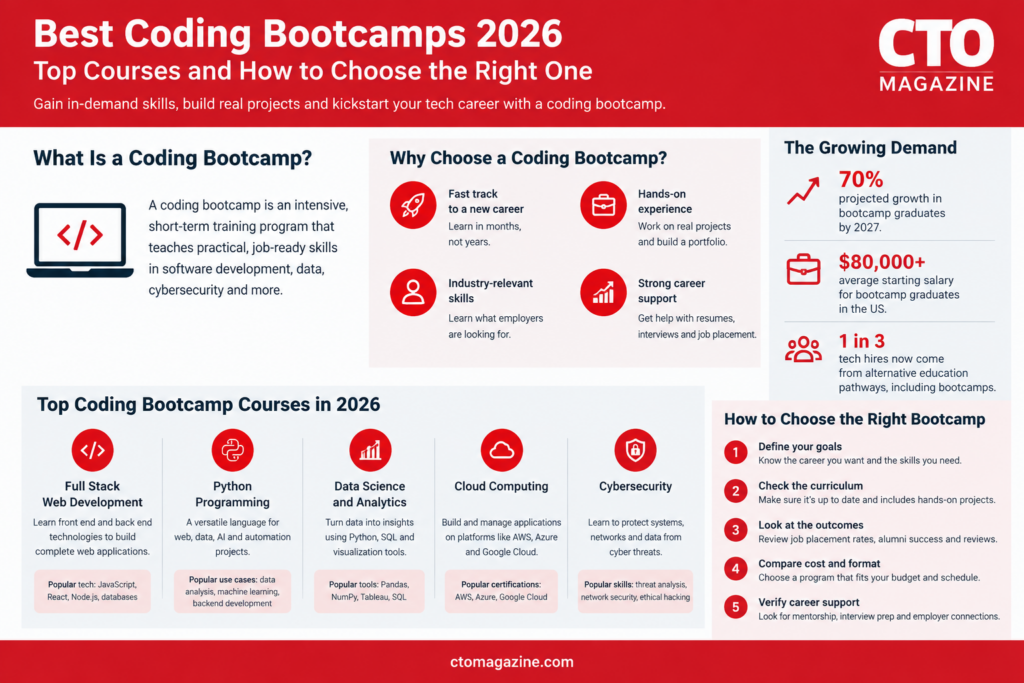
Coding bootcamp reviews need context
When doing the research, we ignored the overall score when looking at reviews until we had read some recent comments from students who had gone through the same course and format.
For example, the experience of a full-time software engineering group can be quite different from that of a self-paced cybersecurity track offered by the same company.
Look for repeated details:
- Did the instructors look at the code or did they only answer questions?
- How fast did the students receive assistance when they were stuck?
- Did the projects include deployment, debugging, and iteration?
- Does the idea of students having to give interviews make them feel ready to explain their work?
- Did support with regard to one’s career go on after graduation?
A review containing the statement ‘great experience’ is not as helpful as one that describes how frequently a mentor looked over the code, what took place when a project failed, or how the student prepared for technical interviews.
Coding bootcamp ratings are not job outcomes
The fact that the rating is high does not show that the graduates have secured relevant jobs; it only shows that a sufficient number of students gave the program a high rating as part of the platform’s review procedure.
The student guidance provided by CIIR states that its reports contain information on graduation rates, employment outcomes at 180 and 360 days, median salary data, typical job titles, employment types, and the time it takes to secure employment. It also states that the reports submitted by member schools are subject to annual independent audits.
If a provider gives a placement rate, CTOs should request to see the original report. Which group or cohort is it based on? How many students participated? How many of them graduated? Does ’employed’ mean any kind of job or one that is related to the training? Are positions that are freelance, contractual, and part-time to be included?
CIRR also cautions students against vague “job placement” statements, selective data, inconsistent reporting periods, and the absence of graduation data. These points are useful warnings for hiring managers as well.
How to compare the best coding bootcamp programs
| What to compare | What CTOs and learners should check |
|---|---|
| Curriculum | Programming fundamentals, APIs, databases, testing, debugging, Git, and deployment |
| Projects | Original work, deployment, code review, and projects that candidates can explain in an interview |
| Instruction | Live teaching, mentor access, feedback speed, and instructor availability |
| Format | Full-time, part-time, self-paced, online, in-person, or hybrid |
| Career support | Interview practice, portfolio review, employer connections, and how long support lasts |
| Outcomes | Cohort period, employment definition, reporting window, salary data, and independent audit |
| Cost | Tuition, fees, financing, equipment, and income lost while studying |
| Team fit | Whether the program can support hiring pipelines, internal upskilling, or team workshops |
Programs worth putting on a shortlist
There is no bootcamp that is suitable for all learners or all teams. The programs mentioned below are given as examples for you to look into, not as recommendations. Although they are included in Course Report’s 2026 list, the curricula, schedules, tuition fees, and results can change rapidly. You should check the details directly with each provider.
Le Wagon
The Course Report has included Le Wagon’s AI Software Bootcamp in its list of the top-rated courses for 2026; in its directory, Le Wagon is described as a global provider that gives full-time and part-time training in AI software, data science, data analytics, and related areas.
When a CTO is looking at the graduates of Le Wagon, the important question to ask is what exactly ‘AI Software’ means in practice. Does the course teach students how to build and deploy applications, or does it instead place a main emphasis on using AI tools? You should ask to see a sample project, the assessment criteria, and the extent of the code review.
Springboard
Springboard’s Software Engineering Career Track might be suitable for learners who are looking for a structured online program accompanied by mentorship. Concerning hiring managers, you should find out how much direct code feedback the students get and whether the projects involve working with existing systems or merely consist of building standalone applications.
TripleTen
The Course Report includes TripleTen’s AI Software Engineering Bootcamp in its list of the top-rated groups for 2026.
The fact that it is labeled AI makes the syllabus particularly important; you should ask students whether they have tested AI-generated code, whether they have linked their applications to real services, and whether they can explain their architectural decisions. A graduate who is able to do all of these things is more useful than one who can only carry out a guided project.
Coding Temple
Coding Temple’s AI Software Engineering program is in the top-rated group. Its directory describes Coding Temple as a fully online provider offering self-paced pathways in software engineering, cybersecurity, and AI engineering.
When choosing a self-paced program, find out the amount of human feedback that is provided. Although self-paced learning can be effective for students who are disciplined, this does not mean that it is the same as having a cohort that receives regular instructor-led code review.
Codesmith
Codesmith’s full-time and part-time software engineering programs cover full-stack JavaScript, computer science, machine learning, DevOps, and React.
It could be a good idea to consider this option if your team requires engineers who are capable of working throughout the entire stack rather than just on front-end interfaces. Find out what portion of the curriculum covers system design, testing, deployment, and working with codebases that are similar to actual production ones.
Fullstack Academy
Fullstack Academy is featured in Course Report’s 2026 list, the directory of which covers online programs in software engineering, AI and machine learning, cybersecurity, cloud computing, data analytics, and product management.
The wide range is useful for companies that have several hiring pipelines, but it also implies that each track must be assessed on its own. For example, a course in software engineering and a course in cybersecurity may share the same brand but will require very different skills.
Ironhack
Ironhack lists programs across web development, data analytics, cybersecurity, AI engineering, DevOps, cloud computing, and data science and machine learning.
Engineering leaders might want to consider Ironhack if they need various entry routes, such as those in cloud computing and DevOps. They should check if the cloud and DevOps course involves practical work on infrastructure, monitoring, CI/CD, and security rather than just preparing students for certification.
Launch School
Launch School’s core curriculum is roughly 1,200 to 1,800 hours, or eight to more than 16 months, before an optional admissions-based capstone.
This might not be ideal for someone who is looking for the quickest possible way to get into a job. However, for teams that place a high value on depth, it could result in candidates having stronger fundamentals. Find out how students are assessed and whether they spend sufficient time reading, altering, and testing existing code.
Team workshops and bootcamps for engineering teams
Individual bootcamps aren’t the only alternative; for CTOs, team-oriented workshops are more useful when the aim is not to hire new engineers but to improve the way an existing team builds, reviews, tests, and ships software.
An effective team workshop should make use of your actual codebase, workflows, and genuine tickets; it shouldn’t merely consist of a presentation on AI strategy.
The objective is to reach agreement regarding how engineers are to use AI, to review the code that has been generated, to deal with security issues, and to assess whether the workflow actually improves delivery.
AI-assisted development workshops
Caltech’s CTME provides a one-day workshop that is assisted by AI for technical teams. The workshop’s description includes topics such as structured prompting, verification, policy-aware workflows, Python refactoring, generation of FastAPI tests, React scaffolding, troubleshooting CI/CD failures, and the establishment of guardrails to meet security and audit requirements.
A workshop of this kind is suitable when a team has already adopted Git and contemporary development practices but requires a common method for AI-assisted coding; the benefit lies in carrying out the exercises on actual tasks rather than in hearing a vendor describe what AI could do.
Secure AI coding workshops
The Secure AI Coding with Claude Code Masterclass offered by AppSecEngineer is designed for developers, AppSec engineers, DevSecOps teams, and platform engineering teams. The description stresses the use of AI-assisted development workflows without exposing any code, systems, or secrets.
For CTOs, this is a category worth keeping an eye on. While AI can accelerate development, it can also make it simpler to incorporate insecure dependencies, reveal secrets, or produce code that appears correct but fails when it is reviewed. A workshop should instruct engineers on how to restrict AI workflows, review the output, and ensure that security checks remain part of the pipeline.
The Enterprise AI Coding with Claude Code session in SecAppDev’s 2026 program addresses machine-readable requirements, secure coding prompts, reusable GitHub workflows, architecture and security constraints, and review gates. The program also mentions repository governance files, including CLAUDE.md, REQUIREMENTS.md, ARCHITECTURE.md, and SECURITY.md.
A generic AI workshop is more interesting than that approach since it regards AI as a component of an engineering system, with requirements, plans, code, tests, and reviews having to be connected rather than remaining as separate activities.
AI engineering bootcamps for teams
Hyperskill provides a 10-week live AI engineering course in both open groups and private groups for engineering teams. According to its description, the teams go from idea to production of an AI feature, covering a RAG pipeline, agents equipped with tools and memory, deployment on AWS, monitoring, and cost limits. The program also refers to weekly sprints, live sessions, code reviews, and instructor support.
For a CTO, that model can be useful when the goal is to help an existing team ship an AI feature rather than hire a separate machine-learning team.
The important check is whether the private cohort can work on your stack and data, and whether it includes security, evaluation, and cost controls.
Agentic coding training
Drutek provides agentic coding training for engineering teams, highlighting practical, practitioner-driven activities using tools like Claude Code and OpenAI Codex; the description states that participants are required to plan, implement, and verify changes to multiple files in a production codebase, not merely work with autocomplete snippets.
It is in the case of training that becomes important when teams go beyond simple code completion; it is with regard to multi-file changes, tests, review gates, and production context that AI-assisted development proves itself either to be useful or risky.
AI coding bootcamp or AI bootcamp
The labels overlap, yet they aren’t identical. A bootcamp that teaches AI coding might instruct developers in how to build applications using AI APIs or in how to use AI tools as part of software development. Alternatively, an AI bootcamp might concentrate on machine learning, data science, or AI product work.
Before hiring from an AI bootcamp, check whether the course includes:
- Programming and data fundamentals.
- To build and deploy an application that uses AI.
- The evaluation and testing, including instances in which the model’s output is incorrect.
- Data privacy, security, and its responsible use.
- An assignment which allows the student to explain their own contribution.
The more important question isn’t whether a student has used AI; it is whether they are able to spot when the AI’s output is incorrect and then correct it. According to CoderPad’s research, hiring teams find this kind of judgment ever more relevant.
Cloud computing bootcamp, DevOps bootcamp, or AWS bootcamp
The tracks ought to consist of practical work on infrastructure. The topics that are relevant will depend on the role in question and can be things such as Linux, networking, identity and access management, containers, infrastructure as code, monitoring, CI/CD, and security.
While an AWS bootcamp might help students obtain a certification, passing an exam doesn’t mean that they can operate a real system. You should ask the students what kind of deployments they have made, how they deal with failures, and whether they work in actual cloud environments.
Cybersecurity bootcamp
A cybersecurity bootcamp should build foundations in networking, operating systems, security concepts, and investigation. Course Report describes Fullstack Academy’s cybersecurity curriculum as including Linux, bash scripting, Python, SIEM tools, penetration testing, digital forensics, and preparation for CompTIA Security+.
Inquire of the program as to whether it makes a distinction between security operations, penetration testing, governance, and cloud security, since these different roles call for different skills and a brief course cannot realistically offer in-depth knowledge of all of them.
Data science bootcamp or data analytics bootcamp
Typical data analytics bootcamps concentrate on SQL, the use of spreadsheets, data cleaning, visualization, and communicating the results, while data science bootcamps will also include statistics, Python, machine learning, and model evaluation.
Compare the projects and tools rather than relying on the course title. Fullstack Academy, for example, describes its data analytics program as including AWS Glue, Python, SQL, visualization, generative AI tools, and Tableau training.
Are coding bootcamps worth it?
The answer to “are coding bootcamps worth it?” depends on the learner and the specific course. A bootcamp can be worth it when it gives a student a clear path, useful feedback, and practical projects that align with the work they want to do.
It is less likely to be worth it if a student is relying on a job guarantee without reading its conditions, cannot commit the required study time, or has not checked whether the curriculum matches the role they want.
Before enrolling, calculate the full cost. Include tuition, financing charges, equipment, and the income a student may forgo while studying. Then compare that with alternatives such as community college, self-paced courses, employer-sponsored training, or a part-time program that lets the learner keep working.
A boot camp is more likely to be a reasonable investment when:
- The student has a clear target role.
- The curriculum maps directly to that role.
- The student can commit the required hours.
- The program provides meaningful feedback on code and projects.
- The school publishes outcome data a hiring manager can understand.
- The student plans to keep learning after graduation.
What CTOs should expect from bootcamp hiring in 2027?
The bootcamp market is likely to keep shifting toward AI-assisted development, but the hiring bar should not drop.
In 2027, employers might care less about whether a candidate used AI and more about whether they can validate, secure, and improve what AI produced.
For engineering leaders, that means three practical changes.
- First, technical assessments should reflect real work. Give candidates a small codebase with a bug, incomplete tests, or a poorly documented dependency. Watch how they investigate, communicate, and improve the code. A candidate who can do that is more valuable than one who can generate a feature from a prompt.
- Second, programs offered in bootcamps should be evaluated according to the results they achieve rather than the use of flashy terminology. A course that involves AI should also ask students to test the output of the AI, deal with edge cases, record their decisions and explain the limitations. If these elements are omitted, then the AI aspect is probably just there for show.
- Third, hiring teams should build clearer pathways for early-career engineers. Bootcamps can supply motivated candidates, but companies still need structured onboarding, code review, mentoring, and realistic first assignments. A bootcamp cannot replace the first six months of practical engineering experience.
The programs that make it through this stage will be those that teach students how to work with flawed systems, rather than merely producing impressive demonstrations.
Questions to ask before you enroll
Ask the school these questions and save the answers:
- May I have the syllabus and the details of the project for the specific cohort?
- How many hours a week should I reckon I will need to spend in class and on my studies?
- Who is going to look at my code and how frequently shall I get individual feedback?
- What will happen if I fall behind or have to stop?
- What cohort and what program does the employment data relate to?
- What is the definition of an in-field job given by the school?
- Has the outcome report been independently audited?
- What career services are provided and for how long?
- How much will the total cost be, including the fees and the financing?
- May I talk to some of the graduates who have completed this particular course and followed this specific format?
If a provider is unable to give basic answers regarding curriculum, cost, or the method of measuring outcomes, then this should be taken as a reason for delaying consideration.
Frequently asked questions
What are the top coding bootcamps in 2026?
The Course Report list for 2026 features 25 schools, arranged alphabetically not by rank. The ones rated highest are Le Wagon, Springboard, TripleTen, and Coding Temple, according to the review threshold mentioned on the page. This list is a helpful discovery resource, not evidence that these programs are the best option for every learner or employer.
What makes a coding bootcamp one of the best?
Look for a strong curriculum, substantial projects, regular instructor feedback, clear costs, and outcome reporting you can understand. The best fit also depends on the target role, schedule, budget, and prior experience.
Are online coding bootcamps effective?
The course works well for those learners who require a structured approach and are able to keep to a regular study timetable. You should compare the aspects of live instruction, access to mentors, code review, interaction with other students, and career support. The term “online” by itself doesn’t indicate the level of interactivity in the course.
Are coding bootcamps worth it for beginners?
They can be useful for beginners who want a structured path, but the pace can be demanding. Try an introductory programming course first, check admissions requirements, and ask what support is available to students who are new to coding.
Do coding bootcamps guarantee that you will get a job?
Certain providers do advertise job guarantees or refund terms. When looking at the contract, make sure to read it carefully, paying attention to the eligibility rules, the job-search requirements, the deadlines, and the exclusions. It must not be assumed that a guarantee means that each graduate will definitely get a job.
What is the best way of comparing coding bootcamp reviews and ratings?
Read recent reviews from students who took the same program and format. Look for recurring details about teaching, code feedback, workload, and career support. Then compare those experiences with the syllabus and available outcome reports.
What is the difference between an artificial intelligence bootcamp and an AI coding bootcamp?
There is no universal definition. An AI bootcamp may focus on machine learning, data science, or AI applications. An AI coding bootcamp may emphasize using AI tools or APIs in software development. Compare the modules, projects, and prerequisites rather than relying on the name.
Should engineering teams use workshops instead of bootcamps?
It depends on the goal. Bootcamps work well for individuals entering a new field. Workshops work better when an existing team needs to align on a workflow, such as AI-assisted development, secure coding, testing, or cloud deployment. The best team workshops use the company’s own codebase and real work.
In brief
The best coding bootcamps are not necessarily the shortest, most heavily advertised, or highest-rated. They are the ones that match a learner’s goal and provide enough practice, feedback, and transparency to justify the commitment.
Compare the exact course, ask how its outcome numbers were produced, and look closely at student projects. If the curriculum teaches programming fundamentals, debugging, collaboration, and thoughtful use of AI, it is more likely to prepare learners for the work than a course built around tools and trend words alone.