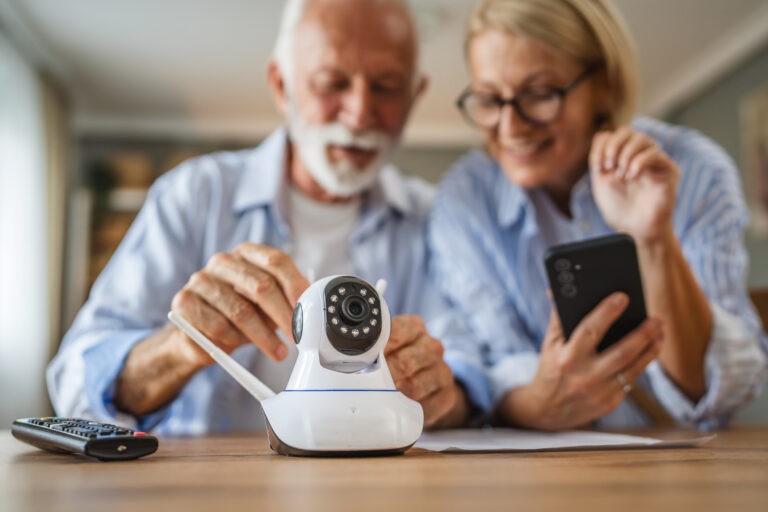

Building AI-Powered Elderly Monitoring Systems: What CTOs Need to Get Right
An elderly monitoring system once meant a wearable emergency button, a fall alert, and a caregiver responding after something had already gone wrong. AI is changing that model. Connected sensors can now identify unusual movement, detect potential falls, monitor changes in daily routines, and alert care teams when a resident may need assistance.
The shift is creating a new category of healthcare technology, one that combines ambient sensing, computer vision, radar, edge AI, and predictive analytics. Companies such as Inspiren are bringing these capabilities into senior living facilities, while other technology providers are exploring contactless monitoring for older adults living independently.
But the engineering challenge extends well beyond detecting a fall. An effective elderly monitoring system must distinguish genuine emergencies from ordinary activity, protect highly personal information, operate reliably across different environments, and deliver alerts that caregivers can act on. It must also integrate with the operational systems already used by care providers.
For CTOs, this is a particularly demanding product category. It brings together real-time AI inference, connected hardware, sensitive data, clinical workflows, and the need for measurable safety outcomes.
The opportunity lies in building systems that help caregivers intervene earlier without turning older adults’ everyday lives into continuous surveillance.
Why has elderly monitoring become a technology priority?
The demand for better elderly monitoring is rooted in a growing safety and care-delivery challenge.
According to the US Centers for Disease Control and Prevention (CDC), more than 14 million older adults, or approximately one in four people aged 65 and older, report falling each year. Falls are also the leading cause of injury among this population. The age-adjusted fall death rate increased by 21% between 2018 and 2024, reaching 78.4 deaths per 100,000 older adults.
These figures underline why conventional emergency-alert devices are insufficient as the only layer of protection. A pendant or panic button can help someone request assistance, but it depends on the person being conscious, able to reach the device, and capable of activating it.
An AI-powered elderly safety monitoring system can offer another layer of visibility. Depending on its capabilities, it can detect a fall, identify an attempt to leave a bed, or flag changes in movement that warrant a caregiver’s attention.
The operational case is also significant. Senior living facilities must monitor residents with varying mobility, cognitive and medical needs, often with limited staff availability. They need better visibility into resident safety without increasing the burden of manual observation.
For technology providers, this creates demand for ambient sensors, wearables, remote monitoring platforms and AI-powered care systems. However, the value of these products depends on whether they improve actual care workflows, not simply how much data they collect.
What does an elderly monitoring system actually do?
An elderly monitoring system combines hardware, software, connectivity and human response processes to identify safety concerns and support timely intervention.
Basic systems detect falls or respond to emergency-button activation. More advanced platforms combine multiple data sources to monitor movement, sleep, room activity and changes in daily routines.
The capabilities vary considerably across products.
| Monitoring capability | What it detects | Typical response |
|---|---|---|
| Emergency alerts | Panic-button activation or distress signals | Notify caregivers or emergency services |
| Fall detection | Sudden movement patterns consistent with a fall | Trigger an immediate response |
| Predictive safety monitoring | Bed-exit activity, unusual movement or other potential risk indicators | Alert caregivers for early intervention |
| Remote elderly monitoring | Activity, location or wellbeing information | Provide updates to families or care teams |
| Behavioural monitoring | Changes in movement, sleep or daily routines | Support care-plan reviews and further assessment |
The distinction between detecting an event and predicting one is important. A system that identifies a person getting out of bed does not necessarily know that a fall will follow. It can, however, give caregivers an opportunity to intervene.
A useful elderly care monitoring system must turn information into an actionable workflow. That means identifying the event, providing relevant context, notifying the appropriate person, recording the response and supporting the next decision.
How is AI changing elderly monitoring?
AI is changing elderly monitoring in three important ways: automating routine observation, interpreting sensor data in context, and identifying changes that may require earlier attention.
Traditional motion and pressure sensors can detect movement or changes in position. AI models can analyze patterns to distinguish between activities that might otherwise trigger similar alerts.
For example, a person sitting down quickly, bending to pick something up, exercising or falling may generate overlapping movement signals. A system that treats every sudden movement as a fall will generate unnecessary alerts and increase the workload for caregivers.
Inspiren illustrates how this technology is being deployed in senior living environments. Its wall-mounted systems use computer vision and privacy-oriented stick-figure representations to analyze resident activity. The company also uses radar and floor detection in bathrooms, where conventional cameras may be inappropriate.
Other providers are exploring different approaches.
- CarePredict uses wearable and ambient sensing technologies with machine learning to identify changes in daily activity and provide insights to caregivers.
- Kepler Vision Technologies develops computer vision systems for fall detection and safety monitoring in healthcare environments.
- NtelCare and Vayyar have worked together on contactless monitoring solutions combining radar sensing and AI to detect falls and bed-exit events.
- Zoe Care uses Wi-Fi sensing and edge AI to identify activity without requiring cameras or wearable devices.
These approaches demonstrate that there is no single hardware configuration for an elderly monitoring system. The appropriate combination depends on the environment, the event being detected, privacy requirements and the response workflow.
AI also introduces new engineering responsibilities. Models need representative training and evaluation data, clearly defined alert thresholds, measurable false-positive and false-negative rates, and mechanisms for reviewing why an alert was generated.
A system that performs well in a controlled demonstration may behave differently in a busy care facility with multiple residents, unusual movement patterns and inconsistent connectivity.
Inside the business case: Why Inspiren is attracting attention
Inspiren offers a useful example of the commercial interest in AI-powered senior care technology.
In September 2026, the company announced a $70 million Series C funding round led by NewView Capital, bringing its reported total funding to $225 million. Forbes reported a valuation of $550 million.
The company’s technology was deployed across more than 500 senior living facilities in the United States, monitoring approximately 40,000 residents, according to Forbes. Its reported contracted revenue had exceeded $60 million, while subscription revenue had grown from $8 million to $29 million.
These figures suggest that senior living operators are willing to invest in monitoring technology when it addresses operational and safety requirements.
The company has also reported results from a 10-month deployment at Solera Senior Living’s Lumina Las Vegas community. The January-to-October 2025 study reported:
- 48% fewer falls across the community.
- 54% fewer emergency room visits and hospitalizations, respectively.
- 50% faster staff response times.
These are company-reported results from a specific deployment, not independently established outcomes that can be assumed across other facilities. They nevertheless illustrate the performance measures that prospective buyers are likely to examine.
Inspiren’s development also reflects the importance of combining clinical understanding with technology expertise. Founder Michael Wang previously worked as a cardiothoracic nurse after serving in the US Army. His experience with patient safety informed the development of the company’s monitoring technology.
For CTOs, the business case is not simply about attracting investment. It is about demonstrating that a monitoring platform can improve safety, reduce operational friction, support staff and deliver measurable value to care providers.
What technology powers modern elderly monitoring systems?
Most advanced elderly monitoring platforms are multimodal systems. They combine different sensors and processing capabilities rather than relying on a single device.
Sensors and edge devices
Common inputs include:
- Accelerometers and gyroscopes in wearable devices.
- Pressure sensors in beds and chairs.
- Radar and infrared sensors for movement detection.
- Floor sensors for identifying falls or unusual activity.
- Smart mattresses for monitoring occupancy and movement.
- Cameras for computer vision-based analysis.
Wearables provide direct information about the individual, but they introduce practical challenges involving battery life, charging, comfort and device compliance.
Ambient monitoring reduces dependence on wearable devices. However, its effectiveness depends on sensor placement, environmental conditions and the ability to distinguish individual residents in shared spaces.
Zoe Care’s Wi-Fi sensing approach is one example of how monitoring can work without conventional cameras or wearables.
Computer vision and radar
Computer vision can identify movement patterns, changes in posture and events consistent with falls. Radar can detect presence and movement without capturing conventional visual footage.
These technologies serve different purposes.
Inspiren’s use of stick-figure representations illustrates an approach to reducing the exposure of identifiable visual information. Its radar and floor-sensing capabilities also support monitoring in bathrooms and other sensitive areas.
For product architects, the decision should begin with the monitoring requirement. Using cameras simply because computer vision is available may introduce unnecessary risks to privacy and data management.
Edge AI and cloud platforms
Edge computing allows devices to process sensor information locally rather than sending every data point to a central cloud platform.
This is particularly useful for time-sensitive events. A fall alert should not depend entirely on a cloud round trip when a local device can identify the event and initiate an appropriate response.
Cloud infrastructure can support historical analysis, dashboards, reporting, model management and integration with other enterprise systems.
A sensible architecture separates immediate detection from longer-term analytics:
- Edge processing: Time-sensitive event detection and initial alert generation.
- Cloud processing: Historical trends, reporting, model updates and cross-facility analysis.
- Application layer: Caregiver notifications, incident management and care-team workflows.
This separation helps balance latency, availability, scalability and data privacy.
Connectivity and interoperability
Monitoring devices need reliable connectivity, power management and appropriate offline behavior.
In senior living facilities, platforms may need to integrate with nurse-call systems, electronic health records, staffing applications and incident-reporting tools.
At home, the challenges are different. Broadband reliability, installation complexity, device maintenance and family access become more important.
Interoperability should be considered early in product development. A technically sophisticated monitoring platform can still struggle commercially if it requires caregivers to manage another disconnected dashboard.
What should CTOs consider when building an AI elderly monitoring platform?
The biggest engineering challenge is not collecting more information. It is ensuring that the system produces reliable, understandable and actionable outputs.
1. Design around the caregiver workflow
Start by defining the events the system needs to detect and what should happen after each one.
A fall alert may require an immediate response. A gradual change in walking patterns may warrant a review by a qualified care professional.
These events should not generate identical notifications.
Define who receives each alert, how quickly they must respond, what context they need and how the outcome is recorded.
The interface should prioritize decisions and actions rather than presenting caregivers with endless streams of sensor data.
2. Engineer for false positives and false negatives
False alarms are more than a model-performance issue. They can affect caregiver trust and operational efficiency.
If a system repeatedly identifies ordinary activities as emergencies, staff may begin ignoring its notifications. Conversely, missed falls or delayed alerts can create serious safety risks.
Evaluation datasets should include difficult, realistic scenarios:
- A resident sitting down quickly.
- Bending to pick up an object.
- Exercising or performing prayer movements.
- Walking with mobility aids.
- Unusual movement associated with an individual resident’s condition.
CTOs should evaluate sensitivity, specificity, precision, recall and alert latency under realistic deployment conditions.
Performance should also be monitored after deployment, since changes in the environment or resident population can affect model behavior.
3. Make privacy an architectural requirement
Older adults should not have to surrender their privacy to receive better safety monitoring.
Technology teams should assess the least intrusive sensing method that meets the intended requirement.
Depending on the application, this could mean radar, Wi-Fi sensing, wearables or locally processed computer vision.
Where video is necessary, edge processing, restricted access, data minimization and carefully defined retention policies can reduce exposure.
Privacy should be addressed during system design, not added as a compliance feature after deployment.
4. Build for unreliable environments
A home and a senior living facility present very different operating conditions.
Homes may have inconsistent Wi-Fi, power interruptions and users who forget to charge wearable devices. Care facilities may have dense networks, shared rooms, multiple connected devices and changing staff responsibilities.
Devices should have defined offline behavior. Where technically possible, they should retain critical events locally and synchronize them when connectivity returns.
The system should also communicate when a sensor is offline, a battery is low or monitoring coverage has been interrupted. A silent failure is particularly dangerous in a safety-related product.
5. Make alerts explainable and auditable
A caregiver needs more than a notification saying that an AI model has identified a potential problem.
The system should provide sufficient context to understand what happened, when it happened and why the alert was generated.
An auditable event record should capture:
- The event or activity detected.
- The time and relevant sensor information.
- The model or detection rule responsible for the alert.
- The person or team notified.
- The response and any subsequent action.
This information supports incident reviews, model improvement, operational accountability and communication with families.
It also helps technology teams investigate whether an incorrect alert resulted from sensor placement, connectivity, model performance or an inappropriate threshold.
6. Plan integrations before deployment
A standalone monitoring application may be relatively easy to develop, but it can be difficult for care providers to adopt.
Operators need systems that fit into existing processes for staffing, care planning, incident reporting and health records.
CTOs should evaluate integration requirements early, including APIs, identity management, access permissions, data formats and vendor dependencies.
The goal is to make monitoring part of the care workflow rather than another technology that staff must remember to check.
Can AI elderly monitoring replace caregivers?
No. AI can extend a caregiver’s visibility, but it cannot replace human assessment, physical assistance or clinical judgment.
A monitoring system can identify a fall, recognize an unusual movement pattern or alert staff when a resident may need assistance. It cannot independently understand every aspect of that person’s condition or provide the human support required in a difficult situation.
The more credible operating model is augmentation.
AI handles continuous sensing, pattern recognition and routine alerting. Caregivers assess the situation, communicate with residents, provide physical assistance and make decisions that require clinical or personal judgment.
This distinction also matters commercially. A product positioned as a replacement for caregivers may encounter resistance from both staff and families. A platform that helps care teams respond sooner, reduce repetitive checks and prioritize attention has a clearer operational proposition.
The technology should make human care more effective, not make it less central.
What is the future of AI-powered elderly care technology?
The next stage of elderly monitoring will likely involve a move from isolated incident detection toward broader care intelligence.
Three developments deserve attention.
More multimodal sensing
Future systems will increasingly combine radar, wearables, environmental sensors, audio and computer vision.
The objective is to interpret context rather than rely on a single movement signal. A resident getting out of bed at night may not require intervention. Repeated bed exits combined with changes in mobility or sleep patterns may warrant closer attention.
The challenge will be combining these inputs without creating excessive data collection or unreliable conclusions.
Earlier identification of health and safety changes
Monitoring platforms are moving beyond detecting individual incidents toward identifying changes in activity and behavior over time.
A sustained change in walking speed, sleep patterns or daily activity could provide a reason for further assessment.
However, these signals should not be treated as diagnoses. An AI system can identify patterns that warrant attention, but clinical interpretation must remain with qualified professionals.
Greater automation in care operations
AI may also support documentation, incident review, staff coordination and communication with families.
These applications could reduce administrative work and make it easier for care teams to understand where attention is needed.
For CTOs, this creates an opportunity to build platforms that connect monitoring, operational workflows and care management rather than offering fall detection as an isolated feature.
In brief
The elderly monitoring system market presents a demanding technology challenge. Building a useful product requires reliable sensors, accurate AI models, privacy-conscious architecture, resilient connectivity and integration with the everyday work of caregivers.
The commercial opportunity is real, but product adoption will depend on more than impressive demonstrations or ambitious market projections. Technology providers must show that their systems deliver dependable alerts, improve response workflows and support measurable safety outcomes.
For CTOs evaluating this category, the most important question is not how much an AI platform can monitor. It is whether caregivers can trust what it detects and act on the information when it matters.
The companies that build lasting products will be those that understand both the engineering of continuous monitoring and the human realities of elderly care.
Frequently asked questions
How is AI transforming elderly monitoring?
AI can be used to transform the way we monitor the elderly by interpreting the data from the sensors, identifying unusual activity, and thereby reducing the number of false alarms. It can support earlier intervention rather than just detecting a fall after the fact. The system can look at movement, sleep, and behavior to identify the signs of an emerging risk.
Why are CTOs investing in AI elderly monitoring startups?
CTOs and investors see a growing market driven by aging populations, caregiver shortages, and the cost of preventable falls. AI monitoring can improve response times, reduce avoidable hospitalizations, and create recurring software revenue for care providers.
What tech is used in the elderly monitoring systems?
Common techs are wearables, motion sensors, pressure sensors, radar, floor sensors, smart mattresses, computer vision, edge AI, cloud analytics and care management integrations. The appropriate blend will vary depending on whether it’s being used in the home, in an assisted living setting or in a clinical setting.
What should CTOs consider when building AI for elderly monitoring?
Prioritize the caregiver workflow, false-positive reduction, privacy, offline reliability, interoperability, and auditable alert history. A monitoring platform must produce timely, trustworthy actions rather than simply collecting data.
Can AI elderly monitoring replace caregivers?
No. AI can monitor continuously, detect risks, and prioritize alerts, but caregivers remain essential for assessment, physical assistance, emotional support, and clinical judgment. The most effective systems augment caregivers rather than replace them.
What is the future of AI elderly care technology?
The future points toward multimodal sensing, predictive health signals, and deeper integration with care operations. Monitoring will shift from incident detection to earlier identification of evolving health and safety risks.