

CTO Role in Startup Growth: Balancing Product Velocity and Operational Scale
The CTO role in startups changes as the company grows. At first, a CTO might focus on building the first product. Later, they take on engineering leadership, reliability, security, hiring, budgets, and business risk.
This shift creates one of the toughest leadership challenges in a growing technology company. The habits that help a startup move quickly are not always the same ones needed to operate safely at scale.
Early on, a CTO might be praised for quick decisions, hands-on coding, and personally clearing roadblocks. Later, the CTO needs to build an organization where many decisions happen without their direct input.
The title remains the same. The job does not.
The CTO role in startup companies has changed
People often say the CTO is in charge of technology strategy. That’s true, but it’s not the whole story. In a startup, the CTO links customer problems, product choices, technical work, and business limits.
During the first year, a CTO might write code in the morning, talk to a customer in the afternoon, and explain the system to an investor in the evening. They might also pick the infrastructure, hire the first engineers, set up security, and handle the first big production issue.
As the company grows, the CTO’s focus shifts. They start to care more about engineering structure, system reliability, security, budgets, meeting enterprise needs, and developing future technical leaders.
That’s why the CTO’s job at the seed stage often looks very different from what’s expected after the company grows. Early on, the CTO gets results by doing things themselves. Later, they achieve results by building systems, teams, and decision-making processes.
The early-stage CTO: Compressing the learning cycle
A young startup doesn’t need a mini version of a big company. It needs a quick way to turn customer problems into tested product solutions. An early-stage CTO should ask if the company is learning fast enough from real customers. Is the team gathering evidence or just adding features?
What technical risks could slow growth? Which choices can be changed later, and which ones might lock the company in? That’s why hands-on work matters in the early years. Writing code keeps the CTO close to the product and helps spot problems that might not show up in plans.
But being overly involved can backfire if the CTO is the only one who can make key decisions, deploy the system, or fix issues after a problem arises. This creates dependence instead of building leverage. So, early CTOs should mix hands-on work with sharing knowledge.
They should explain important decisions, ensure key systems have more than one owner, and help engineers build the confidence to make decisions on their own.
The growth-stage CTO: Design for repeatability
Once the company gains traction, the CTO needs to shift from doing things themselves to designing how the organization works. The company no longer needs one person to make every decision quickly. Instead, it needs several teams and technical leaders to make reliable decisions.
This means having clear ownership, predictable planning, better incident management, smart hiring standards, good visibility into infrastructure, and security practices aligned with the company’s risks.
At this point, the CTO isn’t judged just by what they build themselves. Instead, people look at whether engineers can deliver good results without always needing executive help. This is when the CTO’s role shifts from being the smartest technical person in the room to ensuring the whole team is effective.
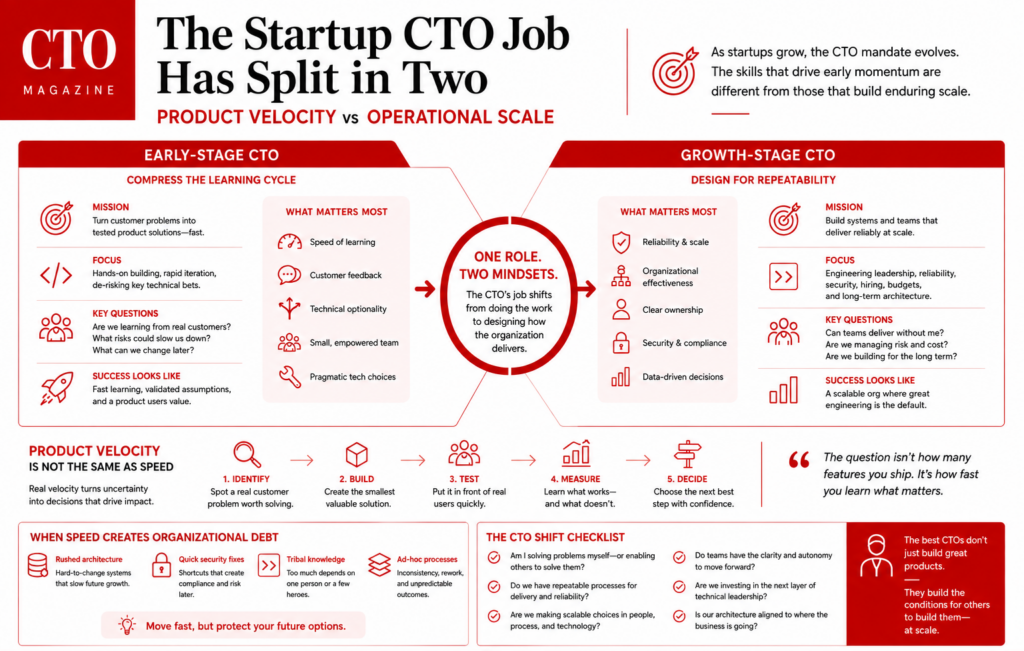
Product velocity is not the same as speed
Many tech companies use the frequency of releases as a sign of product velocity. It’s a helpful measure, but it doesn’t always mean real progress.
A team might release code every day but learn little about customers. They could close hundreds of tickets, but still solve the wrong problems. More engineering output can even create technical and operational issues that slow the company down later.
Real product velocity is the speed at which a company turns uncertainty into useful decisions.

The question isn’t how many features the team has shipped. It’s how quickly the company can identify a customer problem, build a focused solution, test it with real users, measure the result, and decide what to do next.
Sometimes that means building less software, not more.
A startup CTO can protect this learning cycle by removing unnecessary dependencies. The company might use a managed service instead of building its own infrastructure, choose a simple data model rather than a complex one, or delay a platform project until several teams actually need it.
The better question isn’t, “What would a large company build?”
It’s “What’s the smallest technical step that lets us learn something important without creating significant problems later?”
When speed becomes organizational debt?
Speed can be risky when quick fixes quietly turn into permanent systems. For example, a database built for a specific workflow can be difficult to adapt when the company enters a new market. Authentication set up just for internal users can become a security risk when customers start using the product. If only one engineer knows the deployment process, it becomes a big problem if they leave.
Shortcuts aren’t always bad. During experiments, they might be the right choice. The problem starts when the company keeps treating them as temporary, even after the product matters to customers.
The CTO doesn’t have to remove every shortcut. That would slow things down too much. Instead, they should make shortcuts visible and set clear rules for when to revisit them.
Technical debt should be seen as a business decision. If a shortcut doesn’t hurt revenue, reliability, security, or future delivery, it might not need urgent attention. But if it’s slowing growth or raising customer risk, someone should own it and have a plan to fix it.
Operational scale requires a different operating system
Operational scale isn’t just about handling more users or traffic. It’s about delivering reliably as the company adds more employees, teams, integrations, vendors, and business responsibilities. A company might spend a lot on cloud infrastructure and still not be ready to scale. True scale also needs clear accountability, good monitoring, tested recovery plans, strong security, solid documentation, financial discipline, and strong leadership.
This is where the difference between startups and big companies matters. Startups aren’t always fast, and enterprises aren’t always slow. They just deal with different levels of uncertainty, coordination, and risk. A startup is usually trying to show that its product solves a real problem. An enterprise is often focused on running a proven business across many teams, regions, systems, and responsibilities.
So, leading technology in an enterprise isn’t just like startup leadership with more meetings. It means dealing with more risks, longer planning, more dependencies, and bigger consequences if things go wrong. The mistake is copying big-company processes before the startup actually needs them.
A better question is: What’s the smallest control that addresses the actual risk the company faces today?
CTO responsibilities must evolve with the company
The CTO’s responsibilities at the seed stage differ from those needed after major growth. At first, the CTO focuses on whether the product is technically possible, getting customer feedback, building a maintainable first version, setting secure defaults, and running quick experiments. The aim is to build sufficient technical strength to support learning without overspending on problems that might never arise.
Once the product takes off, the focus shifts to making releases reliable, improving operational visibility, ensuring teams own their services, testing key workflows, handling incidents, and managing technical debt that affects revenue or the customer experience. At scale, the CTO is responsible for a broader range of outcomes: technology strategy, engineering structure, architectural direction, security, business continuity, budgets, vendor risk, executive communication, and the development of technical leaders. The CTO’s work becomes less visible in the code but is even more important for the whole company.
If a CTO stays involved in every technical decision, they might feel engaged, but the company will struggle to develop independent leaders. At this stage, the CTO needs to clarify who makes decisions, what the investment priorities are, and how much risk the company can accept.
CTO vs VP of engineering
The distinction between CTO and VP of Engineering varies across companies, but a practical boundary is useful. The CTO is usually accountable for technology direction, business-level technical risk, architecture strategy, and the company’s external technical position. The VP of Engineering is usually accountable for engineering execution, team structure, managers, delivery planning, hiring, quality, and organizational health.
| Decision | CTO | VP of engineering |
|---|---|---|
| Entering a regulated market | Accountable | Consulted |
| Engineering team structure | Accountable to the VP | Responsible |
| Rewriting a core service | Owns business trade-off | Leads technical assessment |
| Hiring an engineering manager | Consulted | Accountable |
| Release process | Sets risk expectations | Designs and operates process |
In a small company, one person might do both jobs. That’s not a problem on its own. Trouble starts when the responsibilities aren’t clear as the company grows.
The metrics a CTO should watch
A good CTO dashboard brings together product, delivery, operational, and organizational metrics.
Product measures
- Time from customer insight to tested release.
- Adoption of new capabilities.
- Retention and repeat usage.
- Conversion through critical workflows.
- Support volume caused by product defects.
- Percentage of roadmap work tied to measurable outcomes.
Delivery measures
- Lead time from approved change to production.
- Deployment frequency, where appropriate.
- Change failure rate.
- Time to restore service.
- Review and approval delays.
- Rework caused by unclear requirements.
The 2025 DORA research warns that delivery speed isn’t the whole story. It found that faster development doesn’t always lead to greater stability when the technical and organizational foundations are weak. The research also shows that strong internal platforms help improve delivery at scale. The main takeaway: more output doesn’t always mean more progress.
Organizational measures
The CTO should also monitor:
- Time required to onboard engineers.
- Work dependent on one person.
- Manager’s span of control.
- Attrition among key technical staff.
- Time spent on unplanned work.
- Unresolved high-severity risks.
- Engineering confidence in the roadmap.
Avoid using lines of code, hours online, or raw ticket counts as performance measures. They reward visible activity rather than useful outcomes.
Technology companies are balancing velocity and scale
Amazon and Stripe are good examples of tech companies that combine speed with strong operational discipline.
Amazon’s Builders’ Library explains how development teams run the systems they build, review performance, share knowledge, and learn from incidents. The lesson for a startup CTO isn’t to copy Amazon’s setup, but to make ownership clear. Teams should know how their systems work in production and how failures affect customers.
Stripe is another good example. In a 2025 engineering talk shared on LinkedIn, Stripe reported shipping about 1,145 pull requests to production each day, with less than a minute of API downtime all year. As Jamie Lord from CDS UK shared on LinkedIn:
In Stripe‘s engineering velocity data from their 2025 sessions, one number stands out: 1,145 pull requests shipped to production daily. That’s not just code written or reviewed – that’s finished work, deployed and running, with less than a minute of API downtime across the entire year. Breaking this down reveals something remarkable about operational excellence at scale. With roughly 3,400 engineers (40% of their 8,500 workforce), each developer averages one production change every three days whilst processing $1.4 trillion in payment volume annually. The real insight isn’t the raw throughput – it’s what this velocity requires. Operating at this pace with Stripe’s reliability demands sophisticated automation across testing, deployment, rollback systems, and observability infrastructure. You can’t manually gate-check 1,145 changes daily without breaking something critical.
In the post, Jamie further added:
This aligns with Google’s DORA research defining “elite” software delivery as multiple daily deploys with sub-5% failure rates. Stripe appears to operate in the top percentile of these metrics, but the interesting question becomes: what organisational structures enable this? Based on discussions in the engineering community, Stripe’s approach centres on small, incremental changes rather than large feature releases. Many of these PRs likely represent feature flag toggles, configuration updates, or gradual rollouts – changes that reduce deployment risk whilst maintaining development momentum. The trade-off becomes clear when you consider alternatives. Companies doing monthly releases with scheduled downtime windows face entirely different risk profiles. A four-hour maintenance window monthly versus distributed micro-changes with automated rollback capabilities represents fundamentally different approaches to system reliability.
The key lesson isn’t the number itself. It’s the system behind it: small changes, strong testing, rollback options, detailed monitoring, and clear ownership in production.
Startups shouldn’t try to copy these companies’ results. Instead, they should learn the principles that make those results safe. Product velocity gets better when changes are small, easy to understand, and reversible.
Building thought leadership for tech company executives
People often treat building thought leadership for tech executives as a content scheduling issue. In reality, it’s about credibility. A CTO should share insights based on experience, evidence, and clear opinions. Good topics include when to delay platform investment, why engineering productivity isn’t just about individual output, when to hire a VP of Engineering, or how operational discipline can boost product speed.
Strong executive content can cover topics such as a failed migration, a tough hiring decision, a change in the release process, or the rationale behind an architectural trade-off.
A practical publishing schedule could be one big article each month, a few LinkedIn posts based on that article, and one technical case study each quarter. The executive should approve every key claim and keep their natural voice. Polished writing helps, but fake certainty doesn’t.
Thought leadership works when the market associates the executive with a distinctive way of thinking, not simply with frequent posting. Research on executive thought leadership similarly emphasizes clear positions, authentic expertise, and distribution across owned and external channels.
In brief
The startup CTO role changes because the source of leverage changes.
At first, the CTO creates leverage by turning ideas into working products quickly and shortening the company’s learning cycle. As the organization grows, the CTO creates leverage by building people, architecture, controls, and decision-making systems that enable the company to move forward without relying on a single person.
The best CTOs don’t choose between velocity and operational scale. They add just enough structure to protect velocity while building the capabilities the next stage of growth requires.
The real CTO job isn’t simply owning technology. It’s deciding when to build, when to delegate, when to standardize, and when to leave something simple. As the company changes, those decisions change with it.