

Founding CTO vs Hired CTO Leadership and How Their Styles Diverge
Choosing between a founding CTO and a hired CTO is more than picking a job title. It’s about deciding who owns what, how much risk to take, the direction of the product, technical leadership, pay, and the type of company you want to create.
The CTO a startup needs at the beginning may not be the CTO it needs as it grows. Early-stage companies often need a technical leader willing to build from zero, make decisions with limited resources, and shape the product alongside the founders.
As the company gains customers, engineers, investors, and technical complexity, the role can evolve toward scaling infrastructure, formalizing engineering processes, and managing risk.
Understanding the difference between a founding CTO and a hired CTO is therefore a question of timing, leadership style, and the company’s next stage of growth.
Founding CTO vs hired CTO: The essential difference
The biggest difference is timing.
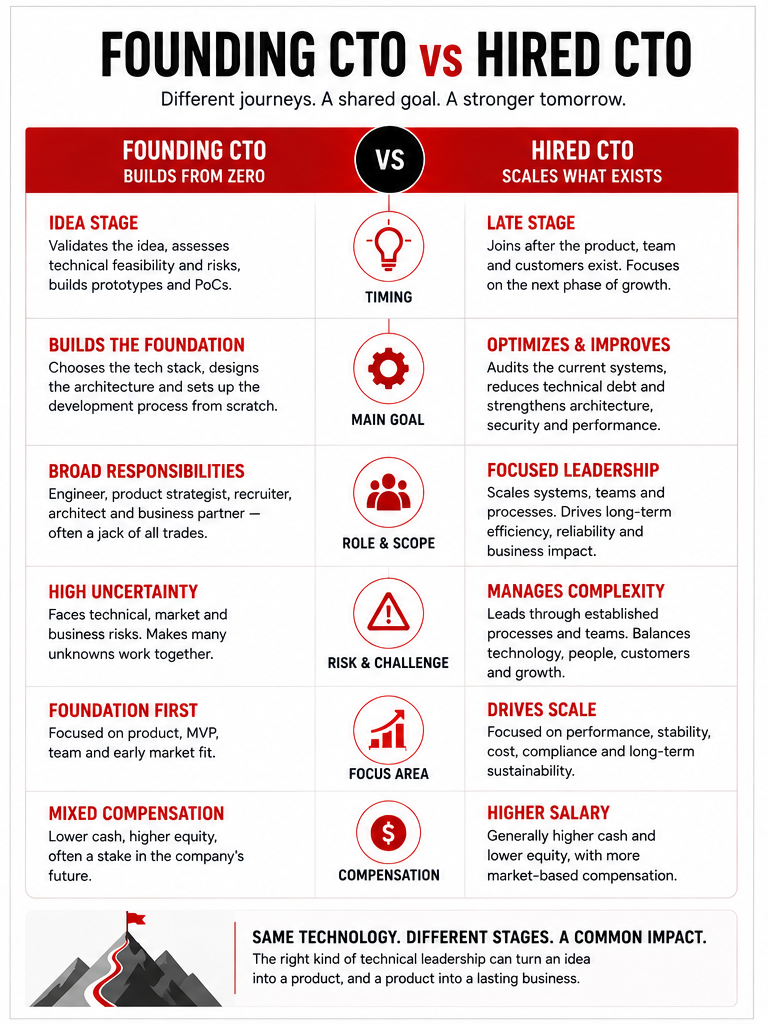
A founding CTO often joins before the product, team, or technical culture exists. They might be a co-founder or one of the first hires. Their job can involve testing the idea, building the first prototype, picking the tech stack, hiring engineers, and explaining the company’s technical strengths to investors.
A hired CTO joins an existing company, often as an executive or employee. The startup might already have a product, customers, revenue, funding, technical debt, or an engineering team. The hired CTO’s job is to add structure, boost reliability, manage growth, and make sure technology choices support the business.
Both roles need strong technical judgment, but they face different challenges. The founding CTO deals with uncertainty, while the hired CTO usually handles complexity.
What does a founding CTO do?
A founding CTO often wears many hats: engineer, product strategist, recruiter, architect, and business partner. Early on, they might write code one day and explain the technology to investors the next.
The Founding CTO’s Mandate
- Evaluating whether the business idea is technically feasible.
- Translating the business concept into a product roadmap.
- Building a prototype, proof of concept, or minimum viable product.
- Selecting an appropriate technology stack.
- Designing an architecture that supports learning without unnecessary complexity.
- Recruiting the first developers and technical contractors.
- Establishing source control, testing, deployment, and documentation practices.
- Speaking with early users and converting feedback into product decisions.
- Managing security, data protection, hosting, backups, and operational risks.
- Supporting fundraising, partnerships, hiring, and technical due diligence.
At first, the founding CTO’s goal isn’t to build a flawless system. It’s to determine whether customers want the product and whether the business model is viable.
Advice for startup CTOs usually focuses on product development, technical feasibility, risk management, team building, and fundraising.
Founding CTO responsibilities over time
A founding CTO’s priorities often shift as the startup grows and changes.
At the idea stage, the work is highly experimental. The CTO may build prototypes, test APIs, compare vendors, estimate costs, and identify technical risks.
When building the MVP, the focus is on getting a usable product out fast. Speed is important, but the CTO still needs to avoid choices that could cause big security, reliability, or maintenance issues.
After the product gains users, the role becomes more managerial and strategic. The founding CTO may need to:
- Introduce engineering processes.
- Manage technical debt.
- Improve system performance and reliability.
- Hire senior engineers and engineering managers.
- Establish monitoring and incident-response practices.
- Prepare infrastructure for higher traffic.
- Coordinate product, engineering, design, and operations.
This shift can be tough. A founding CTO might be great at building the first version, but not as interested in running a big team. In some companies, the founding CTO continues to focus on innovation while another tech leader handles scaling operations.
Hired as CTO with responsibilities in a growing company
A hired CTO’s main responsibilities usually involve scaling the company, maintaining consistency, and reducing risk. Moreover, a hired CTO might take over a working product that still has some technical limitations. They need to figure out what to keep, what to improve, and what to replace over time.
Their responsibilities may include:
- Auditing the current architecture and technical debt.
- Creating a technology strategy for the next stage of growth.
- Improving availability, performance, security, and scalability.
- Building a sustainable engineering organization.
- Recruiting technical leaders and specialist teams.
- Establishing development, review, testing, and release standards.
- Managing cloud costs, vendors, infrastructure, and technical budgets.
- Supporting compliance, privacy, enterprise sales, and due diligence.
- Communicating technical risks to the CEO, board, and investors.
- Aligning engineering priorities with revenue and customer objectives.
A good hired CTO doesn’t show up planning to change everything right away. They start by learning how the product, team, customers, and business work. After that, they decide which technical changes will really make a difference.
Wellfound describes the startup CTO role as involving technology strategy, architecture, data, team leadership, security, compliance, and cross-functional collaboration.
How their leadership styles diverge
These two leaders often tackle the same problem in different ways.
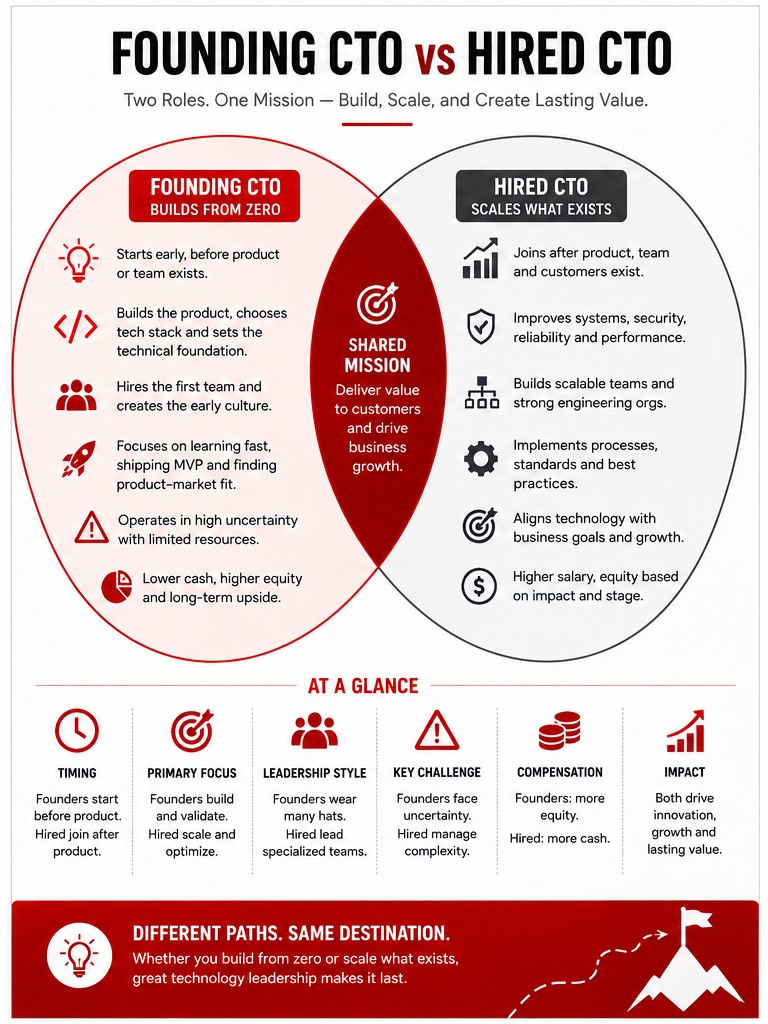
| Area | Founding CTO | Hired CTO |
|---|---|---|
| Primary objective | Prove the idea and build the first product | Scale the product, team, and technology function |
| Decision-making | Fast, experimental, and highly hands-on | Structured, measured, and process-oriented |
| Technical focus | MVP, speed, learning, and core architecture | Reliability, security, performance, and governance |
| Relationship with product | Very close to users and daily product decisions | Works through product leadership and strategic planning |
| Team role | First engineer, recruiter, and culture builder | Organizational leader and talent developer |
| Risk tolerance | Accepts uncertainty to gain speed | Reduces operational, financial, and compliance risk |
| Typical compensation | More equity and potentially a lower salary | Higher salary with a smaller equity grant |
| Main challenge | Avoiding burnout and premature complexity | Creating change without damaging momentum |
A founding CTO may ask:
“What is the fastest responsible way to learn whether customers want this product?”
A hired CTO may ask:
“Can this system support ten times the users, meet customer expectations, and be maintained by a larger team?”
Neither approach is always better. The right style depends on where the company is, how complex the product is, how much funding there is, and how mature the technology is.
Startup CTO vs corporate CTO
A startup CTO and a corporate CTO may share the same title, but their working environments are very different. Also, a startup CTO often works with a small team, limited resources, and changing priorities. In a single week, they might help with architecture, hiring, product planning, infrastructure, customer conversations, and incident handling.
A corporate CTO generally works with larger budgets, specialist departments, formal governance, and multiple technology platforms. Their priorities may include enterprise architecture, innovation portfolios, cybersecurity, procurement, compliance, vendor management, and board-level communication.
A startup CTO usually builds systems from scratch. A corporate CTO often needs to simplify, update, or manage systems that are already in place.
CTO equity vs salary
The choice between CTO equity and salary is closely linked to risk.
A founding CTO might take a lower salary because they get founder-level ownership and share in the company’s long-term risk. Their equity should match their contribution, time, financial sacrifice, when they joined, intellectual property, and leadership role.
A hired CTO usually gets a market salary, benefits, and stock options or other equity. Since they join after the company has grown, their equity percentage is usually lower.
There is no universal answer to the question, “How much equity should a CTO get?” Market references vary widely, but recent benchmarks often place a hired CTO’s equity at roughly 1% to 5% at the seed stage, with lower percentages at Series A and later stages. A genuine technical co-founder may receive a much larger founder allocation because they are joining before the business has meaningful value.
How much equity should a CTO get?
The following ranges are broad negotiation references, not fixed rules:
| Joining point | Possible equity range | Compensation logic |
|---|---|---|
| Technical co-founder before product | 10%–50% or more | Founder-level risk and responsibility |
| First hired CTO before or around seed | 2%–5% | High risk, early leadership, limited company resources |
| Hired CTO at seed stage | 1%–4% | Salary plus meaningful growth incentive |
| Hired CTO at Series A | 0.5%–2% | More company value and lower personal risk |
| Later-stage corporate CTO | 0.1%–1% | Higher salary and established business infrastructure |
Equity should be calculated against the fully diluted cap table. The agreement should clearly explain the type of equity, vesting schedule, cliff, dilution, exercise terms, acceleration, termination treatment, and tax implications.
A four-year vesting schedule with a one-year cliff is a common structure for founder and early employee equity. Under that arrangement, 25% generally vests after the first year, followed by monthly vesting over the remaining three years. (Cremades, 2026)
When should a startup hire a CTO?
Not every startup needs a full-time CTO immediately.
At first, a technical founder might lead engineering, or the company might use a part-time CTO while testing the product. But hiring a CTO becomes urgent when technology is key to staying ahead or when technical choices are too important for the current team to handle casually.
A statrup needs to bring in a CTO when:
- The founders cannot confidently evaluate technical decisions.
- The product involves complex AI, data, security, or integrations.
- Engineering hiring has become a serious bottleneck.
- Technical debt is slowing product delivery.
- Reliability, privacy, or compliance risks are increasing.
- Enterprise customers require stronger technical assurance.
- The CEO is spending too much time managing engineering details.
- The company needs a long-term technology strategy for fundraising or expansion.
If you hire a CTO too early, you might add extra management you don’t need. If you wait too long, weak systems, security issues, and unclear roles can turn into costly problems.
The impact of a CTO leaving a startup
When a CTO leaves a startup, it can affect product delivery, team morale, fundraising, infrastructure, and investor confidence.
Where the risk concentrates
The impact is particularly severe when the CTO is the only person who understands:
- Production credentials and deployment processes.
- The system architecture.
- Key vendor and API relationships.
- Unwritten product decisions.
- Security controls and backup procedures.
- Technical limitations hidden inside the product.
Startups can lower this risk by using shared accounts, maintaining clear documentation, automating deployments, conducting code reviews, implementing access controls, monitoring systems, establishing clear incident procedures, and planning for succession.
A CTO should be valuable for their judgment and leadership, not just because the company relies on their memory due to poor documentation.
Founding CTO vs hired CTO: Which path is right for your company?
Choose a founding CTO when the business is still discovering its product, technology is central to the company’s future, and the technical leader is ready to share founder-level risk.
Choose a hired CTO when the company has an existing product, engineering team, customer base, or operational complexity that requires experienced technology leadership.
The transition doesn’t always mean replacing someone. A founding CTO might continue leading product innovation or research, while a hired CTO handles engineering operations, hiring, security, and scaling.
The best choice isn’t always the person with the fanciest title. It’s the leader whose strengths fit the company’s biggest challenge right now.
What tech giants teach us about founding CTO vs hired CTO
The difference between a founding CTO and a hired CTO is clearer when we look at how big tech companies built their technical leadership. Not all of them used the title “founding CTO,” but their stories show how technical responsibility can shift from founders and early engineers to experienced executives.
Google is a strong example of founder-led technical direction. Larry Page and Sergey Brin developed the original search technology and co-founded Google, with PageRank becoming the foundation of the company’s search engine. In the early years, the founders were deeply involved in product development, engineering decisions, and the company’s technical vision.
As Google grew, its leadership became more specialized. The company set up formal roles to manage search, ads, cloud computing, AI, and global infrastructure. This shows how a founding CTO’s role can evolve into a wider executive tech structure.
Amazon
Amazon demonstrates how a founder and a hired CTO can work together. Jeff Bezos founded Amazon and established the company’s customer-focused business model, while Werner Vogels joined the company in 2004 as director of systems research and later became its CTO.
Vogels helped build Amazon’s large-scale tech systems and is known for shaping the engineering behind Amazon Web Services. His story shows how a hired CTO can add specialized skills and operational experience while working with the founder.
Microsoft
Microsoft represents a mature company that hires technical leadership to guide transformation. Bill Gates and Paul Allen provided the company’s original technical foundation as co-founders, but Microsoft later developed a professional executive structure as it expanded into enterprise software, cloud computing, cybersecurity, and artificial intelligence.
Kevin Scott became Microsoft’s CTO after leading engineering and operations at LinkedIn. His appointment shows that a corporate CTO is often chosen for their experience in scaling teams and leading tech strategy, not just for being there from the start. news.microsoft+1
Meta
Meta combines founder-led product direction with long-term internal technical leadership. Mark Zuckerberg founded Facebook and continues to guide the company’s overall product strategy and core technology direction.
Andrew “Boz” Bosworth joined Facebook in 2006 as an early engineer and later became Meta’s CTO. His career demonstrates a third path: a company may not choose between only a founding CTO and an external hire. It can develop an early technical employee into a senior technology leader who understands the product, culture, and engineering history.investor.atmeta+1
Apple
Apple shows the importance of a technical co-founder even when the company’s public identity becomes strongly associated with another leader.
Steve Wozniak co-founded Apple with Steve Jobs and designed the Apple I and Apple II computers, which provided the company’s early technical foundation. Wozniak was more like a founding engineer and technical co-founder than today’s corporate CTO. As Apple expanded, technical responsibility spread across engineering, design, operations, and executive teams.
This shows that the person who builds the first product isn’t always the best fit to lead technology as the company grows worldwide.
Strategic Insights
Founding CTOs build the technical foundation; hired CTOs scale it.
The distinction is less about title and more about whether the company needs technical discovery or organizational and operational scale.
CTO compensation reflects the company’s stage and risk profile.
Founding CTOs typically take on greater uncertainty in exchange for potentially more equity, while hired CTOs tend to command higher salaries with smaller equity stakes.
The need for a CTO emerges when technology becomes a business-level concern.
Hiring becomes critical when technical complexity, reliability, talent, or technology risk begins to directly affect growth.
A CTO’s departure shouldn’t put the technology organization at risk.
Documentation, access controls, vesting structures, and succession planning can preserve continuity when leadership changes.
The right CTO is determined by the company’s needs—not the title.
Startups should choose a technical leader based on their stage, challenges, and next phase of growth.
In brief
Founding CTOs and technical co-founders usually build the first product, set the tech vision, and take on early risk. Hired CTOs often join later to scale systems, hire leaders, boost reliability, and bring structure. Stories from Google, Amazon, Microsoft, Meta, and Apple show that tech leadership often changes as companies grow. The right choice depends on your company’s stage, product complexity, funding, and long-term goals.