

Climate Risk Modeling Is Changing the Way Banks Make Lending Decisions
Financial institutions have always relied on historical data to assess lending risk. Credit scores, repayment histories, cash flow, and collateral have long formed the foundation of lending decisions.
But climate change is exposing the limits of those models.
Extreme weather, rising insurance costs, supply chain disruptions, and evolving climate regulations are introducing risks that traditional financial metrics often fail to capture. As a result, banks are increasingly turning to climate risk modeling, combining artificial intelligence, environmental data, satellite imagery, and predictive analytics to understand how climate-related events could influence a borrower’s long-term financial resilience.
JPMorgan Chase is among the institutions investing heavily in this approach, using AI-driven climate models to evaluate portfolio risk, support regulatory requirements, and improve lending decisions in an increasingly uncertain environment. For many years, banks used a standard approach to approve loans. They checked income, assets, repayment history, debt, and market conditions. If everything added up, they saw the risk as manageable.
Why are traditional credit models no longer enough?
Traditional lending models have one major advantage. They work well when tomorrow looks a lot like yesterday.
Credit scores, repayment history, cash flow, and collateral remain strong indicators of financial health because they rely on years of past performance. The problem is that climate risk does not always follow these patterns.
A factory that has run smoothly for twenty years might suddenly face repeated floods.
A logistics company could see its costs rise due to extreme heat or new fuel regulations. Even commercial real estate can lose appeal if insurance premiums keep going up.
None of those risks is easy to identify from financial statements alone.
Banks increasingly recognize that past performance is only part of the picture. To assess future risk, they must also consider how climate events could impact customers, industries, and local economies. As a result, the banking sector is rapidly investing in AI-driven credit and climate risk modeling.
Climate data is becoming financial data
Only a few years ago, climate information was mostly used by sustainability teams. Today, it is finding its way into lending, investment analysis, and enterprise risk management.
Banks now consider factors such as flood risk, wildfire risk, drought conditions, energy transition plans, and local carbon policies, along with traditional financial data. Together, these details give a fuller view of a borrower’s long-term resilience.
Artificial intelligence makes this possible because it can quickly process large amounts of diverse information, much faster than people can by hand.
Instead of reading through hundreds of separate reports, analysts now get models that point out where they should look more closely.
Human experts still make the final lending decisions, but AI gives risk teams a much clearer starting point.
How JPMorgan uses AI to price climate risk in lending
Climate risk has become significant enough that JPMorgan is no longer treating it as a separate sustainability initiative. Instead, the bank is gradually embedding it into lending decisions, portfolio management, and enterprise risk assessment.
The main goal is simple: understand how changing climate conditions could affect borrowers over time and use that knowledge to make better lending decisions before issues arise.
This work supports JPMorgan climate risk AI initiatives that combine financial information with environmental data, helping risk teams evaluate exposure across industries and regions.
Rather than relying on a single prediction, the models examine multiple future scenarios, enabling the bank to understand how different climate pathways could affect long-term credit performance.
Looking beyond today’s balance sheet
A borrower’s financial statements still matter. But they no longer tell the whole story.
Suppose two manufacturers report similar revenues, profitability, and debt levels. On paper, both appear equally creditworthy.
Now add another layer. One operates in an area facing repeated flooding and rising insurance costs. The other has invested in resilient infrastructure and is located in a lower-risk region.
Traditional credit models might treat them similarly.
Modern AI-powered credit risk models are built to spot these differences. They give lenders a fuller view of future risk instead of just looking at past performance.
JPMorgan’s climate commitments
JPMorgan’s lending strategy is supported by broader sustainability goals that influence how the bank evaluates long-term investment and financing opportunities.
| Climate commitments | Roadmap |
|---|---|
| Sustainable development financing | More than USD 2.5 trillion by 2030 |
| Clean energy financing | USD 1 trillion by 2030 |
| Net-zero operational emissions | 2030 |
| Net-zero financed emissions | 2050 |
These commitments do not decide each lending choice, but they guide the bank’s ongoing investment in climate risk modeling AI and risk analytics.
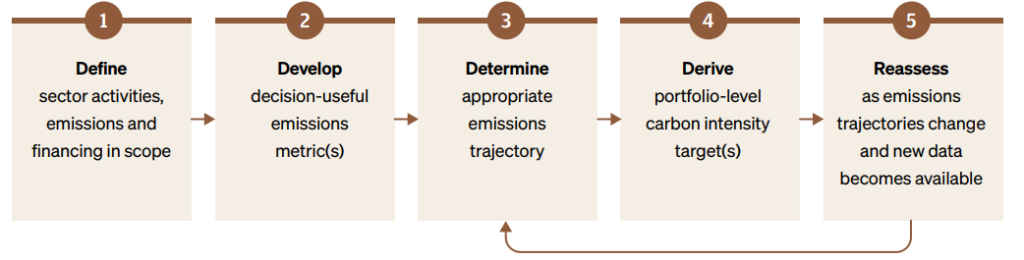
Why does better data matter more than better algorithms?
When people think about artificial intelligence, they usually focus on the model. Banks tend to focus on the data.
Even the best algorithm gives unreliable results if the data is incomplete or inconsistent. This is especially true for climate data, which comes from weather models, satellite images, public reports, geographic data, and industry research.
Building reliable AI models for climate risk in the banking industry, therefore, starts long before the machine learning model is trained.
The real challenge is to gather reliable information, verify its accuracy, and combine it with financial data in a way that reflects how businesses really operate.
Only then can artificial intelligence produce insights that lenders can confidently use in real-world decision-making.
Data-driven loan pricing starts with better data
Building an effective climate risk modeling framework requires more than selecting the right AI model. The greater challenge is ensuring the model has access to reliable data.
Banks have always been able to collect financial information, such as balance sheets, repayment histories, credit scores, and market data. Climate data is different. It comes from many sources, is updated at different times, and rarely fits easily into traditional banking systems.
For this reason, many financial institutions devote as much effort to improving data quality as to developing algorithms.
The data waterfall approach
JPMorgan describes its climate framework as a layered approach rather than a single predictive model. The process begins with the highest-quality available information, such as verified borrower disclosures, emissions reports, and property-level data.
When these datasets are unavailable, the bank supplements them with industry averages, geographic information, scientific research, and carefully selected proxy datasets.
The objective is straightforward.
Banks do not have to wait for every customer to provide perfect climate disclosures. They can estimate exposure using trusted outside sources, and as better information comes in, the models get more accurate.
This approach enables continuous improvement in climate risk financial modeling rather than keeping it static. One of the biggest obstacles facing lenders is incomplete information.
Many businesses, especially smaller ones, do not publish detailed environmental data. This does not always mean their climate risk is low. It just means there is less data available.
Artificial intelligence helps bridge those gaps.
Instead of disregarding missing information, machine learning models identify relationships among similar businesses, geographic locations, infrastructure, and industry characteristics to estimate likely exposure. Analysts continue to review the results, but AI significantly reduces the need for manual research.
This further demonstrates how AI models for climate risk in banking support, rather than replace, human expertise.
Climate risk in lending requires a different mindset
Traditional lending models focus on one central question. Will the borrower repay the loan? Climate risk introduces another layer. Will environmental changes make repayment more difficult over time?
This difference is changing how banks approach long-term lending. A manufacturing business near a risky coastline might look financially strong today. But in 10 years, repeated flooding, higher insurance costs, or tougher environmental rules could significantly change that outlook.
Those factors rarely appear in conventional financial statements. They do, however, influence long-term credit quality. That is why climate risk in lending is becoming a regular part of underwriting, not just an ESG task.
Dr. Sarah Kapnick, Global Head of Climate Advisory, J.P. Morgan, authored the bank’s more recent report flagged a key modeling gap: “Climate tipping points are under-modeled … their lack of historical analogues and deeply uncertain nature make them difficult to plan for. However, scenarios and tabletop exercises, borrowed from other spheres of decision-making, can help prepare for emerging shifts.”.
ESG risk pricing in banking is becoming operational
Only a few years ago, environmental metrics often appeared in annual sustainability reports after lending decisions had already been made. Today, those same metrics are beginning to influence lending itself.
Banks are now adding ESG risk pricing into portfolio management, commercial lending, and infrastructure finance. Instead of seeing environmental performance as just a reporting task, they are starting to treat it as another factor in long-term financial strength.
This does not mean companies with higher emissions automatically receive worse loan terms. Instead, lenders look at the broader picture.
- How exposed is the business to future regulation?
- How resilient are its operations?
- Is management investing in adaptation?
- How likely is climate disruption to affect cash flow?
Artificial intelligence helps answer these questions by pulling together information that would otherwise be scattered across different systems.
AI-powered credit risk modeling supports better decisions
No AI model can predict the future with complete certainty. What it can do is help decision-makers understand a wider range of possible outcomes.
That is one reason AI-powered credit risk modeling is gaining traction across global banking.
Instead of relying only on past repayment data, these systems look at environmental, operational, geographic, and financial factors together. This gives a deeper view of how resilient a borrower is.
For loan officers, this means having more context before making a lending decision.
For risk managers, it provides another layer of insight when monitoring portfolio exposure. In the end, the goal is not to replace human judgment. It is to help experienced professionals make better decisions.
Machine learning for credit risk continues to evolve
The role of machine learning for credit risk has expanded well beyond traditional credit scoring.
Modern models can handle millions of records, find subtle links in large datasets, and keep improving as new information comes in. For example, machine learning may discover that businesses operating in certain regions become more financially vulnerable when repeated climate events coincide with rising insurance costs and supply chain disruption.
These connections would be hard to spot using only traditional statistical methods.
By finding these patterns sooner, banks can manage portfolios better and cut down on unexpected losses.
AI credit scoring models look beyond financial history
Conventional credit scores remain important, but they tell only part of the story. Today’s AI credit scoring models now mix financial records with operational, geographic, environmental, and industry information to give a broader view of risk.
The objective is not to replace existing credit models. It is to supplement them with additional intelligence that reflects how businesses operate in a changing world. As climate disruptions happen more often, this wider view is becoming more valuable.
Predictive risk modeling in banking supports long-term planning
Banks have always tried to anticipate future risk. Artificial intelligence just lets them do it faster and with much more information.
Modern predictive risk modeling banking platforms simulate multiple economic and environmental scenarios instead of relying on a single forecast. Analysts can examine how rising temperatures, severe weather, carbon pricing, or regulatory changes might influence borrowers over time.
This scenario-based approach helps banks prepare for uncertainty instead of reacting only after problems appear.
It also supports more consistent data-driven loan pricing, allowing lenders to balance opportunity and risk using a much broader evidence base.
AI models in banking continue to mature
Banks have spent years experimenting with artificial intelligence. What is changing now is where that technology is being used.
Earlier projects often focused on automating customer support or detecting fraud. Today, AI is becoming part of core banking operations, helping institutions assess lending decisions, monitor portfolio risk, and understand how climate-related events could influence future financial performance.
That evolution is making climate risk modeling a practical business capability rather than a research initiative.
JPMorgan’s Chief Risk Officer Ashley Bacon set the tone in the bank’s 2025 climate report, “Success in the New Climate Era hinges on our ability to integrate climate considerations into daily decision-making. Those who adapt will lead, while others risk falling behind”.
AI models are becoming part of everyday lending
Lending has never relied on a single data point.
Relationship managers still consider financial statements, industry outlooks, collateral, and conversations with borrowers before making a recommendation. AI simply gives them another source of insight.
Modern AI models in banking can review thousands of variables in minutes, highlighting patterns that would be difficult for analysts to identify manually. Instead of replacing experienced lenders, they help them investigate areas that deserve closer attention.
For example, a borrower may appear financially healthy today but operate in a region expected to experience increasing climate-related disruptions over the coming decade. AI can surface that information early, allowing risk teams to ask better questions before approving a loan.
That is one reason AI for loan risk assessment is becoming part of mainstream banking operations.
Python continues to power AI development
Most enterprise AI projects are built using established open-source technologies. Python remains one of the most widely used programming languages for developing AI models in banking due to its mature machine learning ecosystem and extensive data science libraries.
Popular frameworks include TensorFlow, PyTorch, XGBoost, LightGBM, and Scikit-learn. Together, they support everything from predictive analytics to deep learning and explainable AI.
Banks rarely depend on a single model. Instead, data scientists build multiple models, compare their performance, validate the results, and continuously retrain them as new financial and climate data becomes available.
This iterative approach helps improve model accuracy while ensuring lending decisions remain transparent and explainable.
Digital transformation is changing risk management
The conversation around digital transformation banking AI often focuses on automation or customer experience. Risk management deserves equal attention.
As more lending processes become digital, banks gain access to richer datasets and faster analytical tools. Environmental disclosures, satellite imagery, insurance records, weather forecasts, and financial information can now be evaluated together instead of in isolation.
This broader perspective enables institutions to assess borrower risk more comprehensively than traditional credit models alone.
Artificial intelligence does not eliminate uncertainty.
It simply helps reduce it.
What comes next for climate risk modeling
Climate risk is unlikely to become a separate department inside banks. Instead, it will become part of everyday lending.
Over the next few years, climate risk modeling AI is expected to become increasingly integrated with underwriting systems, portfolio management platforms, and enterprise risk frameworks. As regulations evolve and more companies disclose environmental data, AI models will have access to stronger and more consistent datasets.
Banks are also expected to rely more heavily on ESG climate risk analytics when evaluating industries that face significant transition risks, including energy, manufacturing, transportation, agriculture, and commercial real estate.
At the same time, improvements in predictive risk modeling banking will allow lenders to simulate multiple economic and climate scenarios before making major financing decisions.
The direction is becoming clearer.
Instead of asking whether climate should influence lending decisions, banks are increasingly asking how to measure that influence more accurately.
Key AI technologies supporting climate risk modeling
| Technologies | |
|---|---|
| Machine learning | Identifying long-term borrower risk patterns |
| Satellite imagery | Monitoring flood, wildfire, and land-use exposure |
| Geospatial analytics | Mapping climate risk by location |
| Predictive analytics | Forecasting future credit performance |
| Natural language processing | Analyzing ESG disclosures and regulatory filings |
| Cloud computing | Processing large climate and financial datasets |
In brief
Banks have always managed financial risk. What is changing is the amount of information they can use to understand it. Climate risk modeling is bringing together financial records, environmental data, artificial intelligence, and predictive analytics to provide a broader view of borrower resilience. JPMorgan’s work illustrates how AI in credit risk modeling is moving beyond research into day-to-day lending operations.
Key takeaways
- Climate risk modeling is becoming a core part of lending as banks move beyond traditional credit scores to assess long-term environmental and financial risks.
- JPMorgan is using AI, machine learning, and climate data to improve loan pricing, portfolio management, and risk assessment.
- Climate data is now influencing lending decisions alongside financial metrics, making AI-powered analytics an important tool for enterprise banking.
- Better data quality, not just better algorithms, is driving more accurate climate risk models.
- As climate regulations evolve, AI-powered climate risk modeling is expected to become a standard capability across the banking industry.
The technology is still evolving, and no model can predict every outcome. Even so, AI is helping banks identify emerging risks earlier, evaluate borrowers more consistently, and improve long-term portfolio resilience.
How JPMorgan uses AI to price climate risk in lending offers a glimpse of where enterprise banking is headed. The future of lending will depend not only on understanding a borrower’s financial history but also on anticipating the environmental and economic conditions that could shape its future.
FAQs:
Climate risk modeling is the process of assessing how physical climate events and the transition to a lower-carbon economy could affect financial assets, businesses, and lending portfolios. Banks combine financial information with climate data to estimate future risk more accurately.
JPMorgan uses AI in lending by combining financial information with environmental datasets, predictive analytics, and machine learning to better understand long-term borrower risk. These models help identify climate-related vulnerabilities that traditional credit models may overlook, supporting more informed lending decisions.
AI enables banks to analyze much larger datasets than traditional credit models. It identifies hidden relationships between financial, environmental, and operational data, helping lenders assess how climate events, regulations, and transition risks could affect future loan performance.
AI-powered credit risk modeling uses machine learning algorithms to evaluate borrower risk by combining financial records with operational, geographic, and environmental information. The objective is to improve lending decisions while supporting human judgment rather than replacing it.
ESG risk pricing in banking refers to incorporating environmental, social, and governance considerations into lending and investment decisions. Climate exposure, transition risks, and sustainability performance may all influence long-term credit assessments.
Banks increasingly use machine learning, satellite imagery, geospatial analytics, cloud computing, predictive analytics, and ESG climate risk analytics platforms to strengthen climate risk financial modeling and improve portfolio management.
No. AI helps analysts process large volumes of data, identify emerging risks, and improve decision-making, but lending decisions still rely on human expertise, regulatory oversight, and professional judgment.
As more organizations disclose environmental information and climate regulations mature, AI-powered climate risk models are expected to become more accurate, transparent, and integrated into lending, portfolio management, and enterprise risk assessment across the banking industry.