

Deloitte’s 2026 Tech Leadership Study Reveals a C-suite Reset

For years, technology leaders fought to earn a seat at the business table. According to Deloitte’s 2026 Global Technology Leadership Study, that battle is over.
The challenge now is something entirely different.
Technology leaders have finally reached the center of enterprise decision-making, but many organizations have not evolved fast enough to support the broader role they are now expected to play. Based on insights from more than 660 senior technology executives worldwide, Deloitte’s latest research shows that the CIO, CTO, and technology leadership mandate has expanded far beyond infrastructure, operations, and delivery.
Today, leaders are being measured by their ability to drive growth, shape strategy, scale AI, and create measurable business outcomes. Yet while expectations have changed, enterprise structures often have not.
The result is a widening gap between ambition and organizational readiness.
Technology leaders are now expected to create business value
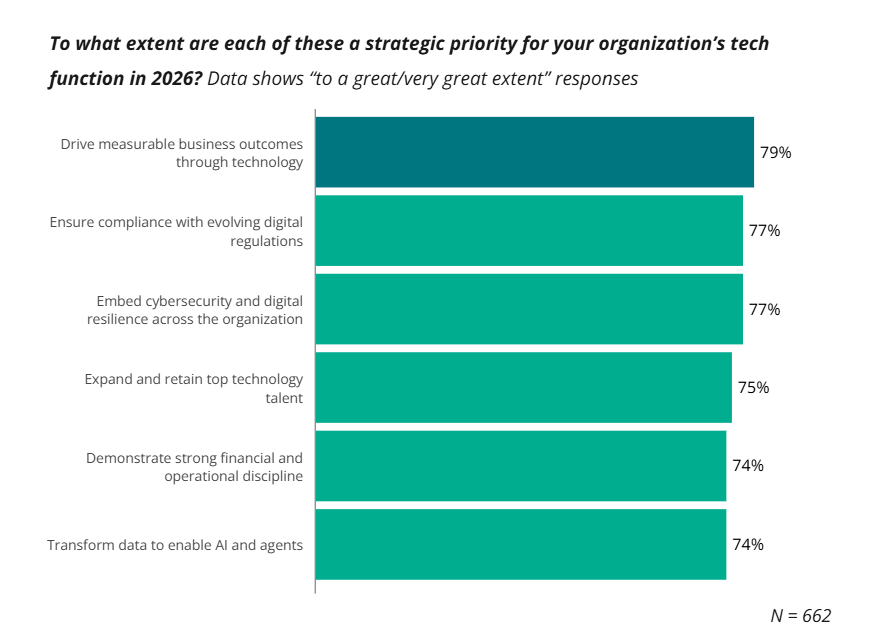
The study found that 79% of technology leaders now consider driving business outcomes their top priority. That represents a significant shift from the traditional focus on uptime, operational efficiency, and technology delivery.
Technology leaders now need to influence revenue growth, productivity improvements, customer experience, and enterprise transformation.
As AI accelerates change across industries, boards and executive teams are looking to technology leaders not simply to implement new tools but to help redesign how work gets done.
“The era of the operational technologist is over. This shift has been building for over a decade, and AI is the catalyst bringing that into focus. Today’s CIO isn’t just leading technology; they are being asked to redesign the very fabric of how the business runs. As operating models and investments catch up to this new reality, success will be defined by judgment and trade-offs. This is the moment for tech leaders to redefine their mandate and their organization’s trajectory.” said Anjali Shaikh, Managing Director, Deloitte Consulting LLP and Leader of Deloitte Global CIO & US Tech Executive Programs.
The real challenge is not AI. It is the enterprise
One of the most striking findings from the research is the contradiction between confidence and readiness. While 81% of leaders say they are confident in their ability to scale AI, 75% also acknowledge that their operating model needs significant change to unlock greater value.
That disconnect points to a deeper issue. The biggest barrier to AI transformation may no longer be the technology itself.
Speaking about the findings, Shaikh noted that many organizations continue to focus on AI adoption challenges, but the research suggests something different. We asked Shaikh:
The study says that 81% of leaders are confident they can scale AI, while 75% say their operating model must fundamentally change. Why do you think this confidence gap exists?
Shaikh replied, “For a long time, these leaders have been evolving into this role. We’ve been tracking and doing this survey for over a decade, and this has been the progression we’ve seen. I think the confidence comes from the fact that most organizations recognize technology as a critical part of their strategy. A few years ago, leaders were still asking whether technology investments were needed. Today, many organizations realize technology is critical to their success and growth.”
She further added, “I think the 81% of leaders who are confident they can scale AI feel that way because they’ve seen this before. They know how to do this. The conversation has moved beyond piloting use cases, deploying copilots, and basic automation because organizations have proven they can do things like this at scale.
The second number tells the more important story, and that’s where we focused much of our research. Scaling AI across the enterprise is not just a technology challenge. It is truly a challenge in both operating and capital allocation. Most organizations were not originally designed for the level of speed, agility, coordination, and data interoperability that AI requires.”
“You’re going to need a leader who can explain that and educate the organization on what’s required. And second, the enterprise, especially at the board and CEO level, must make decisions around what that looks like in practice because it requires an enterprise-wide shift. For organizations operating with siloed functions and legacy governance structures, that shift is going to be necessary. But that’s not on the CIO or head of technology alone. It requires collaboration across the entire C-suite. What creates the gap between those two data points is that leaders are confident in their capabilities because this is almost the moment, they’ve been gearing up for. If we’ve been talking about the evolution of the role, this is the moment. Now, there are things within their control and things that are not. The less confident part is whether the enterprise itself is structured to absorb and operationalize all of this at scale. In many ways, AI is exposing organizational debt faster than it is exposing technical debt”, Shaikh shared with CTO magazine.
Why do many organizations still struggle to show AI ROI?
The report also found that 42% of leaders report low or no ROI from AI investments. At first glance, that statistic appears concerning. When we asked Shaikh:
The study found that 42% of leaders report low or no ROI from AI investments. Are organizations struggling more with identifying the right use cases, scaling them, or measuring value effectively?
Shaikh replied, “I think the ROI question itself needs to be reframed. If we continue treating AI like another technology implementation, we’re going to miss part of the story. The ROI conversation is evolving.”
Many organizations are still using measurement frameworks designed for traditional technology investments rather than for AI-driven initiatives. Those frameworks often focus on isolated ROI metrics. AI value often appears in more complex forms. It shows up in faster decision-making, improved employee productivity, better customer experiences, and the ability to scale work in different ways. Those outcomes are harder to measure and quantify immediately. You often hear the narrative that organizations are stuck in pilot mode.
She also added, “They may have a dozen use cases or experiments running across the enterprise. But I don’t think enough attention is being paid to understanding what those outcomes would have looked like without AI and how value should actually be measured in this new environment. The conversation is still being measured too narrowly in terms of cost reduction and productivity gains. The leaders making the most progress are looking at a broader set of indicators: productivity, speed to market, decision quality, customer outcomes, and resilience.”
Many organizations continue to evaluate AI using traditional technology investment frameworks that were designed for software implementations rather than AI-driven transformation. Those frameworks typically emphasize direct cost savings and productivity gains. The reality is more complex. AI value often manifests as faster decision-making, improved employee effectiveness, enhanced customer experiences, greater resilience, and the ability to scale operations in entirely new ways.
These outcomes are often harder to isolate and measure using conventional ROI metrics. During the conversation with CTO magazine, Shaikh shared, “I wouldn’t say AI is not delivering value,” Shaikh explained. “I would say organizations are still learning how to operationalize, measure, and capture that value at scale.”
The leaders making the most progress are broadening their definition of success beyond simple cost reduction and looking at indicators such as decision quality, speed to market, customer outcomes, and organizational agility.
Leadership is becoming an orchestration role
Another major theme emerging from the research is the growing complexity of technology leadership itself. Today, 71% of organizations report having five or more senior technology leaders across the enterprise.
As responsibilities become increasingly distributed, leadership is shifting from direct authority to orchestration. Technology leaders are now expected to align business priorities, coordinate across multiple stakeholders, manage competing investments, and drive enterprise-wide outcomes.
The ability to influence, collaborate, and guide change is becoming just as important as technical expertise.
“For years, we’ve tracked the tech leader’s journey toward the center of the business. This year’s study shows they have arrived, but the enterprise wasn’t fully prepared for them. The challenge is significant, but the opportunity is immense. Today’s leaders are defined by their ability to orchestrate across the C-suite and translate technology into measurable outcomes. Those who remain focused solely on delivering underlying systems risk being sidelined, while those who embrace this moment can lead their organizations into the future.” said, Steve Pratt, Principal, Deloitte Consulting LLP, US Tech Exec Programs Leader
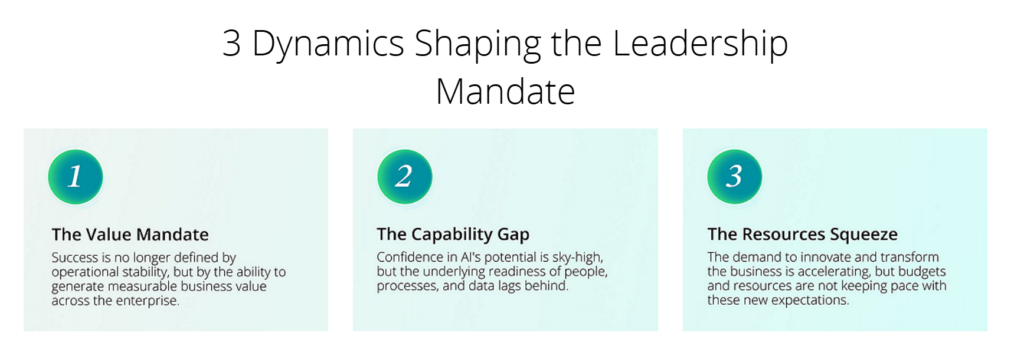
The research revealed three shifts redefining technology leadership
| Shift | What it means |
|---|---|
| The Value Mandate | Technology leaders are increasingly responsible for delivering measurable business outcomes, not just operating systems. |
| The Capability Gap | AI ambition is growing faster than enterprise readiness, creating a disconnect between expectations and execution. |
| The Resource Squeeze | Leaders are expected to run, protect, transform, and grow the business simultaneously, often without proportional increases in resources. |
The next competitive advantage may be organizational
The study suggests that the future of technology leadership will depend less on access to technology and more on an organization’s ability to adapt around it.
AI capabilities are becoming increasingly accessible. What differentiates organizations is how effectively they align people, processes, governance, and decision-making structures to capture value from those capabilities.
That is why Deloitte’s findings point toward a broader transformation challenge. Technology leaders may be ready for the AI era. The bigger question is whether the enterprise is ready to evolve with them.
About Deloitte
Deloitte provides industry-leading audit, consulting, tax, and advisory services to many of the world’s most admired brands, including nearly 90% of the Fortune 500® and more than 9,000 U.S.-based private companies. At Deloitte, we strive to live our purpose of making an impact that matters for our people, clients, and communities. It brings together distinct talents, technologies, disciplines, and an ecosystem of alliances to help tackle today’s most complex business challenges and drive long-term progress. Bringing more than 180 years of service, Deloitte’s network of member firms spans more than 150 countries and territories. Learn how Deloitte’s approximately 470,000 people worldwide connect for impact.
In brief
Deloitte’s 2026 Global Technology Leadership Study highlights a fundamental shift in the role of technology leaders. Today’s CIOs and CTOs are increasingly responsible for driving business outcomes, orchestrating enterprise-wide change, and translating AI ambition into measurable value. While confidence around AI remains high, the research reveals a growing gap between leadership expectations and organizational readiness. As AI continues to reshape business models, the companies that succeed will likely be those that address organizational capability challenges as aggressively as they pursue technological innovation.
Explore more exclusive interviews, executive insights, and analysis on AI, technology leadership, digital transformation, and the future of the C-suite from the author. Browse all articles →