
Are Small Language Models the Future of Enterprise AI?

The rise of artificial intelligence has come with some unexpected costs. For the past three years, many companies have focused on building bigger language models, thinking that more parameters would lead to better results. In reality, Small Language Models (SLMs) are now providing faster results, lower costs, and often better accuracy for about 70 percent of tasks that don’t need extremely complex reasoning.
As governments around the world introduce stricter data regulations, cloud data sovereignty is quietly encouraging more companies to adopt SLMs. These smaller models can run on local servers or in secure cloud environments, helping keep sensitive data within appropriate boundaries while still offering strong AI capabilities.
The idea that bigger is always better is being replaced by the belief that smaller can actually be smarter.
The enterprise AI reality check: Are large language models too expensive for businesses?
Large Language Models (LLMs) dominated AI conversations fueled by ChatGPT’s cultural impact. But implementation reveals two fatal flaws preventing widespread enterprise adoption:
| Problem | Impact |
|---|---|
| General-purpose limitation | “Average” company models fail because no “average” company exists. Effective AI must be tuned to specific organizational needs |
| Black box opacity | Proprietary LLMs lack data transparency, hindering tuning with enterprise data where AI’s true value lies |
The economics are brutal. Running a 7B-parameter SLM costs 10-30 times less than operating a 70-175B LLM. GPU hours, energy consumption, and memory bandwidth requirements multiply non-linearly as parameters increase.
IBM’s early proofs of concept show their Granite SLM models costing 3 to 23 times less than large frontier models while outperforming or matching similarly sized competitors on key benchmarks.
The 40-70 percent query replacement opportunity
NVIDIA research reveals a startling fact: 40-70 percent of current LLM queries could be handled by SLMs without any meaningful drop in performance quality.
Many companies are spending a lot on advanced systems to handle simple tasks like answering routine questions, processing returns, and managing bookings and jobs that don’t require such complex technology.
In other words, many companies are using highly advanced AI for everyday tasks, even though a simpler solution would work just as well.
Small Language Models: What makes SLMs different from LLMs
Small Language Models typically contain under 10 billion parameters (anything under 30 billion is considered an SLM). Compare this to GPT-4, which has over 1 trillion parameters.
Subscribe to our bi-weekly newsletter
Get the latest trends, insights, and strategies delivered straight to your inbox.
This dramatic size difference creates four concrete advantages:
Speed and edge deployment
SLMs run smoothly on consumer-grade devices without requiring massive cloud infrastructure. Their compact design enables deployment on edge devices, allowing real-time decision-making without cloud dependency.
This is ideal for applications like:
- Autonomous vehicles
- Voice assistants
- Wearable tech
- Factory equipment
- Medical devices
A comprehensive study of 60+ publicly accessible SLMs (including Microsoft Phi and Google Gemma) shows that state-of-the-art SLMs outperform 7B models across general tasks, demonstrating practical viability for resource-constrained devices.
Data privacy and Cloud data sovereignty
Processing happens locally, keeping sensitive information secure and meeting compliance requirements. Cloud data sovereignty is the principle that data is governed by the laws of the country where it’s stored or processed, not where your company is headquartered.
The EU AI Act and GDPR have made it clear: data doesn’t belong to the cloud provider. It belongs to the jurisdiction where it’s processed.
SLMs enable this by:
- Processing data on-premises
- Running in sovereign cloud environments
- Keeping data within national borders
Some 65% of business leaders report having changed their cloud strategies in response to geopolitical pressures, including data sovereignty regulations, according to the Kyndryl Readiness Report.
Cost effectiveness
The mathematics are undeniable. Inference costs scale non-linearly with model size. For small and medium-sized businesses, SLMs are transformational: AI deployment no longer requires million-dollar .
Energy efficiency and sustainability
SLMs consume less energy and require fewer resources, making them more sustainable and accessible for widespread use. They offer companies AI models that contain only data relevant to specific tasks, saving costs and energy.
Performance that surprises the industry
Real-world results are proving that smaller models can be just as strong. For example, Hymba-1.5B, a small language model, performs better than some much larger models and delivers 3.5 times higher throughput.
This performance gain comes from more efficient training methods and optimized inference processes. For businesses, this means faster responses, lower infrastructure costs, and better user experiences.
Gartner predicts 3x more SLM usage than LLMs by 2027. Bayer achieved a 40% increase in accuracy by switching from LLMs to specialized SLMs.
Cloud data sovereignty: The hidden driver
As data sovereignty reshapes cloud strategy, enterprises must balance regulation, governance, and innovation through hybrid models.
75% of business leaders say they are concerned about geopolitical risk associated with storing and managing data in global cloud environments. [Source]
The trust gap is real. Some enterprises overseeing critical infrastructure or personal data worry that when their sensitive data resides on infrastructure owned by US-headquartered companies, it could be subject to US jurisdiction—including the possibility of data access requests relating to criminal investigations under laws like the CLOUD Act.
At least 41% of organizations have begun repatriating some of their data from the cloud to on-premises or local environments.
How small language models enable cloud data sovereignty?
SLMs are the technical enabler for cloud data sovereignty strategies. Their edge deployment capabilities mean enterprises can:
- Keep sensitive data local while still tapping into the scale of AI capabilities
- Process data within jurisdictional borders to comply with GDPR, HIPAA, and local data localization laws
- Avoid foreign government access to data by running inference on-premises
- Build intentional hybrid architectures that balance control and innovation
The Asia Pacific region is emerging as the fastest-growing market for SLMs, driven by AI localization strategies and Cloud data sovereignty requirements.
Managing cloud data sovereignty at scale requires consistency across data governance, observability, and policy enforcement. SLMs provide the technical foundation for this coherence.
Where small language models excel in enterprise: High-value business use cases
We’ve seen SLMs transform operations across industries with specialized, focused applications:
| Industry | SLM Application | Benefit |
|---|---|---|
| Customer Service | Routine inquiries with speed and accuracy | Reduces operational costs while delighting customers |
| Content Personalization | Real-time product recommendations | Creates genuinely personal experiences |
| Industrial Automation | Manufacturing process control and quality checks | Improves efficiency and safety |
| Healthcare | Local patient data processing | Maintains privacy and meets regulatory requirements |
| Finance | Domain-specific fraud detection | Enhanced accuracy through fine-tuning |
| Mobile Applications | On-device features without internet | Truly responsive user experiences |
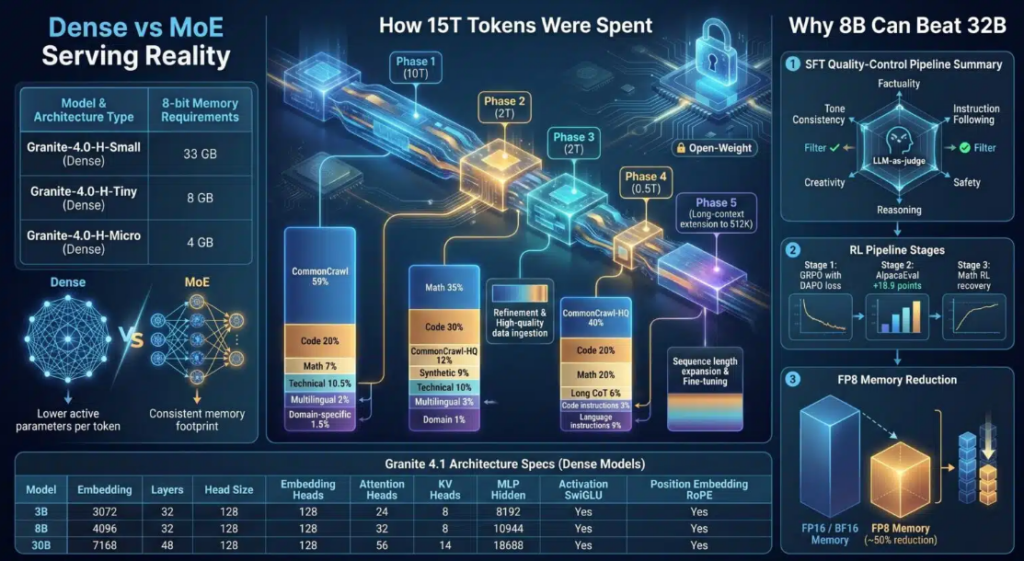
SLMs, including IBM Granite models, are already making an impact.
Global sports institutions use Granite models trained on domain data to enhance fan experiences through AI-generated commentary. Internally, IBM uses Granite models to power AskHR, saving time for both employees and HR professionals.
The smart hybrid approach: small language models and large language models
This doesn’t mean LLMs will disappear. They remain essential for:
- Complex, multi-step reasoning tasks
- Open-ended problem solving
- Large-scale creative projects
The winning strategy combines both approaches: Use SLMs for roughly 70% of routine workloads and reserve LLMs for complex edge cases that truly require their power.
It’s about using the right tool for the job. Instead of “What can the biggest model do?” forward-thinking businesses ask “What’s the smallest model that meets our needs?“
Implementation: Making SLMs work for your enterprise
Identify which tasks truly require LLM capabilities and which are suitable for SLMs. Most routine operations can be handled by smaller models.
Key questions to ask:
- What percentage of your queries are routine vs. complex?
- Do you have data sovereignty requirements?
- What’s your total cost of ownership, including infrastructure and energy?
Design a hybrid architecture
Create systems that route queries intelligently between SLMs and LLMs based on complexity. Think of it as an intelligent traffic management system.
New techniques like InstructLab (introduced by IBM and Red Hat in May 2024) simplify the infusion of enterprise data into LLMs, enabling customization with far less human-generated information and computing resources than traditional retraining.
Focus on cloud data sovereignty requirements
Before deploying, map your data governance requirements:
- Which data must stay within national borders?
- What regulations apply (GDPR, HIPAA, local data localization)?
- Do you need sovereign cloud options?
SLMs enable deployment in sovereign cloud environments that ensure data remains within a country’s borders and complies with local laws.
Measure the total cost of ownership
Factor in not just model costs but infrastructure, maintenance, and energy consumption. The true picture often surprises.
Combining a small Granite model with enterprise data can achieve task-specific performance rivaling larger models at a fraction of the cost. IBM provides intellectual property (IP) indemnity for all Granite models, boosting confidence in merging data with models.
The future of business AI isn’t about the biggest models. It’s about the smartest deployment of right-sized solutions.
SLMs offer compelling advantages:
- Lower costs (10-30x less than LLMs)
- Faster processing (3.5x higher throughput)
- Enhanced privacy through local processing
- Broader deployment options, including edge devices
- Cloud data sovereignty compliance without sacrificing AI capabilities
They’re not a compromise; they’re often the better choice.
Democratizing AI innovation
Businesses that embrace SLM-first strategies will reduce costs while opening entirely new markets. They’ll deliver better user experiences and build more sustainable AI operations.
For small and medium-sized businesses, this is transformational. AI deployment no longer requires million-dollar cloud budgets. State-of-the-art capabilities become accessible to companies of all sizes, democratizing innovation.
The question isn’t whether SLMs will play a role in your AI strategy. It’s how quickly you’ll recognize their potential and act on it.
The NVIDIA Prediction: SLMs as the enterprise backbone
According to NVIDIA researchers, small language models (SLMs), rather than their larger counterparts (LLMs), could become the true backbone of the next generation of intelligent enterprises.
The age of “bigger is better” may be giving way to “smaller is smarter”. With their adaptability and efficiency, SLMs are positioned to drive practical, responsible innovation across industries.
Key takeaways
- Small Language Models (SLMs) deliver powerful AI with fewer parameters, lower costs, and flexible deployment compared to LLMs
- 40-70 percent of LLM queries could be handled by SLMs without a meaningful performance drop
- Cloud data sovereignty regulations are driving 65% of leaders to change cloud strategies
- SLMs cost 10-30 times less than LLMs while delivering 3.5x higher throughput
- Gartner predicts 3x more SLM usage than LLMs by 2027
- Bayer gained +40 percent accuracy with specialized SLMs
- IBM Granite SLMs cost 3-23x less than frontier models while matching or outperforming competitors
The smart money is on small models. The question is: will your business be smart enough to follow?
In brief
Small Language Models (SLMs) are delivering 10-30x lower costs and 3.5x faster throughput for 70% of enterprise workloads, while enabling Cloud data sovereignty by running on-premises to keep data within jurisdictional borders. Bayer gained +40 % accuracy by switching to SLMs, and Gartner predicts 3x more SLM usage than LLMs by 2027, proving the future isn’t “bigger is better”; it’s “smaller is smarter.”