Join a growing network of CTOs and tech leaders receiving bi-weekly briefings that highlight emerging trends, leadership lessons, and innovation opportunities.
A startup CTO’s compensation can vary significantly depending on when they join the company and what the role actually requires. A technical co-founder may accept a modest salary in exchange for substantial ownership. A hired CTO brought in to scale a Series B company may command an executive-level salary with a much smaller equity stake.
That makes “the average CTO salary” a misleading benchmark on its own. Funding stage, company size, location, technical complexity, experience, and founder status can all significantly affect the package.
In 2026, US startup CTO compensation can range from relatively modest founder salaries to more than $350,000 in base pay for senior, later-stage executives. Equity can range from a meaningful founder stake to a fraction of a percent. The important question is not simply how much a CTO earns. It is whether the compensation reflects the role’s risk, scope, and expected impact.
The benchmarks below are primarily US-focused and should be treated as directional ranges rather than fixed market rates.
What does a startup CTO’s compensation package include?
A CTO compensation package normally contains four elements:
Base salary.
Annual or performance bonus.
Equity or stock options.
Benefits and executive perks.
The balance between these components changes as the company grows.
A pre-seed technical co-founder may take a low salary because a substantial ownership stake represents much of the compensation. A hired CTO joining after a significant funding round is more likely to receive a competitive executive salary, performance incentives, and a smaller equity grant.
The distinction matters because a founding CTO and a hired CTO are taking different levels of risk. A founder helps create the company before its value is established. A hired CTO typically joins after the company has funding, customers, employees, intellectual property, and a defined market position.
The role itself also changes with company maturity. Early-stage CTOs are often hands-on, building products and making foundational technology decisions. Later-stage CTOs typically spend more time on organizational design, hiring, budgets, security, infrastructure, board communication, acquisitions, and long-term technology strategy.
What determines startup CTO compensation?
The funding stage is the only variable. CTO compensation also depends on:
Company scale. A CTO responsible for 15 engineers has a different mandate from one overseeing a 300-person engineering organization.
Technical complexity.AI infrastructure, cybersecurity, regulated products, fintech, and other technically demanding businesses may require specialized leadership that commands a premium.
Revenue and runway. Two companies at the same funding stage may have very different abilities to pay cash.
Location. US compensation benchmarks cannot be applied directly to India, the UK, or other markets.
Founder status. A founding CTO’s compensation reflects ownership and risk; a hired CTO’s package reflects executive-market compensation.
Scope of responsibility. A CTO who owns security, infrastructure, data, AI strategy, compliance, and engineering will generally have a different compensation profile from one focused primarily on product engineering.
If the CTO is joining at formation, taking founder-level risk, contributing intellectual property, and helping define the product and company before meaningful funding or traction exists, the negotiation is fundamentally different. Their ownership may be measured in percentage points of founder equity, not the much smaller employee grants typically offered after funding.
Once a company has raised significant capital, established a product, and hired an executive team, the role changes. A hired CTO is usually negotiating an executive compensation package consisting of salary, bonus, and an equity grant rather than founder ownership.
How CTO compensation changes as a startup scale?
The funding stage provides a useful starting point for benchmarking, but it should not be treated as a salary formula. Two companies at the same stage can offer very different packages depending on revenue, runway, location, technical complexity, and the scope of the CTO role.
The following ranges are directional US benchmarks for full-time hired and founding CTO roles, synthesized from current 2026 compensation data and market references. They are not guaranteed averages. Current sources themselves vary substantially by sample and methodology.
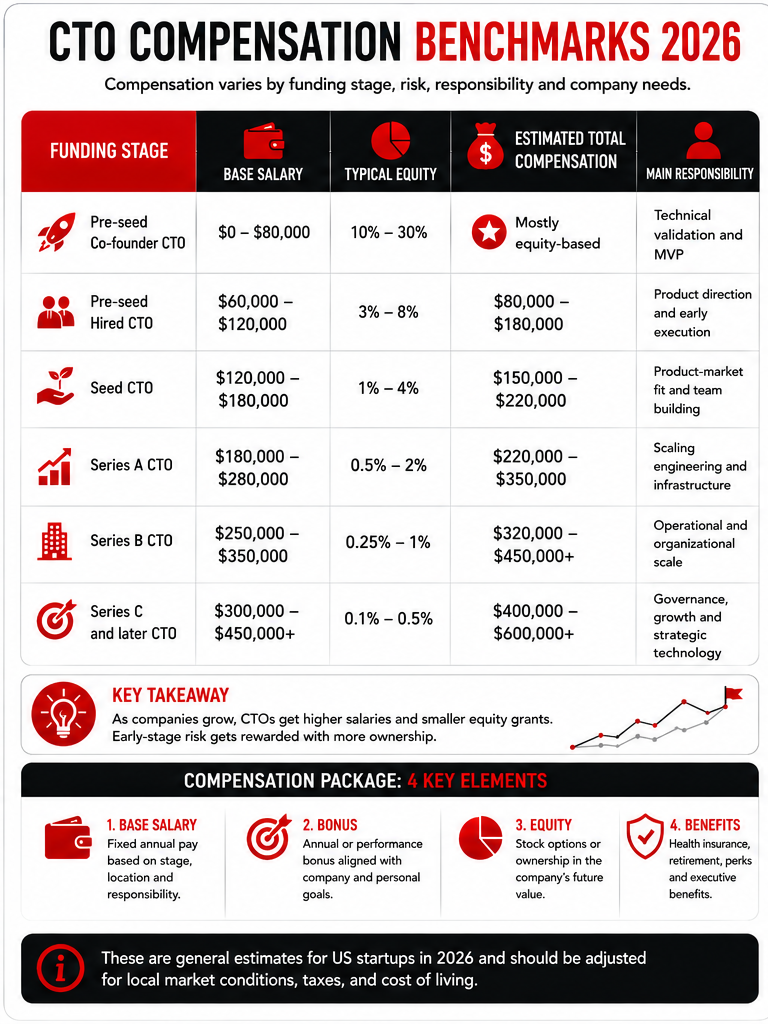
Some 2026 salary guides show seed startup CTO compensation at about $120,000–$180,000, Series A at $180,000–$280,000, and Series B at $250,000–$350,000. Other reports show different numbers because they use different samples by location, company size, and whether they include founder CTOs.
These numbers should be used as references for negotiation, not as guaranteed averages. A CTO leading an AI infrastructure company may command more than a CTO at a small consumer app, even when both businesses have raised the same amount of funding.
Is there an average startup CTO salary in 2026?
There is no single global average CTO salary for 2026. For a non-founder CTO at a US startup, a reasonable estimate is about $150,000–$250,000 in base salary.
But averages can be misleading when you mix companies at different stages. A pre-seed founder might earn $0–$80,000, while a Series C CTO could get over $300,000 in base salary. It’s best to compare companies with similar funding, revenue, team size, location, and technical needs.
What actually determines a startup CTO’s salary?
Funding is only one part of the compensation equation.
Company scale: A CTO managing a five-person engineering team has a different mandate from one overseeing a 200-person organization.
Technical complexity: AI infrastructure, cybersecurity, fintech, healthcare, and other technically demanding businesses may require specialized leadership that commands a premium.
Revenue and runway: Two companies with the same funding can have very different abilities to pay cash depending on revenue, burn rate, and remaining runway.
Location: US salary benchmarks cannot be applied directly to India, the UK, or other markets. Local salary levels, taxes, hiring competition, and cost of living all affect compensation.
Experience: A CTO with a track record of scaling teams, navigating major infrastructure changes, or leading a successful exit may command a different package from a first-time CTO.
Role scope: A CTO responsible for engineering, security, infrastructure, data, AI strategy, and compliance has a broader mandate than one focused primarily on product engineering.
Founder status: Founders generally exchange some cash compensation for ownership and long-term upside. Hired executives typically receive more cash and less equity.
How much equity should a startup CTO get?
Equity compensates CTOs for some of the risks associated with joining an early-stage company. But the appropriate percentage depends heavily on when the CTO joins, what they are expected to build, and whether they are a founder.
Based on CTO Magazine’s analysis of interviews with top technology leaders and our assessment of leading secondary sources, current 2026 benchmarks vary, but several sources put hired CTO grants around 1.5%–3% at the seed stage, falling to roughly 0.3%–1.5% as companies move through Series A and B.
CTO equity compensation gives the technology leader a stake in the company’s future value. This is especially important when the startup cannot offer salaries as high as those of big companies.
Equity is usually given as founder shares, stock options, restricted stock units, or other long-term incentives. The percentage alone does not tell the whole story. A 1 percent grant can be worth very different amounts depending on the company’s value, liquidation rules, future dilution, and chances of a successful exit.
How much equity should a CTO get at the seed stage?
A hired seed-stage CTO may receive approximately 1 percent – 4 percent equity, with around 2 percent – 4percent commonly used as a negotiation reference. A first technical executive joining before or around the seed round may receive 3 percent–8 percent if they accept a below-market salary and take responsibility for building the product and engineering function.
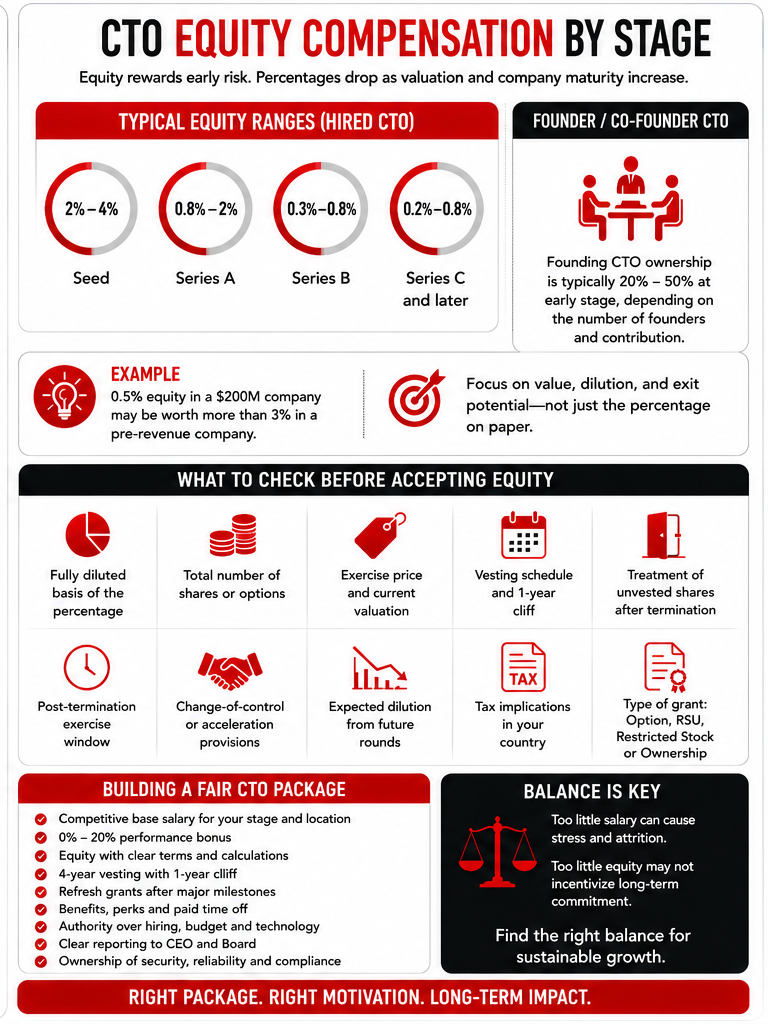
A true technical co-founder is different from a hired CTO. If someone joins before the product exists, takes founder-level risks, adds intellectual property, and helps start the company, their equity should be negotiated as founder equity. Some 2026 benchmarks put founding CTO ownership between 20% and 50% at the early stage, based on Carta’s Founder Ownership Report, which analyzes more than 45,000 startups. The exact figure depends on the number of founders and their contributions.
How CTO equity changes after seed funding
As a company raises more money, the equity percentage usually goes down. This is because the company is worth more and the CTO is taking less early-stage risk.
A broad 2026 reference range is:
Seed hired CTO: 2 percent–4 percent.
Series A CTO: 0.8 percent–2 percent.
Series B CTO: 0.3 percent–0.8 percent.
Series C or later CTO: 0.2 percent–0.8 percent.
These stage-by-stage ranges come from Metamindz’ equity guide, which draws on Index Ventures, TopStartups, and DigitalDefynd. A smaller equity grant can still be valuable if the company’s valuation is high. For example, a 0.5percent grant in a $200 million company may be worth more on paper than a 3 percent grant in a pre-revenue company, though neither outcome is guaranteed.
What to check before accepting equity?
A CTO should ask the company to clarify:
Whether the percentage is calculated on a fully diluted basis.
The total number of shares or options being granted.
The exercise price and current company valuation.
The vesting period and one-year cliff.
The treatment of unvested shares after termination.
The post-termination exercise window.
Change-of-control or acceleration provisions.
Expected dilution from future funding rounds.
Tax consequences in the relevant country.
Whether the grant is an option, RSU, restricted stock, or direct ownership.
A four-year vesting schedule with a one-year cliff is widely used for founders and early employees. Under this structure, 25 percent generally vests after the first year, followed by monthly vesting over the next three years.
How to build a fair CTO compensation package
A good CTO compensation package should match pay to the CTO’s responsibilities and the company’s stage. Founders should first decide what success looks like over the next 12 to 24 months, then set salaries, bonuses, and equity based on those goals:
Base salary aligned with the company’s location and funding.
A 0 percent–20 percent annual performance bonus.
Equity with transparent ownership calculations.
Four-year vesting with a one-year cliff.
Additional refresh grants after major milestones.
Health insurance, retirement benefits, and paid leave.
Authority over engineering hiring and technical budgets.
Clear reporting lines to the CEO and board.
Defined responsibility for security, reliability, and compliance.
When deciding between salary and equity for a CTO, consider the company’s runway. Giving a large equity grant but paying too little salary can cause resentment and make it hard to keep people. On the other hand, offering a high salary with little upside may not attract someone ready to take early-stage risks.
Leaders on LinkedIn make the same point. Tech executive recruiter Mateo Villa warns that boards and the market are “often completely misaligned on compensation,” noting that “equity is the primary hook (1.0%–2.5%) to attract heavy-hitting builders ready to trade short-term cash for long-term upside.”
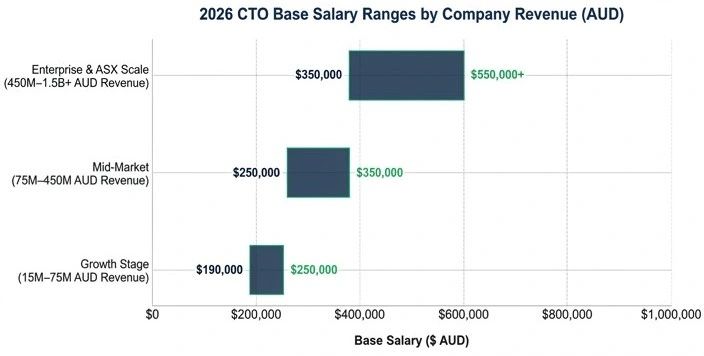
Matro quoted on LinkedIn: “Some insights into the market and what packages incentivize incredible performance according to company revenue: Growth Stage ($15M–$75M): Base of $190K–$250K. Equity is the primary hook (1.0%–2.5%) to attract heavy-hitting builders ready to trade short-term cash for long-term upside. Mid-Market ($75M–$450M): Base of $250K–$350K. Packages balance cash stability, equity, and performance bonuses (25%–45%) to secure strategic scale-up leaders. Enterprise ($450M–$1.5B+): Base of $350K–$550K+. Global transformation leaders push total packages beyond $750K+ through complex short-term incentives, bonuses, and LTIs.
Product advisor Ilia Mikhailov frames the founder-versus-hire split bluntly: a technical co-founder “starts with 50% if nothing is built,” while a hired CTO’s “baseline is 10%.”
Ilia shared that, “How much equity should you get as a CTO in a startup? Here is the best decision tree I’ve seen:
Technical co-founder starts with 50% if nothing is built
There is an MVP (not just wireframes), subtract 10% — Has paying customers, subtract additional 10% — Or, has over 10K users, subtract additional -5%
Non-tech co-founder has valuable connections or experience, -10%
Non-tech cofounder has raised VC before, -10%
Non-tech cofounder had a successful exit before, -10%
Non-tech co-founder invests own money (after hiring a CTO), -5% for every 10K in investment”
He further added, “The baseline is 10%. But your experience counts too.
Scale alters everything. As your organization expands, tech executive compensation must evolve from a straightforward cash/equity mix into a highly diversified incentive structure to attract the talent that moves the needle.
If your business is looking to structure a competitive offer that attracts transformative tech talent, or if you require a confidential market mapping report, please reach out:
The compensation package should be set out in a formal agreement and reviewed by a qualified lawyer and tax adviser. Equity terms can have different legal and tax effects in the US, India, the UK, and other countries.
In brief
There is no single market rate for a startup CTO in 2026. Compensation varies with the company’s stage, role scope, geography, experience, and whether the CTO is a founder or a hired executive.
The most useful benchmark is therefore the entire compensation package, not just base salary. CTOs should evaluate equity terms, dilution, vesting, and potential value alongside cash compensation. Founders, meanwhile, need to balance market competitiveness with the company’s runway and the level of ownership the role warrants.
The right CTO package is not necessarily the highest salary or the largest equity grant. It is the package that properly aligns risk, responsibility, and upside.
Disclaimer: The compensation and equity figures in this article are based on 2026 benchmarks drawn from US-focused startup data, salary guides, and industry reports, and reflect CTO Magazine’s independent analysis of interviews with technology leaders and our assessment of leading secondary sources. They are intended as general reference points, not precise market averages or personalized advice. Actual CTO pay varies widely by funding stage, company size, location, technical scope, and whether the role is a founder or a hired executive. Readers should adjust these ranges for local salary levels, taxes, hiring competition, and cost of living, and consult qualified legal and tax professionals before making compensation or equity decisions.
Rajashree Goswami is a professional technology writer with 13+ years of experience covering AI, cybersecurity, cloud computing, SaaS, fintech, regtech, healthtech, sustainable technology, digital transformation, and enterprise innovation. She also specializes in software and app analysis, emerging technologies, and enterprise technology trends. Her work is grounded in research and in-depth conversations with industry leaders, subject matter experts, and technology practitioners, with a focus on the business impact of technology on innovation, operational efficiency, growth, and ROI.
To provide the best experiences, we use technologies like cookies to store and/or access device information. Consenting to these technologies will allow us to process data such as browsing behavior or unique IDs on this site. Not consenting or withdrawing consent, may adversely affect certain features and functions.
Functional Always active
The technical storage or access is strictly necessary for the legitimate purpose of enabling the use of a specific service explicitly requested by the subscriber or user, or for the sole purpose of carrying out the transmission of a communication over an electronic communications network.
Preferences
The technical storage or access is necessary for the legitimate purpose of storing preferences that are not requested by the subscriber or user.
Statistics
The technical storage or access that is used exclusively for statistical purposes.The technical storage or access that is used exclusively for anonymous statistical purposes. Without a subpoena, voluntary compliance on the part of your Internet Service Provider, or additional records from a third party, information stored or retrieved for this purpose alone cannot usually be used to identify you.
Marketing
The technical storage or access is required to create user profiles to send advertising, or to track the user on a website or across several websites for similar marketing purposes.