

CIOs Are Gaining Strategic Ground, Deloitte Survey Shows
As emerging technologies reshape the corporate landscape, the CIO’s role is undergoing one of its most significant evolutions in decades. Deloitte’s CIO Program has launched the second phase of its Tech Exec Survey, including a pivotal moment in corporate leadership and business impact.
With emerging technologies like GenAI fueling a new wave of business transformation, CIOs are emerging as architects of business strategy. They are taking charge of the P&L, defining growth drivers, and exerting CEO-level influence.
The team surveyed a comprehensive range of C-level technology leaders, including over 600 US CIOs, CTOs, CDAOs, and CISOs.
Technology moves from back office to growth engine: A strategic role comes into focus
The survey includes responses from 622 senior technology leaders across the United States, collected between March 7 and April 1, 2025. Participants were screened for seniority, organization size, and responsibility for setting the strategic direction of technology.
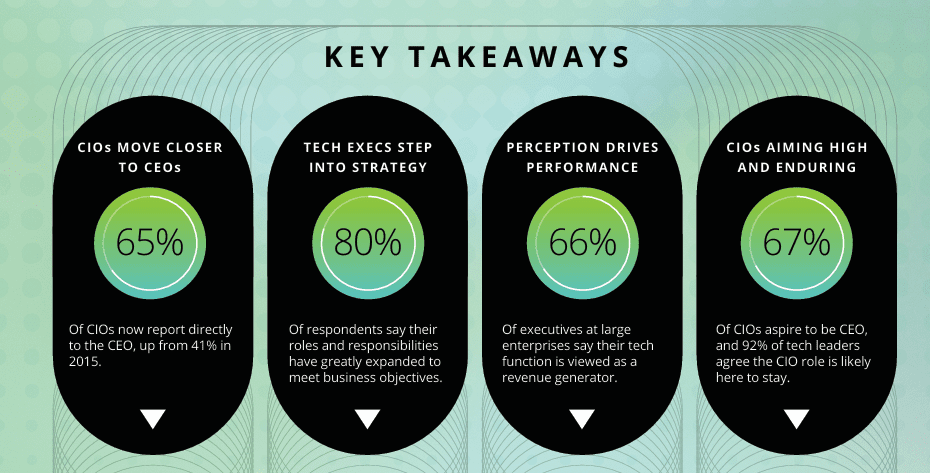
Notably, 80 percent of tech leaders surveyed report that their roles and responsibilities have significantly expanded to meet business objectives. What was once a support function is now, particularly at larger enterprises, as a powerful driver of business value.
At companies with more than $5 billion in revenue, two-thirds of tech leaders say their organizations now see technology as a source of revenue, compared with less than half at mid-sized firms. Where tech is a growth engine, leaders report different priorities: heavier investment in market expansion, deeper focus on customer acquisition, and a more aggressive push to implement GenAI across the enterprise.
“This moment marks the realization of what we’ve long anticipated: the expanded strategic role of CIOs and the broader tech C-suite,” said Lou DiLorenzo Jr. Technology, AI, and Data Strategy Practice leader, Deloitte.
“Today’s technology leaders aren’t just influencing revenue and strategy; they’re redefining leadership itself. CIOs and CTOs should move beyond managing systems as true strategists. They are increasingly becoming architects of business advantage, integrating talent, data, and technology to help drive transformation, fuel sustainable growth, and reimagine how the enterprise competes and endures.”
CIOs move closer to the CEO, and toward the corner office: Reporting lines shift
Perhaps the most revealing shift is in reporting lines. Where tech is a growth engine, leaders run organizations differently.
On how the executive leadership perceives tech function, respondents were almost evenly split. 52% say their tech organization is a revenue generator, and 48% say they’re primarily a service center. Yet, a notable gap emerges when comparing perceptions at larger enterprises ($5B+ in revenue) and mid-sized companies ($1B-$4.9B). Two-thirds of executives at large enterprises view tech as a revenue driver compared to less than half at mid-sized organizations.
This shows in the leader’s priorities and accountability. Here’s how approaches compare, respectively:
- They are more focused on growth, prioritizing expanding into new markets (35 percent vs. 29 percent) and attracting and retaining customers (34 percent vs. 30 percent).
- They are the primary leaders implementing GenAI across the organization (42% vs. 36%).
- They are more likely to report directly to the CEO (49 percent vs. 46 percent) and indicate that their reporting structure significantly aids them in delivering business outcomes through technology (63 percent vs. 59 percent).
- They are more likely to agree that the scope of their current role as a technology leader is clear and well-defined (56 percent vs. 49 percent).
A partnership that signals trust: Broader mandates and integrated teams
As their influence grows, CIOs are also overseeing wider and more integrated organizations.
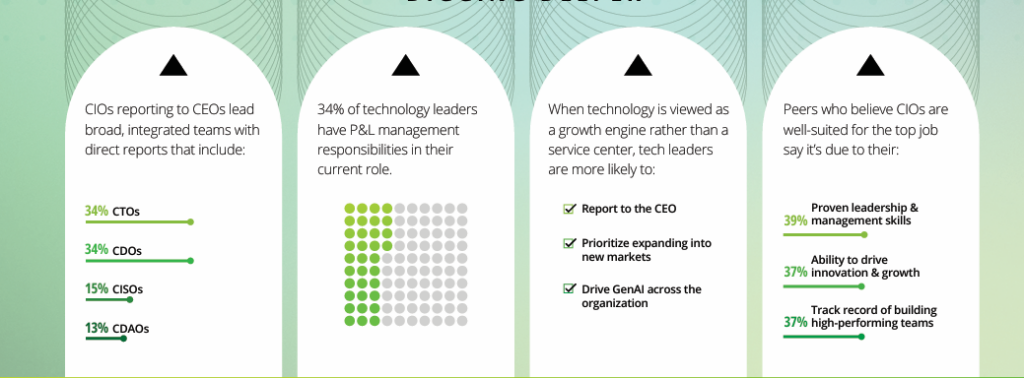
Considering that 36 percent of CIOs now report managing a P&L, and that 67 percent of CIOs say they’d like to pursue a CEO role in the future. Among all tech leaders in the survey, CIOs are the most ambitious. Only 41 percent of CTOs, 42 percent of chief data and analytics officers, and 55 percent of CISOs see the CEO as a future aspiration.
Peers who believe CIOs are well-suited for the top job say it’s due to their:
- Proven leadership and management skills (39 percent)
- Ability to drive innovation and growth (37 percent)
- Track record of building high-performing teams (37 percent)
CIOs’ enterprise-wide remit is also evident through the makeup of their teams. CIOs reporting to the CEO are leading broad, integrated teams with direct reports that include CTOs (34 percent), chief digital officers (34 percent), CISOs (15 percent), and CDAOs (13%).
Despite predictions that the CIO role might fragment or fade, the opposite appears true: 92 percent of tech leaders believe the CIO position will remain essential over the next five years, particularly as enterprises confront cybersecurity threats and accelerate GenAI-led transformation.
“The shift in reporting lines is more than a structural change, it’s a statement of trust,” stated Anjali Shaikh, CIO and CDAO Programs U.S. leader, Deloitte. “Increasingly, CEOs are as invested in the tech agenda as CIOs themselves, a marked shift from the past when technology was seen as a support function rather than a source of competitive advantage. Today, the CEO-CIO partnership is helping shape how organizations grow, innovate, and lead.”
Key takeaways from Deloitte’s Tech Executive survey
- 80% of tech leaders report significantly expanded responsibilities.
- 65% of CIOs now report directly to the CEO.
- 67% of CIOs aspire to be CEO, the highest among tech executives.
- Tech at large enterprises is more likely to be a revenue driver.
- CIOs increasingly lead broad, integrated teams across digital, securit,y and data.
- 92% of tech leaders expect the CIO role to remain essential over the next five years.
A redefined power center in the C-suite
Deloitte’s findings reflect an unmistakable reality. Technology is no longer an enabling function; it is the engine of modern enterprise strategy. CIOs move closer to the CEO and assume responsibilities once reserved for the highest levels of leadership. They are reshaping the balance of power within organizations.
The discussion highlighted both the promise of AI innovation and the widening gap between technological advancements and their real-world adoption. As industries race ahead, the central question remains: are we truly prepared to bridge this divide?
Deloitte: The firm behind the findings
Deloitte provides audit, consulting, tax, and advisory services to many of the world’s most recognized organizations, including nearly 90 percent of the Fortune 500® and more than 8,500 U.S. private companies. Guided by its purpose of making an impact that matters, Deloitte blends deep industry expertise, advanced technologies, and multidisciplinary teams to help organizations confront complex challenges and build long-term resilience.
With member firms in more than 150 countries and territories, a workforce of about 470,000 people, and a history stretching back more than 180 years, Deloitte is part of the world’s largest professional services network.
In brief
Deloitte’s latest Tech Exec Survey finds CIOs moving closer to the CEO seat. It is taking on broader mandates and driving core business strategy. As tech shifts from a support function to a growth engine, the CIO is becoming one of the most influential roles in the modern C-suite.