

Internal Mobility 2.0: The Talent Shift Tech Leaders Can’t Ignore in 2026

In 2026, organizations are rewriting the rules of workforce strategy. After a decade defined by hyper-competition for external talent, rising hiring costs, and persistent skills shortages, leaders are realizing that the next wave of growth won’t come from buying talent, but from building it.
This shift marks the rise of internal mobility 2.0: a system where organizations identify, develop, and redeploy talent in dynamic ways that outperform traditional hiring on cost, performance, and retention.
This isn’t a soft cultural initiative or a “nice-to-have” HR program. It’s becoming a core competitive differentiator, especially for tech companies, federal contractors, and global enterprises that require specialized skills and resilient workforce models.
The data behind the shift: Internal mobility outperforms external hiring
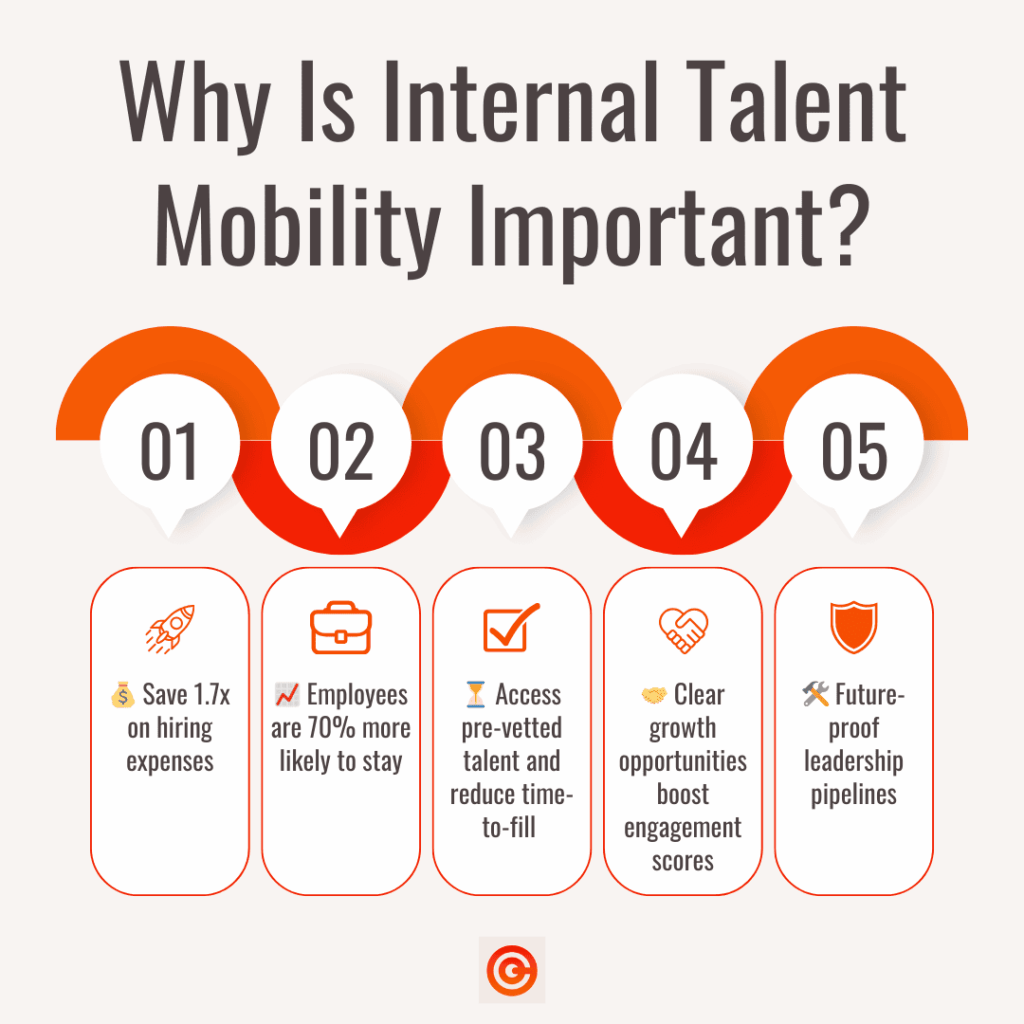
The numbers tell a story a few organizations can afford to ignore. Replacing a professional employee’s costs 50–60 percent of annual salary when you factor in recruiting, onboarding, and productivity loss. Employees at companies with strong internal mobility programs stay 60 percent longer.
Internal hires transition 20–30 percent faster and ramp up more quickly due to institutional knowledge.
Shannon Ogborn of Ashby shared on LinkedIn: “Internal mobility is one of the most overlooked parts of hiring. We talk about it like a retention tool, but the process is often vague, inconsistent, and full of policies that unintentionally block the very people we want to grow.
In the same post, Ogborn also highlighted insights from Kalifa Oliver, Ph.D., Director of Employee Listening Strategy at Ford Motor Company, on what internal mobility looks like when it is done well in practice.
With labor markets tightening and new technologies reshaping roles faster than universities can respond, the trend is only accelerating in 2026. For many industries, external hiring alone is no longer a sustainable talent strategy.
Why 2026 is the inflection point for internal mobility 2.0?
Four forces are converging to make internal mobility a strategic priority — not an optional initiative.
1. Executive priorities have fundamentally shifted
Five years ago, hiring pipelines and compensation battles defined talent strategy. In 2026, leaders are prioritizing:
- retention
- employee engagement
- internal talent development
- succession planning
The message is clear: you can’t hire your way out of skills shortages anymore.
2. Investment in skills-based talent systems is accelerating
Skills-based workforce planning, once an experimental concept, has become mainstream. Organizations adopting skills-first practices in 2024–2025 are entering 2026 with operational internal mobility platforms, competency frameworks, and clearer employee pathways.
These systems give early adopters a measurable competitive advantage in speed, performance, and retention.
3. The rise of the internal talent marketplace
Companies are building platforms that allow employees to:
- explore roles
- view skill requirements
- access internal gigs/projects
- complete skill passports
- find mentors
- pursue cross-functional work
This shift from job-based to skill-based architecture is at the heart of internal mobility.
4. Federal workforce disruption is reshaping cleared talent markets
Tens of thousands of civil servants are retiring or resigning. For government contractors and defense tech companies, the shortage of cleared professionals has become acute. Internal mobility is increasingly the only viable solution to maintain contract performance.
The hidden benefits of internal mobility 2.0: Beyond Retention
While retention is the headline, the downstream effects are even more transformative.
1. Breaking down silos
When people move between teams and programs, they become institutional translators:
- operations → BD
- BD → program management
- engineering → strategy
Cross-pollination increases agility, innovation, and collaboration.
2. Building bench strength
Internal mobility programs develop succession pipelines across critical functions. This reduces:
- operational risk
- client dissatisfaction
- contract performance gaps
3. Strengthening employer brand
Organizations known for promoting from within, attracting better external candidates, especially younger professionals who value growth pathways.
The obstacles in internal mobility and how to overcome them?
Even with technology and strategy in place, Internal Mobility 2.0 fails without cultural alignment.
1. The problem
Managers still block internal moves due to fear of losing good performers. Shift incentives. Managers must be evaluated and rewarded for:
- employee development
- successful internal transitions
- talent pipeline contribution
2. The transparency gap
Employees distrust systems that hide opportunities. Create a clear, open internal talent marketplace where roles, skill requirements, and timelines are visible.
3. The skills development disconnect
Offering opportunities without enabling skill building creates frustration. Link mobility programs directly to:
- targeted learning
- micro-certifications
- project-based experiences
- stretch assignments
This enables a skills-based workforce planning model rather than a reactive hiring model.
What success looks like in 2026 with internal mobility?
Organizations that operationalize internal mobility 2.0 are seeing measurable benefits:
1. Faster time-to-productivity: Internal hires ramp in half the time of external hires.
2. Higher retention among high performers: Employees stay when they can see a future inside the organization.
3. Stronger succession planning: Leaders no longer scramble to find replacements.
4. More attractive employer brand: Top talent gravitates toward companies with clear, equitable promotion pathways.
5. Higher engagement across the workforce: Internal movement signals opportunity, boosting morale and productivity.
The cost of waiting: Organizations that delay internal mobility modernization face:
- rising attrition
- escalating recruiting costs
- weaker succession pipelines
- contract performance risk (for federal contractors)
- shrinking internal skill bases
Meanwhile, early adopters widen their lead through stronger performance, agility, and talent depth.
How to build an internal mobility 2.0 strategy: Three Essential Steps
1. Find hidden talent
Use skills inventories, skill passports, and performance data to identify untapped potential.
2. Build infrastructure for movement
You need:
- an internal mobility platform
- a transparent internal talent marketplace
- clear competency frameworks
- manager incentives for talent development
3. Measure what matters
Track:
- internal mobility rate
- time-to-fill (internal vs external)
- retention after internal movement
- clearance retention (for contractors)
- productivity impacts
Internal mobility 2.0: The shift from talent acquisition to talent cultivation
Internal mobility becomes a strength only when it’s measured with rigor.
In a skills-driven economy, the companies that win aren’t the ones with the biggest recruiting budgets; they’re the ones that know how to develop, move, and retain the talent they already have.
The companies winning in 2026 will be those that stop viewing talent as a fixed asset to be acquired and instead treat it as a renewable capability to be cultivated.
Internal mobility improves retention, reduces hiring costs, accelerates productivity, and builds a resilient skills ecosystem that external hiring can’t match.
But the real differentiator is cultural, organizations that reward managers for developing people, invest in transparent internal marketplaces, and operationalize skills-based pathways will build stronger, more adaptable workforces.
The competition for specialized talent is intensifying. Internal Mobility 2.0 is the disciplined, evidence-backed approach that positions organizations to lead, not chase. The next generation of competitive advantage isn’t about who can recruit faster, it’s about who can redeploy smarter.
In brief
Internal Mobility 2.0 is redefining how organizations compete for talent in 2026, shifting from hiring to developing, from roles to skills, and from static structures to dynamic talent marketplaces. Companies that modernize their internal mobility strategies will gain faster productivity, stronger retention, and a more resilient workforce. Those that don’t fall behind in a skills-driven economy can no longer buy their way through.