

Human Skills That Will Define the AI Era
AI can make specialist knowledge more accessible, but access to information does not automatically translate into sound decisions.
As AI tools lower the barriers to working across fields such as software development, finance, medicine, and law, the ability to connect ideas and ask the right questions could become an important advantage.
For businesses, the challenge is not simply adopting AI, but understanding where it creates value and how people can use it effectively.
Jason Sosa is an AI entrepreneur and emerging technology specialist with more than 20 years of experience building companies and advising leaders. He has founded four technology businesses, three of which were acquired, including computer vision company IMRSV. He is also a four-time TEDx speaker and former Singularity University faculty member.
In this exclusive interview with the CTO Magazine, Sosa discusses why human decision-making remains important as AI tools become more accessible, why organisations struggle to move AI projects beyond the pilot stage, and how a “seed-and-grow” approach can support adoption. He also considers how leaders should make decisions as AI capabilities continue to advance.
As AI makes it easier to work across fields such as coding, finance, and law, what will separate people who use it well from those who simply rely on it?
Jason Sosa: “We’re entering a time where a lot of the language around medical technology, finance, and legal work was a gatekept domain for many years. Those barriers are breaking down. While those words and terms are necessary for using AI, they democratize the entire process. I can use Claude Code and do things without needing to know what these specialized terms mean.”
“But having an understanding of the inner structures of how code, finance or legal work makes them much easier to wield in an AI world. Human judgement is going to be the ultimate win because, while everyone else is racing from zero to intermediate, you’re already there.”
“If you have intermediate knowledge across many domains, you have an advantage in knowing what questions to ask instead of wanting AI to do it all for you. I think we will come to a point when AI will do it all for us.”
“But to direct your own intention, human judgment will rely on your ability to string together those words and understand the relationship between apparently unrelated ideas. This is where human judgement has tremendous importance in the coming world.”
For technology leaders, this distinction matters because making a task easier to perform does not necessarily make the outcome easier to evaluate. An AI system may generate code, analyze financial information, or summarise specialist material, but someone still needs to judge whether its output fits the business problem.
Sosa’s argument also challenges the idea that employees must become specialists in every technology they use. Familiarity with several disciplines can help leaders recognise connections that a narrowly defined technical solution might miss. For a CTO, that could mean understanding enough about finance to assess a proposed investment, enough about operations to identify implementation limitations, and enough about security to question an AI-generated recommendation.
The advantage, then, is not simply knowing how to elicit a model. It is knowing what to ask, which assumptions to test, and when an answer needs closer scrutiny.
Why do AI projects stall after the pilot stage? Many firms can demonstrate what an AI tool does in a controlled trial. Why is turning that early success into concrete business value so much harder?
Jason Sosa: “What causes AI pilots to fail? It isn’t technology. Oftentimes, it’s human.”
“From a small company to a large corporation, there’s a tendency to think you can add a box on the assembly line or sprinkle some AI dust and solve the problem. That’s an unfair way to look at how to apply AI.”
“When you don’t see immediate results, you’re quick to say: “This doesn’t work. The hype is over, and we should go back to using an abacus.” Of course, we’re not going to do that.”
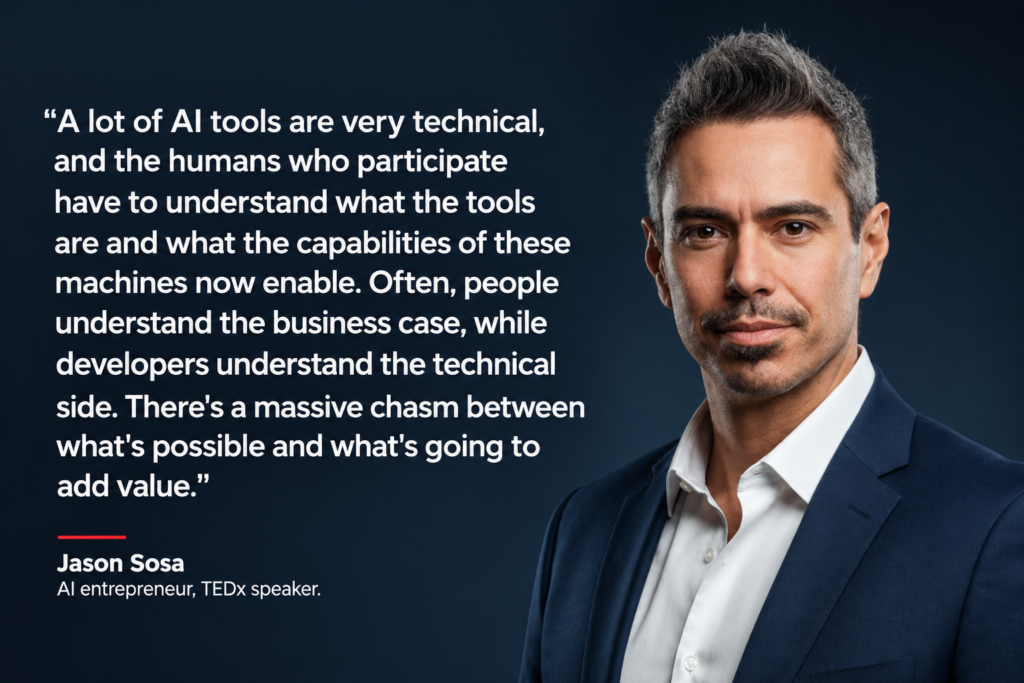
“A lot of AI tools are very technical, and the humans who participate have to understand what the tools are and what the capabilities of these machines now enable. Often, people understand the business case, while developers understand the technical side. There’s a massive chasm between what’s possible and what’s going to add value.”
“There’s also a one-and-done mindset: We did AI last quarter. Let’s move on. It should be more of a seed-and-grow mindset. I think seed and grow is the most effective approach for any organisation that wants to participate.”
“It’s also about how you implement this as an organisational transformation. How do you shift people? That’s always going to be the difficult part of implementing AI in any organization, especially when stockholder interests are moving you in certain directions.”
The gap Sosa describes is familiar to organizations experimenting with generative AI.
A technical team may produce an encouraging prototype, while business stakeholders struggle to see how it fits into an existing workflow. A pilot can demonstrate that a model is capable of completing a task without proving that the wider organization can use the result reliably, securely, or economically.
Moving beyond that stage requires a clearer definition of success. Leaders need to identify the process being improved, establish how performance will be measured, and determine what employees need to change for the solution to work in practice. Data access, integration of existing systems, oversight, and accountability can all affect whether a prospective trial becomes a dependable business capability.
Sosa’s “seed-and-grow” approach gives a different way to think about the process. Instead of treating a pilot as a standalone experiment with a fixed end date, firms can use early results to guide further investment and refinement. This does not mean funding every experiment indefinitely. It means deciding what to scale, what to improve, and what to stop based on evidence.
For CTOs, the organizational challenge is as important as the technical one. AI adoption requires business leaders, developers, and the people who will use the systems to agree on the problem they are trying to solve.
How should leaders plan when AI keeps advancing? When AI capabilities can change significantly within a short period, how can leaders plan ahead without committing to assumptions that may soon become outdated?
Jason Sosa: “Long-term is a relative term in the world of AI. When you look at the world of exponentials, in the next 10 years we have 30 doublings, based on AI doubling in performance about every six months.”
“What that means is that, in the next 10 years, we will see a billionfold improvement in the performance of artificial intelligence. Ten years is a tremendous amount of time in the world of AI. This year, we’re probably going to experience AI improving itself and the beginning of what is called the singularity. We have about a 10-year horizon before these systems are autonomous and moving at a pace and level of knowledge so quick that they outpace our ability to control or corral them. That will be especially true in corporate environments.”
Jason Sosa, AI entrepreneur, TEDx speaker
“This presents a lot of opportunity and risk, with bad actors behind the scenes who don’t wait for approvals or need quarterly budgets. I think we’ll see tremendous value among those who can run fast enough and are brave enough to accept these tools quickly.”
Sosa’s outlook places speed at the centre of the leadership challenge. Yet moving quickly does not require businesses to make every decision on the basis of a single forecast about future AI capabilities. Technology road maps can instead account for uncertainty by setting near-term priorities, reviewing assumptions regularly, and leaving room to change direction as tools develop.
For CTOs, this means distinguishing between decisions that are difficult to reverse and experiments that can be tested with limited exposure. A business might trial an AI tool in a clearly defined workflow while establishing security controls, performance measures, and human monitoring before extending its use to more key operations.
There is also a governance question. As AI tools become more capable, organizations need to know who is accountable for their outputs, what information they can access, and how failures will be identified and addressed. Faster adoption without these safeguards can create dangers that outweigh the benefits.
Sosa emphasises the value of leaders who are prepared to embrace new capabilities. The practical challenge is to combine that willingness with disciplined execution. Organisations need enough flexibility to learn quickly without confusing urgency with a reason to bypass evaluation.
What should audiences learn from from this period of AI-powered change? You describe AI as a period of disruption on an unprecedented scale. What do you hope people take away from that, particularly those who are unsure how to respond?
Jason Sosa: “I wish audiences would take away that this is a time of tremendous disruption and massive change, unlike anything that we’ve seen before. We are going to experience 10,000 years of change over the next hundred years. I hope they leave my speeches understanding that this is a time of opportunity. Tremendous change means opportunity for everybody, and I think we can capitalise on that if we look at it from the right perspective.”
For business leaders, recognizing opportunity is only the starting point. The next step is deciding where AI can address a meaningful business need and giving teams the conditions to explore that potential responsibly. That involves more than purchasing tools or announcing an organisation-wide initiative. It calls for clear priorities, employee participation, continuous assessment, and an openness to adapt when the evidence changes.
Sosa’s wider argument returns to the relationship between technology and people. AI may lower the barriers to specialist knowledge and accelerate the work that individuals and teams can perform. But organisations still need people who can interpret results, connect technical possibilities with corporate aims, and decide what is worth pursuing.
For CTOs, that combination may prove more valuable than the speed of adoption alone. The businesses that make progress will need to learn persistently, judge carefully, and turn experimentation into sustained value.
Explore more exclusive interviews, executive insights, and analysis on AI, technology leadership, digital transformation, and the future of the C-suite from CTO Magazine. Browse all articles →
In brief
- Human decision-making still matters: Cross-disciplinary knowledge helps people ask better questions and direct AI toward useful outcomes.
- AI pilots need more than working technology: Organisations must connect technical capabilities with business priorities and prepare employees for change.
- Adoption needs sustained investment: A “seed-and-grow” approach grants businesses to develop AI capabilities over time rather than treating implementation as a one-off project.
- Leaders face a changing planning horizon: Rapid advances in AI make adaptability, risk management, and timely decisions increasingly important.