

Semantic Layers Explained: Where They Sit Between Iceberg Tables and AI Agents
Agentic AI is shining a spotlight on an area of data architecture that suffers from benign neglect: the semantic layer. Data engineers routinely struggle to get the budget they need for improving the semantic layer because it’s seen as an intangible asset with no direct revenue.
But the semantic layer is most likely to determine whether the output of your AI agents is trustworthy. According to Gartner, neglecting semantics can make AI agents inaccurate and inefficient, exposing organizations to wasted spending and increased data and AI governance vulnerabilities.
An open table format such as Apache Iceberg gives an agent the openness and flexibility it needs to function. A Large Language Model (LLM) gives it reasoning ability. But only the semantic layer gives it an organization-agreed definition of what it’s reasoning about. Getting that layer right now will save you a lot of heartache in the very near future.
Nearly two-thirds of data decision-makers (65%) expect many of their organization’s business processes will be augmented or replaced by agentic AI in the next two years, according to an October 2025 Harvard Business Review study sponsored by Cloudera. Yet 73% say their organization has found it challenging to process and prepare data for AI.
Speaking at the Gartner Data & Analytics Summit in London on May 11, the firm’s Rita Sallam, Distinguished VP Analyst, said:
“Agentic AI outcomes depend on context, including semantic representations of data. Without context: a clear understanding of the specific relationships and rules within an organization’s data, AI agents cannot operate accurately and are far more likely to hallucinate, introduce bias, and produce unreliable results.
Organizations that fail to adopt comprehensive context structures, supported by a robust data layer, will perpetuate data inefficiencies and face heightened financial costs, as well as legal and reputational damage.”
Gartner predicts that by next year, organizations that prioritize semantics in AI-ready data will increase their agentic AI accuracy by up to 80% and reduce costs by up to 60%.
Why does the semantic layer matter for AI agents?
A semantic layer maps physical schema to context, such as metrics, dimensions, entities, and relationships, that are defined once and reused everywhere. It doesn’t move or duplicate data; it defines meaning on top of data.
Agents and chained sub-agents run dynamic, autonomous, high-volume queries. So, an under-specified semantic layer could produce a different definition each time the same question is asked. Here’s why:
- Agents make independent decisions on how to interpret data schemas and join tables on the fly.
- Sub-agents generate new SQL or API queries dynamically without a fixed blueprint.
- Without a centralized semantic layer to lock down metrics and definitions, small context changes alter the output.
- Chained agents pass these shifting definitions to the next step, which multiplies the inconsistency.
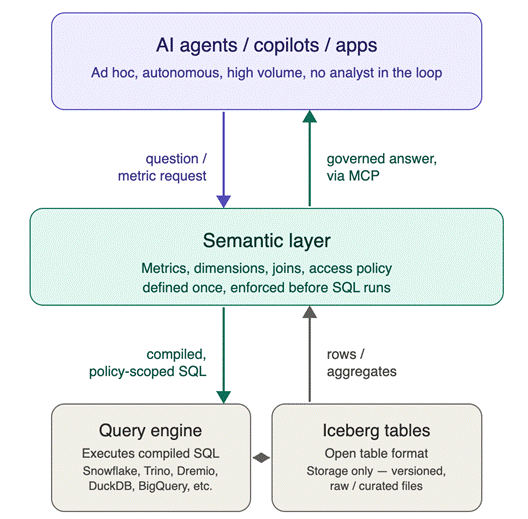
Image created with help from Claude
Iceberg provides table format, schema evolution, time travel, and atomicity, consistency, isolation, and durability (ACID) guarantees on the storage layer. Model Context Protocol (MCP) standardizes how an agent discovers and requests metrics, but says nothing about whether governed metrics exist behind it. A semantic layer enforces one agreed-upon definition for every business metric and provides consistent logic, so agents aren’t guessing column meanings or table relationships. Most importantly, it guarantees the exact same data is returned every time a question is repeated.
How to prepare a semantic layer for AI agents
If you already have a governed metrics layer for business intelligence, the fastest path to agent-readiness is exposing that same layer over MCP, rather than standing up a parallel, agent-specific layer that will drift from the first.
Metrics-layer tooling built to solve business intelligence metric drift can do that job well for agents: define metrics, dimensions, and joins once and expose them over MCP instead of re-deriving them per prompt. But keep in mind that it’s deliberately narrow. For example, it knows what “active_subscription” sums to, but it doesn’t know that “active_subscription,” “renewal_risk,” and “support_ticket” are related concepts an agent might need to reason across.
Semantic meaning, cross-system entity resolution, governance, lineage, and decision memory need to be combined into a single surface an agent can read.
Here are three additional considerations as you prepare a semantic layer for AI agents:
Keep metadata and descriptions clear. Agents rely on rich text metadata to pick the right tools and attributes. Every metric, dimension, table, and join needs explicit, unambiguous natural language descriptions. Use business terms and explicitly state what a metric excludes.
Don’t just expose an open schema. Expose structured, parameterized semantic endpoints. Wrapping common business logic into predefined metric tools reduces the LLM’s search space and minimizes hallucinated joins.
Design for determinism and auditability. The same question must yield the same SQL logic every time an agent asks it. Implement logging within the semantic layer to track generated SQL, cache frequent metric requests, and return line-level lineage metadata so the agent can cite the precise logic used to calculate its answer.
Time to make those budget requests?
If your organization is moving full speed ahead with agentic AI, now’s the time to have that important budget conversation with your boss about upgrading your organization’s semantic layer. It’s the key to enabling your AI agents to perform accurately and efficiently.
In brief
- Agentic AI’s accuracy depends heavily on the semantic layer, the piece often overlooked in favor of storage formats (like Apache Iceberg) and the LLM itself.
- Designing an architecture that supports learning without unnecessary complexity.
- Recruiting the first developers and technical contractors.
- Without a governed semantic layer, agents interpret schemas independently, and chained sub-agents can compound small inconsistencies into major output drift.
- Gartner predicts organizations that prioritize semantics in AI-ready data could see up to 80% higher agentic AI accuracy and 60% lower costs by next year.
- If a BI metrics layer already exists, the fastest path forward is exposing it over MCP rather than building a separate one for agents.
- Key priorities: clear metadata, structured semantic endpoints (not just open schema), and deterministic, auditable query logic.