

PwC’s Global US Alliances Leader Flags the Risks of Adding AI to Broken Workflows
Many organizations are investing billions in AI, yet translating its technological capabilities into measurable business value remains a fundamental challenge. According to PwC’s research, just 20% of companies are capturing 74% of AI’s economic value.
The gap points to a deeper problem. Behind the accelerating investments lie fragmented technology stacks, disconnected data, labour-intensive processes, and operating models that were never designed for intelligent systems. As a result, enterprises stay in a costly illusion of progress: deploying increasingly powerful technology without fixing the business processes that determine whether it delivers value.
For Patrick Pugh, PwC’s Global and US Alliances Leader, closing this gap requires a far more ambitious approach. From reengineering business protocols, rebuilding the connective foundations of enterprise technology, to rethinking how people and AI work together, Pugh challenges leaders to focus on the foundations that determine their impact. His perspective is clear: Stop adding AI in broken workflows – fix the way the enterprise works, or risk using AI to scale its inefficiencies.
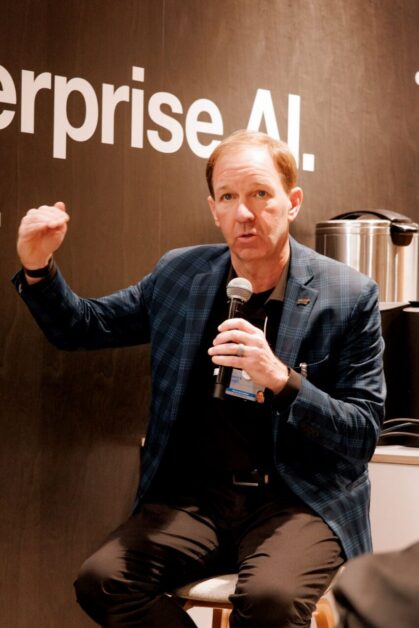
AI in Broken Workflows: Underscores the Need for Business Redesign
Pugh argues that enterprises must move beyond identifying AI use cases to fundamentally redesigning workflows around business outcomes. The real advantage lies in connecting people, processes, data, and technology to turn AI investments into sustained performance.
Are enterprises spending too much time asking, “Where can we use AI?” ? Do they spend enough time asking, “Which business processes should be fundamentally redesigned because AI now exists?”
Pugh: I think that’s exactly the shift enterprises need to make. The first phase of AI adoption was understandably focused on experimentation: Where can we deploy AI? Which use cases can we prove out? Now the bigger opportunity is to step back and ask how AI changes the way the business itself should operate.
AI creates an opportunity to rethink workflows, decision-making, and how people and technology work together, not simply automate individual tasks. That means starting with the business outcome you’re trying to achieve. And then redesigning the process around it and determining what combination of data, technology, AI and human judgment is needed.
That’s a fundamental part of what we mean when we talk about building an Intelligent Enterprise. PwC’s research found that just 20% of companies are capturing 74% of AI’s economic value. The organizations that pull ahead won’t necessarily be the ones deploying the most AI. They’ll be the ones that intentionally redesign how the pieces of their business work together. So that AI can translate into sustained performance.
What lessons from PwC’s work with enterprises have changed your view of what it actually takes to scale AI successfully?
Pugh: One of the biggest lessons is that scaling AI is rarely just a technology challenge. Organizations can have strong models and sophisticated tools and still struggle to translate them into enterprise value if the surrounding business isn’t ready to evolve.
Scaling successfully requires alignment across strategy, technology, data, operations and governance. AI has to connect to the workflows and decisions that actually run the business, with the right data underneath it and clear accountability around how it is used.
We’re also seeing that this requires organizational change. As AI becomes more embedded in how work gets done, companies have to think deliberately about the roles people play alongside AI. They need to consider where human judgment is essential and how the operating model should evolve. The technology matters, but scaling it and capturing value requires the business to evolve alongside it. From the operating model and workforce to leadership alignment and accountability – everything counts.
What is one AI investment you believe enterprises are overestimating today – and one they are underestimating?
Pugh: I think organizations can overestimate the value of adding another standalone AI tool or use case without addressing how it connects to the broader business. A successful pilot can demonstrate what’s possible. But if it remains disconnected from core workflows, data and decision-making, its enterprise impact will always be limited.
What is often underestimated is the investment required in the connective tissue around AI: data, integration, workflow redesign, governance and workforce adoption. Those capabilities may be less visible than the model itself. But they’re what allow AI to move from an interesting experiment into the way the enterprise actually operates.
The real opportunity isn’t simply to have more AI. It’s to build an organization in which AI, people, processes and technology work together as a connected system.
Is the traditional enterprise technology stack becoming a constraint on AI adoption? And if so, what needs to change first?
Pugh: The constraint isn’t necessarily the traditional technology stack itself; it’s often the fragmentation within it. Most large enterprises have made significant investments across cloud, ERP, data platforms, and other technologies. The challenge is that those investments don’t always work together in a way that allows data, insights, and decisions to flow across the enterprise.
AI makes those disconnects much more visible. If the underlying data isn’t accessible and/or trusted, or AI can’t connect into the systems and workflows where decisions actually happen, it becomes difficult to scale beyond individual use cases.
So I don’t think the answer is to rip out the existing stack and start over. It’s to rethink how those investments connect around business processes and outcomes. Getting the data foundation right, improving interoperability and designing AI into the operating environment are critical steps toward making the broader technology estate work harder for the business.
Embedding Governance into AI-Driven Decisions
Addressing AI in broken workflows requires more than process redesign. It calls for clear accountability, continuous monitoring, and appropriate human oversight. Responsible AI controls must be built into the operating model from the outset.
What does effective AI governance look like when AI moves beyond controlled pilots into critical business processes?
Pugh: When AI moves from providing recommendations to influencing or taking actions within critical business processes, organizations need to be very clear about decision rights, guardrails and accountability. Governance has to evolve alongside autonomy.
That includes understanding what decisions an AI system can make, where human judgment needs to remain in the loop, how outcomes are monitored and who is ultimately accountable. Leaders cannot add these controls after deployment. Instead they must build them into the operating model from the start.
Responsible AI remains foundational as adoption scales. The goal isn’t governance for governance’s sake or to stifle innovation. It’s creating the trust and operational discipline organizations need to use increasingly capable AI confidently and at scale.
The CTO’s Expanding Role
AI transformation requires CTOs to look beyond architecture and implementation. Pugh sees technology leaders playing a critical role in aligning business outcomes, operational processes, governance, and the modern workforce.
As AI becomes embedded in critical business functions like ERP, M&A, and finance, how is the CTO’s role changing? Does this shift require CTOs to move beyond technology leadership and take a greater role in business transformation?
Pugh: Absolutely. I think the CTO’s role is expanding. Technology decisions have increasingly become business decisions, and AI accelerates that convergence.
When AI is embedded in ERP, finance, M&A, supply chain, and other core processes, the focus must go beyond architecture and implementation. Technology leaders need to understand the business outcomes the organization wants to achieve. They must also identify how workflows need to change and what those changes mean for data, governance, and the workforce.
That doesn’t mean the CTO owns transformation alone. In fact, the opposite is true. The organizations making the most progress are breaking down the boundaries between technology and the business. The CTO can play a critical role in bringing those pieces together and helping turn technology investment into measurable business outcomes.
AI in Transforming Enterprise Operations and M&A
Pugh discusses how AI can transform complex enterprise operations, from ERP modernization to M&A execution. He also explains how PwC and Palantir are using AI to accelerate transactions, reduce costs, and improve decision-making.
PwC and Palantir are focusing on scaling enterprise AI, M&A execution, and ERP modernization. What makes them particularly well-suited to AI-driven transformation?
Pugh: These are all areas where complexity, data and decision-making intersect, and where even incremental improvements in speed, visibility or execution can create significant business value.
In M&A, for example, integrations and separations involve enormous volumes of information, complex dependencies and decisions that often need to happen very quickly. AI can help teams analyze information faster, identify dependencies, improve visibility and accelerate decision-making. ERP transformations face a different but related challenge: the quality and accessibility of underlying data can have a significant impact on timelines, costs and implementation risk.
Across all three areas, the opportunity is to embed AI into the systems and workflows where the business actually operates. That’s why we’re bringing together Palantir’s AI and data platforms with PwC’s industry, engineering and business transformation experience, to help organizations move from isolated applications of AI toward measurable enterprise outcomes.
Your new AI-native deals IT platform is expected to accelerate transactions by up to 50% and reduce one-time transaction costs by up to 45%. What are the specific bottlenecks in traditional M&A IT execution that enable those gains? What Comes Next for Enterprise AI?
Pugh: Integrations and separations are incredibly complex, and many of the activities involved in executing them have historically been highly manual and resource intensive. Teams have to bring together large amounts of information across different systems, understand dependencies, coordinate decisions across workstreams, and do all of that against an often compressed transaction timeline.
Our AI-native deals IT platform, built on Palantir Foundry and AIP, gives teams greater visibility across the transaction. It also helps them analyze information, identify dependencies, and make faster decisions. By reducing manual effort and giving teams a more connected view of the transaction, we can accelerate execution while allowing people to spend more time on the strategic decisions where their judgment matters most.
Ultimately, speed is only part of the equation. The bigger objective is to help clients reduce execution risk, capture synergies sooner and realize the value of the transaction faster.
What Comes Next for Enterprise AI?
Over the years, success will depend on how well companies integrate AI into core operations and rethink how work gets done. Pugh explains what it will take to AI into lasting business value.
If you look three years ahead, what will separate companies that successfully operationalize AI from those that remain stuck in the pilot phase?
Pugh: The difference will be whether organizations treat AI as a collection of technology investments or as a catalyst to redesign how the enterprise operates. As previously mentioned, PwC’s research shows just 20% of companies are capturing roughly 74% of AI’s economic value.
Companies that successfully capture value from AI will have connected it to their core workflows and decision-making, built the right data foundation underneath it and established the governance and accountability needed to scale responsibly. Those with strong foundations are three times more likely to report meaningful financial returns. They’ll also have redesigned how people and AI work together rather than simply layering AI onto existing processes.
That’s the shift toward an Intelligent Enterprise. The organizations that pull ahead won’t necessarily be those that spend the most on AI. Nearly 9 in 10 operations leaders say their tech investments have fallen short of expectations. The leaders will be the ones that intentionally connect strategy, technology, operations, data and governance around the business outcomes they want to achieve, and build the workforce capabilities needed to sustain that transformation.
Key takeaway:
Organizations must stop adding AI in broken workflows and start by redesigning the work itself.
This requires leaders to look beyond the excitement surrounding new tools and develop a deeper understanding of how work gets done. They must identify where processes break down, where value is created, where waste accumulates, and where AI can responsibly improve outcomes.
The organizations that thrive will not necessarily be those that adopt the most AI tools, but those that rethink how work should be designed and delivered. AI transformation should not be measured by the number of pilots launched, tools purchased, or employees trained to write prompts. It should be measured by tangible improvements in how work gets done: whether processes become clearer, safer, faster, more accountable, more humane, and ultimately, more valuable.
Technology alone cannot repair broken processes. But when applied thoughtfully, it can help managers challenge outdated assumptions, redesign workflows intelligently, and build systems that improve business performance without losing sight of the people behind the work.
The real promise of AI is not more tools. It is better work, better outcomes, and a better way of working.