

What Are Forward Looking AI Firms Doing Differently?
AI has moved beyond experimentation. The companies pulling ahead are not simply adopting more AI tools – they are redesigning how work gets done, how technology is built, and how people and intelligent systems work together.
They are asking tougher questions: Where does work actually slow down? Which processes should be redesigned rather than automated? Where should AI operate autonomously, and where should humans remain firmly in control? And how can organizations continuously improve their AI systems without allowing experimentation to become uncontrolled risk?
For these companies, AI is not another layer added to the business. It is becoming part of how the business operates.
For technology leaders, these principles point to a broader lesson: AI transformation is ultimately a redesign of the enterprise, not an exercise in tool adoption.
The strategies forward-looking AI firms use to turn AI into business value
Here are a few things forward-looking and successful companies are doing differently when it comes to using AI:
Understand how work actually happens
Much of enterprise work remains difficult to see or understand.
A customer-service process may involve dozens of handoffs across email, CRM systems, spreadsheets, internal applications, and meetings. A software release may move between product managers, designers, developers, security teams, testers, and operations. A finance process may depend on approvals and manual checks that are rarely documented as a single workflow.
These processes often contain hidden delays, duplicated effort, unnecessary approvals, and repetitive tasks.
AI can potentially address many of these inefficiencies – but only if organizations first understand where they exist.
This is why forward-looking AI firms begin with workflow visibility. They chart each step, pinpoint where tasks begin, where delays creep in, and what those slowdowns cost.
Instead of asking, “Where can we deploy an AI agent?” they ask:
- What are the individual steps in this process?
- Where do people spend the most time?
- Where do handoffs create delays?
- Which decisions require human judgment?
- Which activities are repetitive and rules-based?
- What information does each step depend on?
- Where can AI improve speed, quality, or decision-making?
This shift is important for tech and business leaders because it changes AI deployment from a technology-led exercise into an engineering and operating-model problem.
AI creates the greatest value when organizations first deconstruct work into measurable activities and then determine where intelligence can change the economics of the process.
For leaders, process mapping may therefore become as important as model selection.
They treat AI as infrastructure, not a feature
Too many companies treat AI like innovation theatre – something to showcase in press releases and investor calls. Forward-looking firms and leaders do it differently: they build AI into core processes and change the way their people work with technology to drive business performance. This changes the conversation from “Where can we add automation?” to “How do we design with AI?” Only then can organizations start compounding returns, speeding up cycles, and uncovering new capabilities at AI pace.
Example of forward looking AI firms
JPMorgan Chase: Building AI Into the Workflow
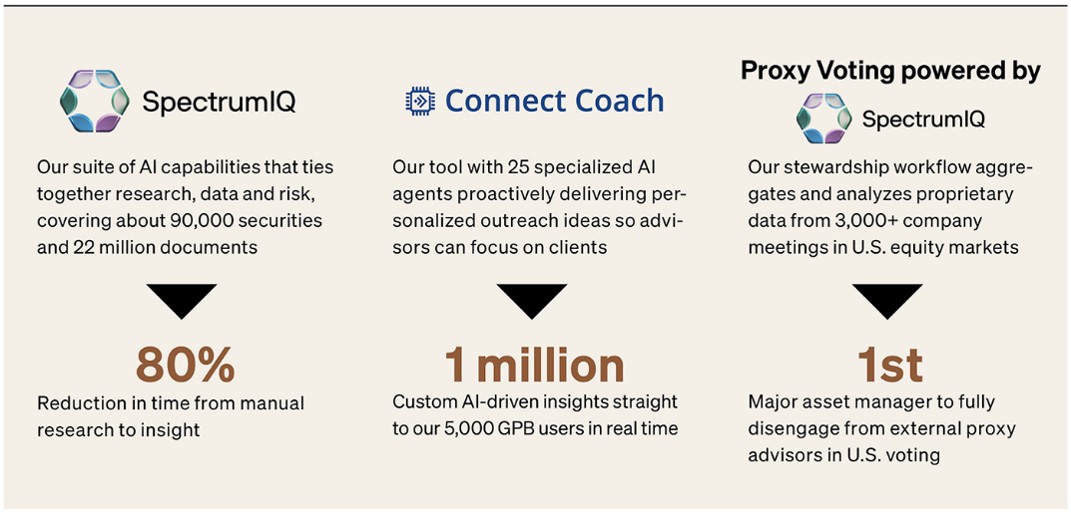
JPMorgan Chase offers a good example of what it means to treat AI as infrastructure rather than a standalone feature. The bank is embedding AI across research, software development, advisor workflows, meeting preparation, client outreach, and decision support. Its SpectrumIQ capability, for example, brings together research, data, and risk information across approximately 90,000 securities and 22 million documents, reducing the time from manual research to insight by 80%, according to the bank. Its Connect Coach uses 25 specialized AI agents to generate personalized outreach ideas for advisors.
The important shift is not the individual AI applications. It is the fact that intelligence is being embedded into multiple stages of the work itself. AI becomes part of the operating infrastructure employees use to research, analyze, prepare, and act.
For leaders, this represents a more mature approach to AI deployment: don’t simply give employees another AI tool; redesign the workflow so intelligence is available where decisions and actions actually happen.
Operate in a state of continuous experimentation
One of the biggest mistakes organizations can make is treating AI transformation as a project with a defined endpoint.
Plan -> Launch -> Implement -> Train the workforce -> Declare success
But in reality, AI systems, models, workflows, and business requirements will continue to evolve. A process that works today may change tomorrow. A new model may make a previous architecture obsolete. An agent that initially assists employees may eventually take responsibility for an entire workflow.
Forward-looking AI firms, therefore, operate in a state of continuous experimentation – where processes are treated as hypotheses and improvements feed the next round of experimentation.
Example of forward looking AI firms
Morgan Stanley aims for continuous experimentation
The financial-services firm built an evaluation framework to test AI use cases before deployment, using real-world scenarios and expert feedback to improve model performance.
Moreover, the evaluation process itself is not static; Morgan Stanley continues to refine its testing as it expands into new use cases, including multilingual translation and meeting summarization.
That is what continuous experimentation looks like at enterprise scale.
For CTOs, the implication is significant: AI evaluation cannot remain a final quality check before production. It needs to become an ongoing engineering discipline.
They build governance into the architecture
Forward-looking firms and leaders understand that responsible AI cannot be bolted on after deployment. It must be engineered into the system from the beginning.
As AI becomes more autonomous, governance can no longer remain a policy document sitting outside the technology stack. It must become part of how systems are engineered.
Organizations need to know what an agent is allowed to do, what information it can access, when human approval is required, how its actions are recorded, and how its behavior can be audited.
This means governance must increasingly be embedded into the technical architecture through identity and access controls, monitoring, evaluation, approval mechanisms, audit trails, and policy enforcement.
Redesign roles instead of simply automating tasks
AI transformation is also workforce transformation.
Consider for example: If AI can prepare research, summarize documents, generate initial analysis, and organize information, the value of a junior employee’s role can shift. So instead of spending most of the day gathering information, that employee can spend more time interpreting results, validating AI outputs, and preparing higher-value work.
Forward-looking AI firms, therefore, work closely with HR, business leaders, and functional executives to determine how roles should evolve alongside technology.
The question is no longer simply, “Which tasks can AI perform?”
It is also:
“What should people do differently once AI performs them?”
That distinction can determine whether AI merely reduces workload or creates entirely new capacity.
They measure business outcomes, not AI adoption
AI usage alone is not proof of transformation.
An organization can have thousands of employees using copilots, dozens of AI pilots running, and hundreds of agents deployed – and still generate little measurable business value.
Forward-looking firms, therefore, connect AI initiatives to business outcomes: shorter cycle times, lower operating costs, faster product development, improved customer experiences, better decision-making, fewer errors, or greater employee capacity.
The distinction is important. The goal is not to maximize the number of AI tools an organization uses. It is to maximize the value the organization creates with AI.
For tech and business leaders, this means moving beyond questions such as “How many people are using AI?” toward more meaningful questions: “Which processes became faster? Which decisions improved? What costs disappeared? What new capabilities became possible?”
That is when AI moves from experimentation to business impact.
In essence: The real AI advantage is organizational
The companies pulling ahead in AI are not necessarily the ones with the biggest models, the largest AI budgets, or the longest list of AI tools. They are the ones willing to rethink how work gets done.
They make invisible workflows visible, treat AI as infrastructure rather than an add-on, experiment continuously, measure business outcomes, redefine roles, and build governance directly into the architecture.
For CTOs, the message is clear: AI transformation cannot remain a technology initiative sitting on the side of the business. It is becoming an operating model transformation.
The organizations that gain a lasting advantage will be those that learn faster than their competitors – not simply by adopting the newest AI capability, but by continuously redesigning their technology, workflows, and workforce around what that capability makes possible.
In brief:
The AI advantage, ultimately, will not belong to the companies that use AI the most. It will belong to the companies that learn how to work differently because of it.
The question shouldn’t be whether AI will reshape how the company operates – it already is. The real question is, whether you will lead your organization to pull ahead or let competitors define what’s possible.