

AI Transformation: Lotte van Uum on Making Change Work
AI adoption in the workplace is about much more than introducing new tools. When everyone has an AI co-pilot, people can work faster and make decisions on their own. The challenge is making sure that speed does not send teams in different directions.
This also changes how organizations think about jobs, teamwork, and accountability. As AI takes on more tasks, leaders have to decide what should be handled by AI, where people should work alongside it, and where human judgment must remain at the center. They also need to make sure that greater efficiency does not come at the cost of creativity, collaboration, or healthy debate.
Lotte van Uum (Chief of Staff, at Miro) shares what it takes to lead AI transformation, why organizations need to move from “single-player” to “multiplayer” AI, and why the human side of leadership becomes more important.
She also offers a candid perspective on growing as a woman leader in a field that is changing faster than anyone can predict.
Leadership when the rules are changing
AI is changing the pace of work, the way teams operate, and even how strategy gets translated into action. Effective leadership now depends on creating the right conditions for people and the management to move quickly in the same direction.
Organizations are navigating AI adoption, changing customer expectations, and new ways of working simultaneously. What does effective leadership look like in this environment – and how is it different from traditional leadership?
Lotte: The pace of change is unprecedented and something none of us has actually led through before. Two years ago, much of what organizations are rebuilding around today didn’t exist.
Previously, traditional leadership was about having the answer and cascading it down through layers. Now everyone has a co-pilot and can move fast in their own direction. So the job shifts to building the shared context and decision rights that keep confident individuals from becoming confident in divergent directions.
The job also used to be “communicate the strategy,” one narrative, cascaded down, everyone executing in the same way. Now every function is rebuilding itself at its own pace and in its own way. The job becomes making sure the organization still recognizes itself through things like enough shared vocabulary and decision rights that it reads as one company, not five different experiments running at once.
While undergoing significant change, how can leaders create sufficient alignment and clarity for teams to move quickly? All without creating unnecessary bureaucracy?
Lotte: Bureaucracy shows up when nobody owns the decision. Likewise clarity disappears the moment there are too many priorities competing for the same attention. The fix is a few clear priorities, each with a named owner, not more process.
When we rolled out Claude to 1,600+ employees at Miro, we shipped before everything was ready and built the human layer alongside it. There were weekly updates on what shipped, office hours, show and tell sessions and functional leaders driving adoption inside their own team’s context along with central enablement. Alignment came from consistency of information, not consistency of approach.
Every function did it differently. AI fluency and adoption look very different in a product organization than in a Go-To-Market organization.
What separates leaders who successfully guide organizations through AI transformation from those who struggle to move beyond pilots and initiatives?
Lotte: Every transformation hits a tipping point. Bottom-up pilots, disconnected initiatives, hackathons, and real enthusiasm. All of it works for a while, then the progress flattens. Not because people stopped trying. But because there’s only so far an individual or team can push before hitting the limits of how the company itself is wired.
Past that point, there are blockers like a workflow that spans three teams with no shared owner, and incentives misaligned with the new way of working or the new roles required. The leaders who get through it recognize the tipping point for what it is and respond by rebuilding the operating model itself: roles, decision rights, processes, the cadences and metrics people are actually rewarded on.
The leaders who struggle mistake the plateau for a motivation problem, because they don’t address how the company is wired, the full context that employees operate in.
From individual productivity to organizational performance
AI can dramatically increase what one person can accomplish. The harder challenge is making sure that individual gains add up to something the organization can see, measure, and build on.
AI can make individuals dramatically more productive, but that does not necessarily translate into better organizational performance. Where does this productivity-to-performance gap come from?
Lotte: The gap between productivity and performance comes from AI making individuals faster without an organizational structure that catches that speed. At Miro, we call this the “single-player” problem: everyone moves quickly in their own context, but nobody has built the shared layer that turns individual speed into a team result.
MIT’s research found the same shape at scale: employees at over 90% of companies already use AI at work, yet 95% of enterprise AI pilots show no measurable financial impact. In other words, individually everyone gets faster, while organizationally most of that speed doesn’t show up anywhere.
Underneath that, a few specific things break: alignment gets harder because everyone produces more without first building shared understanding, faster output is achieved rather than better outcomes because ideas ship before the right people weigh in, and knowledge stops compounding because the prompts and workflows that make one person effective stay with that person instead of becoming something the team can reuse. Additionally, leaders lose visibility into which tools and workflows are actually driving results.
Our CEO once used a great analogy: six people with six AI co-pilots can produce six confident, polished, completely divergent strategies. That’s the gap in one sentence! More output is possible, but without more alignment behind it. Closing it means building “multiplayer AI,” in that people and their agents work from one shared context instead of six separate ones.
Redesigning roles for the human-AI workplace
Organizations cannot simply add AI to existing jobs and expect the operating model to remain unchanged. Leaders have to make deliberate choices about what people own, what AI handles, and where judgment matters most.
As AI takes over more tasks, should leaders rethink how they define roles and responsibilities within teams? What might the organization of the future look like?
Lotte: With AI taking on increasingly more, this is where the operating model point from before actually lands at the individual level. Rebuilding roles isn’t separate from rebuilding decision rights and processes. In fact, it’s the same exercise applied to the smallest unit: what does this specific role do now, and what does AI do instead.
It’s important to treat this as an active decision instead of letting it sort itself out. For every task, determine which of the four modes applies:
- Lead: The task is complex and needs human judgment. The person stays in charge, while AI helps as a copilot.
- Augment: The task is complex, but AI is better at processing information or spotting patterns. AI takes the lead, but a person still oversees the work.
- Automate: The task is simple and does not need much human judgment. AI or automation can handle it on its own.
- Evaluate: The task is simple, but human judgment still has some value. A person should review it instead of automatically handing it over to AI.
Human – AI Collaboration
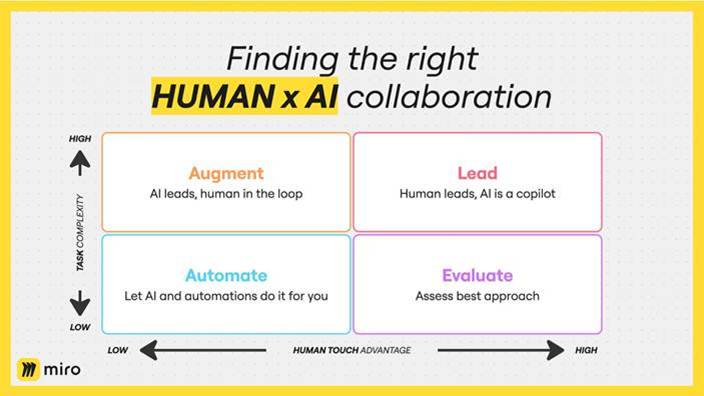
Once you map a role’s tasks that way, the role itself changes shape. The tasks that get automated or handed to AI shrink. What’s left concentrates into judgment calls, like which automated output to trust, when to override it, what to escalate. I’ve felt this in my own role. AI now drafts a lot of what used to require my context, including agendas and comms cascades. That only freed up time because I was deliberate about which parts to hand off and which to keep. Its not because I let it happen by default.
The organization of the future probably has fewer roles built purely around relaying information. Instead, more roles will focus on judgment, knowing where work fits and making sure someone is accountable for the decision.
How should leaders rethink decision-making and accountability when humans and AI increasingly work together?
Lotte: Accountability stays with a named human in every mode of the Lead, Augment, Automate, Evaluate framework. What changes is what that person is accountable for, whether that’s authorship, override or setting the thresholds upfront.
We built AI into our sales tools to assess the health of each deal based on our sales methodology. The AI provides the assessment, but the sales rep remains responsible for deciding what action to take. Nobody gets to say “the model told me to” instead of making the decision.
The real risk is that decision rights are getting fuzzy. Especially with analysis is moving so fast that nobody pauses to ask who’s actually accountable for what it produced. Practically, this means determining the owner for a given piece of work before you automate any part of it. And not after something’s gone wrong and everyone’s pointing at the model.
Building organizations where humans and AI work together
The future of AI-powered work is not about everyone using the same tool. It is about creating shared context so people, teams, and AI systems can work from the same understanding of the business.
AI is changing not just how people work, but how teams collaborate. What does effective human-AI collaboration look like at an organizational level?
Lotte: Effective collaboration comes down to shared context, not solely a shared tool. Most companies get this backwards, picking one AI tool and mandating it. What needs to be consistent is the context everyone’s working from. That’s the real difference between single-player and multiplayer AI.
Single-player is one person’s Claude, another’s ChatGPT, a third’s Cursor, each holding its own memory of the work that dies at the end of that person’s chat window.
Multiplayer is those same tools, whatever they are, reading from and writing back to one shared source of truth. So which tool someone picks stops being the thing that determines whether the team can actually work together. This means connecting data, agents, and tools through open standards like MCP, with context sitting on one open, visual layer everyone can see and point to. Rather than being locked inside any single vendor’s ecosystem. Tools turn over every year or two. If the picture itself lives somewhere open, swapping a tool doesn’t mean rebuilding the whole picture from scratch.
As organizations bring AI into everyday work, how can leaders preserve creativity and collaboration? How can they ensure human judgment remains important rather than focusing only on efficiency?
Lotte: AI can genuinely support creativity, collaboration, and judgment without trading off against efficiency. This only happens if you’ve already decided where it takes the lead, where it’s a copilot, and where a human’s judgment has to stay fully in the room. Skip that step and efficiency wins by default everywhere, including the places it shouldn’t.
There’s a cost to getting this wrong that’s easy to miss because it looks like progress. Dom Katz, who’s on my team and leads Ways of Working at Miro, recently made the point that friction is often what makes collaboration work: the pushback, the competing idea, the person willing to disagree. AI is quietly good at removing exactly that friction, because skipping a hard conversation by asking a chatbot instead feels efficient in the moment. Get the allocation right, protect judgment and creativity where they’re the actual differentiator, and the efficiency gain still shows up. This time it shows up because of good allocation, not as the thing you optimized for directly.
Leadership lessons behind the AI transformation
Technology may be changing rapidly, but leadership is still shaped by experience. The lessons learned under pressure often become the principles leaders rely on when the next wave of change arrives.
What experiences most shaped your leadership philosophy and prepared you for your current role?
Lotte: The volume, more than any single experience, prepared me for where I am at today. At BCG, I worked across several client leadership teams, and for a stretch I was also an internal coach. This meant I sat across from leaders inside BCG itself and watched how they ran teams, made calls under pressure, and handled a room.
Seeing that many leaders up close gave me something theory never could, an actual basis for comparison. I could get specific about which traits and styles genuinely worked, which ones I admired but weren’t mine to copy, and which ones matched strengths I already had and could lean into harder.
The other thing it built was the ability to work well with leadership styles very different from my own, which turned out to be the real job. Stakeholder management is a key part of what I do now. And that only works if you can meet someone across the table on their terms instead of expecting them to operate as you do.
What is one leadership lesson you learned the hard way that continues to influence how you work today?
Lotte: Early in my career at BCG, I ran a case in New York that started right as the pandemic hit. The client was under a lot of stress, and it only compounded from there. It was one of the hardest stretches I’d worked.
The lesson I learned there was about accountability sitting in three directions at once. That is: standing up for your own team when the pressure on them gets unreasonable, managing a client who’s under real stress themselves, and keeping your own leadership informed without letting them get blindsided.
You are doing this all at the same time, with none of those three groups seeing how hard it is with the other two. Nobody teaches you what it actually takes to protect your team from a client’s panic while still delivering what that client needs. You also have to be honest with your own leadership when a case starts going off track, without making it seem like you have lost control.
I learned that accountability and decisiveness are what matter in high-pressure situations. Once you can do that under real pressure, doing it the rest of the time gets a lot easier.
Building the next generation of women tech leaders
Leadership in a technology-driven organization is not about being the person with the deepest technical expertise. It is about staying curious, building strong relationships, and having the confidence to lead even when the answers are still emerging.
What advice would you give to women aspiring to senior leadership roles? Particularly in technology-driven organizations where the pace of change is accelerating?
Lotte: For women looking to grow into senior leadership roles, I recommend building a strong peer network, both inside and outside your company.
Community is where you get real support and real knowledge sharing, not the performance of having it all together. Some of my best thinking partners are from Miro, while others are from outside communities and events. A role like mine benefits from both because it doesn’t come with a built-in peer group.
I also suggest stepping outside of your comfort zone deliberately, especially with the technical parts of a technology-driven organization. I’m not the most technical person in the room when it comes to AI. If I wait until I feel fully ready, I may never take the lead.
The biggest thing I’ve learned over time: everyone is just figuring it out, and most of the time there’s no silver bullet. The senior leaders who look like they have the answer are usually running the same experiment you are, just further along in admitting it.
The future of leadership is still human
Predicting the technology of the next five years may be difficult. But as AI takes on more of the doing, the ability to develop people, navigate ambiguity, and build judgment is likely to become an even bigger part of leadership.
If you look five years ahead, what aspects of leadership do you think will become significantly more important as AI reshapes organizations?
Lotte: Five years is a hard horizon to plan against right now. Look at how much has changed in just the last twelve months. See the models, the cost curves, how fast organizational structures are forming and dissolving around this. I don’t pretend to hold the answers for what’s ahead.
What I am confident about, regardless of the exact timeline, is that the human side of leadership will get more important, not less. As more of the “doing” gets automated, more of a leader’s actual job becomes coaching. That is helping people build judgment, working through ambiguity, and to keep going when the pace doesn’t let up. If I had to bet on one skill mattering more in five years than it does today, it’s the ability to develop people through change you can’t fully predict yourself.
Key takeaway:
AI transformation is not simply about adopting new technology. It is about changing how people work, how teams collaborate, how decisions are made, and how accountability is shared. As Lotte explains, leaders need to find the right balance – using AI where it can add speed and scale while protecting human judgment, creativity, and collaboration where they matter most.
As AI takes on more of the work, leaders will have an even greater role to play in building trust, developing people, creating alignment, and ensuring that individual productivity translates into better organizational performance. The organizations that succeed will not simply be those that use more AI, but those that learn how to work better with it.
The message is simple: AI can accelerate the work, but leadership determines the direction.