

AI Hallucinations in Production: The Enterprise Risk Leaders Can’t Ignore
AI hallucination in production is no longer a quirky model flaw; it is an operational, legal, and brand-risk problem that can affect customer trust, decision quality, and compliance.
For CTOs, the issue is not whether an AI model can sound fluent, but whether it can be trusted under real business pressure.
In enterprise settings, AI hallucination becomes especially dangerous when outputs are used in support, search, analytics, workflow automation, or board-facing summaries.
The cost of being “almost right” can be a support escalation, a bad decision, or a liability claim.
What is AI hallucination?
AI hallucination happens when a model generates content that is plausible but false, unsupported, or fabricated. In large language models, this often appears as invented facts, incorrect citations, wrong policy references, or confident but inaccurate explanations.
The problem is not limited to obvious nonsense; the most dangerous LLM hallucination is often polished, specific, and hard to detect at a glance. That is why many enterprises now treat hallucination as a governance issue rather than a simple accuracy bug.
Why LLMs hallucinate?
LLMs generate responses by predicting likely word sequences, not by verifying truth in the way a human expert would. When prompts are ambiguous, data coverage is weak, or the model is forced to answer beyond its grounding, the system may fill gaps with confident guesswork.
Training data quality, lack of retrieval grounding, and overconfident generation are common drivers of the LLM hallucination problem. In practice, this means the model can be excellent at language and still unreliable at fact production.
Common examples in enterprise use
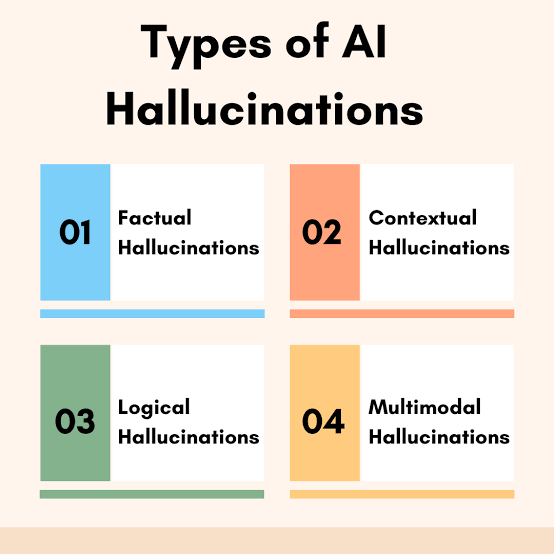
Typical AI hallucination examples include a support bot inventing a refund policy, an internal assistant citing a nonexistent regulation, or a sales copilot summarizing a customer account with wrong details.
Other LLM hallucination examples include fabricated statistics in reports, incorrect code explanations, and false confidence about legal or financial facts. In high-stakes workflows, even a small, hallucinated detail can cascade into bigger operational failures. That is why enterprise teams should never assume a fluent answer is a verified answer.
Where does production risk appear?
AI hallucinations in large language models become most dangerous in production environments where users assume the system is grounded and audited.
A chatbot that gives a wrong answer in a toy demo is inconvenient; the same behavior in customer service, finance, healthcare, or compliance can become a serious event.
The risk is amplified when teams deploy AI quickly without logging, testing, or human review. CTOs need to think in terms of blast radius, not just model quality.
The highest-risk uses are those that influence money, rights, safety, or reputation. These include contract review, policy guidance, medical triage, internal knowledge assistants, and automated response drafting. In each case, the system may sound authoritative while still being wrong. This is why enterprise AI hallucination risks should be mapped by use case, not treated as a single global metric.
People often miss hallucinations because the output is fluent, structured, and emotionally confident. Users also tend to trust AI more when it is embedded inside familiar tools like chat, CRM, or helpdesk software.
If the interface looks official, the answer feels official too. That creates a dangerous trust gap between the model’s language quality and its factual reliability.
Brendan Flynn from Itential shared ” Everyone keeps asking which AI model to trust with their infrastructure, but that’s the wrong question. Teams aren’t failing because the model hallucinated. They’re failing because they asked AI to freeform its way through production without deterministic rails underneath it. At a million operations a day, a 2% failure rate isn’t a rounding error. It’s 20,000 incidents. Per day. That’s not an AI problem. That’s an architecture problem. Governed agentic operations isn’t about slowing AI down – it’s about building the foundation that lets it run at speed without burning down production.”
How to detect hallucinations?
AI hallucination detection should be built into the production lifecycle, not added after a failure.
Good detection combines automated checks, retrieval validation, human review, and monitoring of user feedback. A strong detection strategy looks for unsupported claims, inconsistent answers across prompts, and responses that cannot be traced to approved sources.
For CTOs, this means designing observability for truthfulness, not only uptime and latency.
Detection methods that work
One effective method is grounding every answer in retrieved enterprise content and rejecting responses that cannot cite an approved source.
Another is red-teaming with adversarial prompts to expose failure modes before launch. Cross-model validation can also help when one model reviews another for unsupported claims. In critical workflows, logging prompts, retrieved context, and final outputs create an audit trail that helps teams identify patterns of AI model hallucination issues.resilienceforward+1
Signals to watch
Repeated refusals, overly generic answers, sudden confidence spikes, and invented references are warning signs. So are answers that change materially when the same question is rephrased.
If the model gives precise details without a traceable source, the output deserves scrutiny. A production system should flag those cases automatically and route them for review.
How to reduce hallucinations?
Reducing hallucinations in LLMs requires layered controls rather than one silver bullet. The most reliable approach combines model selection, prompt design, retrieval-augmented generation, and human oversight.
Enterprises should also define what the model is allowed to answer and where it must defer. In other words, the goal is not perfect certainty, but controlled uncertainty.
Practical mitigation framework
- Use grounded retrieval for factual answers, so the model answers from approved sources instead of memory alone.
- Constrain prompts with clear scope, required citations, and refusal rules for unsupported questions.
- Add human review for high-impact outputs such as legal, financial, and customer-facing content.
- Test continuously with adversarial prompts and real enterprise scenarios.
- Monitor errors, retrain where appropriate, and update the knowledge base regularly.
Governance controls that matter
CTOs should define policy for acceptable use, ownership, review thresholds, and escalation paths.
Hallucination risks should sit inside the enterprise risk register alongside security, privacy, and compliance. Teams also need documentation that explains model boundaries in plain language for business users.
Without governance, even a technically strong system can become operationally unsafe.
Justin Mitchell CTO of Armakuni shared on LinkedIn, “Most CTOs see hallucinations as a flaw in the AI model itself. But the truth is, hallucinations become a real problem only when they hit production systems. That’s where integration and governance make or break the outcome. Sure, you can improve prompts, apply model constraints, and use evaluation frameworks. But if you don’t embed checks and guardrails into workflows, a single hallucination can spiral into customer-facing errors, compliance issues, or broken business processes.”
He further added, “We saw this with a global home electronics company. Off-the-shelf Gen AI tools broke down when translating their 60,000+ JSON files. Instead of scrapping the idea, we built a purpose-designed pipeline on AWS, delivering a production-ready prototype in just seven days and later scaling it across formats and languages. This resulted in 80% faster turnaround, 70% lower costs, and hundreds of engineering hours reclaimed. That’s the real takeaway: hallucinations don’t disappear, they’re governed.”
AI hallucination and enterprise liability risks
Enterprise AI hallucination risks go beyond product quality and enter the domain of liability.
If an AI system gives wrong guidance that leads to financial loss, regulatory exposure, or harmful action, the organization may face contractual, reputational, or legal consequences.
Liability becomes sharper when the company markets the system as reliable, but cannot show adequate controls, testing, or oversight. That is why CTOs should treat AI output governance as a core part of risk management, not an optional safety layer.
RackCorp noted on their post, “When AI sounds confident but is wrong, the risk isn’t theoretical. It’s operational. AI hallucinations occur when systems generate fluent, authoritative responses that are factually incorrect. In production environments, these errors can quietly distort decisions, trigger costly rework, and create reputational and compliance exposure before anyone realizes what’s happened. That’s why many organizations are moving away from open, unmanaged deployments and toward private, governed AI environments with clear controls, validation layers, and accountability built in from day one.”
What creates liability exposure?
Exposure rises when AI is used in regulated environments, when outputs are not reviewed, or when the organization cannot prove its guardrails.
Lack of documentation is especially risky because it makes it hard to show due care after an incident.
If the company knows hallucinations are possible but deploys without detection or human review, that can look like negligence in practice. The strongest defense is evidence of testing, logging, escalation, and clear user warnings.
A CTO operating model
The best enterprise response is to manage AI hallucination in production like any other systemic risk: measure it, contain it, and assign ownership.
Start by classifying every AI use case by impact, then decide whether it needs retrieval, review, refusal rules, or complete human approval.
- Build dashboards that show error rates, unsupported-answer rates, and user-reported failures.
- Make sure product, legal, security, and engineering share one governance model instead of working in silos.
- For CTOs, the message is simple: AI hallucination is not a reason to avoid generative AI, but it is a reason to build it properly.
The organizations that win will be the ones that treat truthfulness as a product requirement, not a hope. If the model cannot prove it, the system should not present it as fact.
In brief
AI hallucination in production has shifted from an experimental nuisance to a board-level reliability, governance, and liability issue. For CTOs, the challenge is not simply that models can be wrong, but that they can be wrong in a fluent, authoritative, and operationally persuasive way. In customer support, compliance workflows, internal knowledge systems, and decision-support tools, the cost of an unverified answer can include financial loss, reputational damage, audit findings, and legal exposure.