

Web Scraping in the Age of AI Supercomputing: Competitive Advantage or Governance Risk?
Web scraping has quietly moved from a technical shortcut to a strategic lever. In the race to build better AI systems, it is no longer just about models or computers. It is about access to data.
For CTOs navigating early 2026, this shift is becoming impossible to ignore.
The explosion of AI supercomputing has fundamentally changed the economics of scale. As a result, models can now process vast amounts of training data with unprecedented efficiency. However, the constraint has not disappeared; it has shifted upstream.
Today, high-quality, diverse, and usable data is harder to source than ever. In other words, while compute is no longer the primary bottleneck, data availability and quality have become the defining limitations.
This is where web scraping enters the conversation, not merely as a tool, but as a strategic advantage.
And increasingly, as a risk.
How do AI companies use web scraping for model training?
At its core, modern AI depends on exposure.
Large language models are trained on patterns across massive datasets. Public web content has become one of the most accessible sources of that data. This is why web scraping for AI training has become standard practice across the industry.
Organizations use a combination of proprietary pipelines and third-party web scraping tools to gather:
- Public articles and blogs
- Forums and user-generated content
- Documentation and technical repositories
- Product descriptions and reviews
This data feeds directly into AI model training data pipelines.
Subscribe to our bi-weekly newsletter
Get the latest trends, insights, and strategies delivered straight to your inbox.
At first glance, the logic appears straightforward: the broader the dataset, the more adaptable the model. However, the reality is far more complex. Not all data is equal, and critically, not all data is free to use. As a result, the line between innovation and exposure blurs, raising important questions about ownership, compliance, and risk.
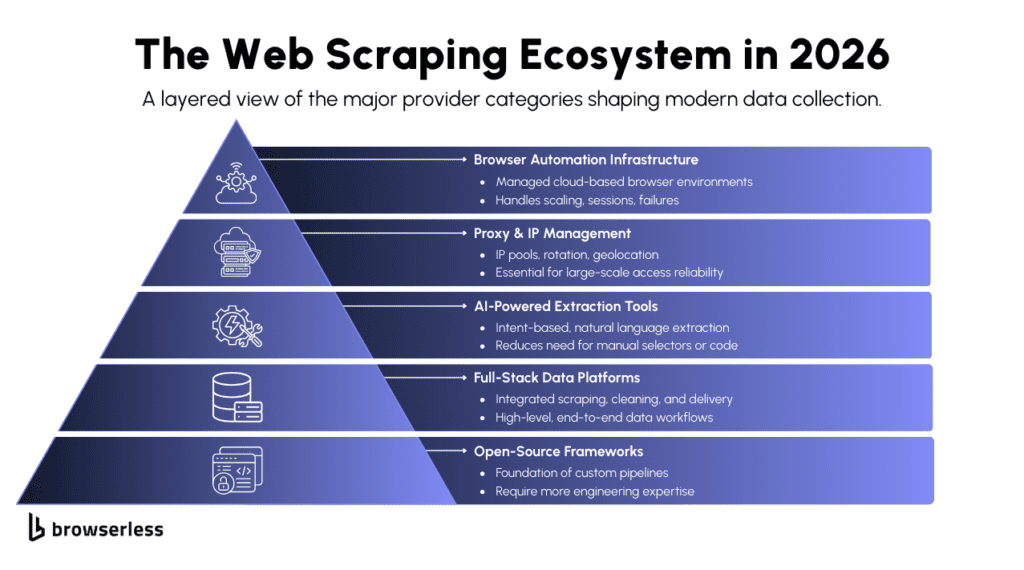
The hidden dependency on AI training data
There is a structural dependency forming across the AI ecosystem.
As compute becomes commoditized through large-scale infrastructure, differentiation is shifting toward AI training data. The companies that control better data will build more capable systems.
This creates pressure.
Teams begin to prioritize volume over provenance. Speed over scrutiny. Coverage over compliance. From a distance, this looks like acceleration. From an enterprise perspective, it introduces fragility.
Because the question is no longer just how data is collected. It is whether that data can be defended.
Is web scraping legal for AI training?
Clarity around legality remains uneven, and that uncertainty is where risk accumulates.
The legality of web scraping depends heavily on jurisdiction and use. Public availability does not automatically imply permission. Regulations governing data scraping laws differ significantly across regions, and enforcement is evolving alongside the technology.
In Europe, for example, GDPR-compliant web scraping imposes strict conditions on the processing of personal data. Even publicly accessible information can fall under regulation if it can be tied to an individual.
For global enterprises, this creates a layered challenge.
Engineering teams may build pipelines assuming accessibility. Legal frameworks may interpret usage differently. That gap is where web scraping legal issues tend to emerge.
The rise of AI compliance as a technical function
Responsibility for compliance is shifting closer to the systems themselves.
What once lived entirely within legal teams is now embedded into architecture and data workflows. AI compliance is becoming a design requirement rather than a post hoc validation step.
Questions that were once peripheral are now central:
- Can data sources be traced and audited
- Are pipelines aligned with AI regulatory compliance expectations
- Do systems support ethical AI data collection practices
Ignoring these questions delays risk. Addressing them early shapes scalability.
Concerns around AI intellectual property risks further complicate the picture. Training models on scraped content without clear usage rights can introduce exposure that extends well beyond technical teams.
Sarah McKenna, from Sequentum shared in of the LinkedIn posts: Can AI alone scrape the high-quality data you need for mission-critical decisions? The short and long answer is no! At Sequentum, we didn’t let ourselves get distracted by the many AI-powered web scrapers that have hit the market over the past couple of years. We took an extremely cautious approach to AI, choosing to carefully integrate it into parts of our platform, to supercharge some steps of the web scraping process. But we never let AI power the entire process. We strategically added AI features, like the AI Magic Wand and AI-generated agents, 𝘰𝘯𝘭𝘺 𝘸𝘩𝘦𝘳𝘦 𝘵𝘩𝘦𝘺 𝘪𝘮𝘱𝘳𝘰𝘷𝘦 𝘰𝘶𝘵𝘤𝘰𝘮𝘦𝘴 𝘸𝘪𝘵𝘩𝘰𝘶𝘵 𝘤𝘰𝘮𝘱𝘳𝘰𝘮𝘪𝘴𝘪𝘯𝘨 𝘥𝘢𝘵𝘢 𝘪𝘯𝘵𝘦𝘨𝘳𝘪𝘵𝘺.
Extracting training data from large language models: A new layer of risk
Attention is also shifting toward what happens after training.
Techniques for extracting training data from large language models are beginning to expose how models may retain and reproduce sensitive information. This introduces a second-order risk that many enterprises have not fully accounted for.
Data risk is no longer limited to ingestion.
It now includes potential inference-time leakage.
Security models built around traditional systems are not always equipped to handle this dynamic. Understanding what a model can reveal is becoming just as important as understanding what it was trained on.
The competitive advantage of web scraping, if done right
Despite the complexity, dismissing web scraping outright would be a strategic misstep.
Organizations that approach it with discipline are finding measurable advantages. Structured data pipelines, clear governance models, and compliant sourcing strategies allow teams to move faster without accumulating hidden risk.
Under these conditions, web scraping supports:
- Faster model iteration
- Domain-specific intelligence
- Reduced reliance on external datasets
The distinction lies in intent.
Ad hoc scraping introduces exposure. Designed systems create leverage.
A CTO’s lens for web scraping strategy
Across many companies, the same challenges keep appearing.
Data collection is not just an early step, not a managed process. As systems grow, this approach stops working. Without clear responsibility for where data originates, accountability can quickly erode. Furthermore, when engineering and legal teams are not aligned, the risk compounds, creating additional operational and compliance challenges. Decisions made without input from both sides often come back during audits or reviews, slowing down progress when it matters most.
A deeper issue sits beneath both of these patterns.
Many organizations have not clearly defined what ‘good data’ means for their needs. Without this clarity, web scraping efforts can become broad but unfocused, raising costs without better results.
This is where data strategy must evolve.
Success is less about collecting lots of data and more about making sure the data fits the intended workflows. Precision is starting to matter more than sheer volume.
Web scraping decision framework for ctos
| Dimension | Low maturity approach | High maturity approach | CTO takeaway |
| Data sourcing | Broad, unfiltered scraping | Targeted, use-case driven collection | Prioritize relevance over volume |
| Compliance | Post-collection review | Embedded AI compliance in pipelines | Shift left on governance |
| Legal alignment | Reactive legal checks | Continuous collaboration with legal teams | Avoid late-stage blockers |
| Data quality | Assumed from scale | Measured and validated continuously | Treat data as a product |
| Ownership | Diffused across teams | Clear accountability for data provenance | Assign responsibility early |
| Risk visibility | Limited | Full traceability and auditability | Build for defensibility |
Where is this heading?
Pressure around web scraping for AI training is unlikely to ease. If anything, it will intensify as AI systems become more embedded in enterprise operations.
Regulatory scrutiny is already expanding, and AI regulatory compliance frameworks are evolving in parallel with technological capability. Organizations that treat compliance as an afterthought will find themselves constrained, not just legally but operationally.
At the same time, the economics of data are shifting.
Freely accessible data is becoming contested. Content owners are beginning to assert control, introducing licensing models and access restrictions. This shift will gradually reshape how organizations source AI model training data.
Enterprises will face a strategic choice.
Continue relying on broad, uncontrolled web scraping, accepting higher risk exposure. Or transition toward curated, licensed, and internally generated datasets with stronger governance
The second path is slower in the short term, but more defensible over time. Another shift will come from architecture.
Expect AI compliance capabilities to move directly into data pipelines. Traceability, auditability, and policy enforcement will become embedded features rather than external checks. Finally, the role of leadership will evolve.
CTOs will not just oversee infrastructure and systems. They will define the boundaries of acceptable data use. Decisions around ethical ai data collection and AI intellectual property risks will increasingly sit at the executive level. In that context, web scraping stops being a technical choice. It becomes a strategic position.
Risk vs advantage in web scraping for AI
| Factor | Competitive advantage | Legal / operational risk |
| Speed of data acquisition | Faster model development cycles | Higher exposure to web scraping legal issues |
| Dataset scale | Broader model generalization | Increased noise and compliance gaps |
| Cost efficiency | Reduced dependency on paid datasets | Potential IP disputes and penalties |
| Flexibility | Rapid experimentation | Lack of auditability |
| Innovation | Enables domain-specific AI | Legal/operational risk |
In brief
Web scraping now sits at the intersection of capability and constraint
It provides data for AI training and accelerates development. At the same time, it introduces legal complexities and makes compliance more challenging. Moreover, while it enables scale, it also raises significant intellectual property risks. For CTOs, therefore, the decision is not simply whether to use web scraping. Rather, the real question is whether the organization can govern it, justify it, and sustain it over time.
Ultimately, in the era of AI supercomputing, data is no longer just an input—it is a governed asset. It is a decision with long-term consequences