

Maarten Verschuere on Why AI Adoption Will Fail Without Workforce Readiness
AI is now easier to use than ever. Tools like enterprise copilots, generative AI, and automation are showing up in every department. Still, many organizations find it hard to turn these investments into real business value. The problem usually isn’t the technology. It’s whether people trust it, understand it, and know when to use it.
Adopting AI is becoming more of a people issue than a software issue. Employees worry about losing their jobs, leaders are unsure about big decisions, and cybersecurity teams are still dealing with breaches caused by human mistakes instead of faulty systems.
To get a better understanding of how it’s affecting the industry, CTO Magazine sat with Maarten Verschuere, an AI researcher, entrepreneur, creator of AI Navigator Framework and author of the AI Will Replace You: A Framework for Leaders in Times of Agentic AI. He talks about why people are still the weakest link in cybersecurity, why HR should lead AI transformation, and how leaders can help employees feel confident about using AI.
Why the human firewall remains cybersecurity’s weakest link?
Companies continue investing in stronger security infrastructure, but many breaches still begin with ordinary workplace behavior. Phishing emails, unsafe downloads, and the growing use of unapproved AI tools have shifted cybersecurity from being purely a technical discipline to a human one. Verschuere believes organizations have underestimated how cognitive overload influences security decisions.
Why do organizations continue to underestimate human behavior despite investing heavily in technical cyber defenses?
Maarten Verschuere: “The human firewall is the missing link in cyber security because we are excellent at building technology that is 100% accurate. You can set up systems that cannot be penetrated from outside. You can have perfect security processes and protocols that are technically perfect.”
“But when you have a human in an organization who opens emails, clicks on links they receive, and tries new tools without thinking about security, it is very easy to have a breach and threaten your entire organization. The human firewall is the last link. It can be the weakest or strongest link in your cyber security. If people are not aware of the risks or how risky certain tools and technologies can be, they will use them naively and let intruders in.”
“I have been doing research at VIVES University of Applied Sciences on this topic. We see that certain people are more prone to being attacked by phishing or falling into phishing traps. Those people have a higher cognitive load. The busier you are and the more things you have in your calendar, the more likely you are to do whatever an email says.”
“It is an important topic that is underappreciated in companies today. We talk a lot about technology and less about the people in the organization. I think the human firewall will be an important aspect of cyber security in the years Cybersecurity talks usually start with topics like zero trust, endpoint protection, and identity management.”
Why AI adoption belongs in HR before IT?
Many companies start their AI projects in the IT department because that’s where the technology comes from. But Verschuere says real success with AI at work starts elsewhere. Employees need to feel confident, understand AI, and see how it can help them do their jobs better, not just replace them, before they can use it well.
Why should workforce AI adoption be treated as an HR responsibility rather than an IT project?
Maarten Verschuere: “It is about preparing your people to create their perspective on AI and technology. Today, there is anxiety: “AI will replace me”, “I am too old to learn new things”, “I am too young”. “I do not know the business yet”. “How can I use these tools? What will my role be if these tools can do my job?”
“In the AI transformation, HR has a key role because they are in touch with people and can transform AI anxiety into a feeling of opportunity. When people understand how AI works, they can see it as a superpower. Because they are experts in their jobs, they know exactly how AI can help them achieve more.”
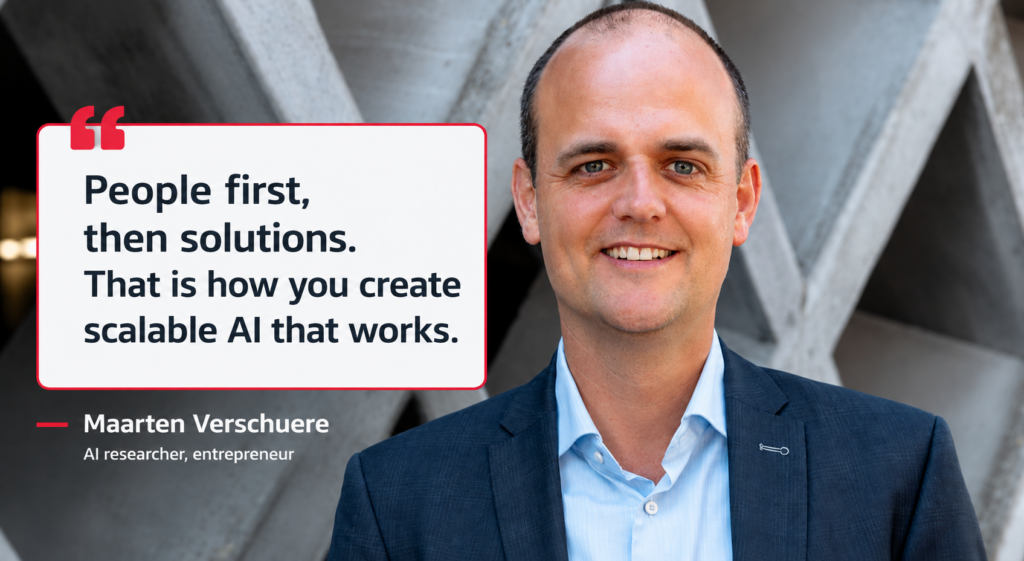
Maarten Verschuere, AI researcher, entrepreneur, creator of AI Navigator Framework
“HR has a key role in creating this awareness, training people, and increasing overall AI literacy. The humans in the business can help the business use AI as a source of scalable value for the future. In the first place, AI is an HR challenge, not an IT challenge.”
This difference matters. Teaching employees about AI isn’t just about writing prompts. It’s about helping experienced staff see where AI can improve decisions, boost productivity, and add value for customers. Companies that treat AI adoption as a people skill, not just a software rollout, are more likely to see lasting results across teams.
From AI experimentation to scalable business value
Most companies have tried out AI, but not many have managed to use it across the whole organization. Verschuere says the problem is often the order of steps. Leaders often announce big AI plans before employees feel ready or confident enough to use the technology in real ways.
Should organizations follow to move from AI experimentation to scalable business value?
Maarten Verschuere: “You have to get through the experimental phase first. You cannot say: ‘We are the leadership team, and we have decided that tomorrow we are going to start using AI at scale from the start. That is a difficult approach because people need to get into using AI and understand what the future will look like before they feel comfortable working and achieving the mission of the company.”
“How do you scale? As I explain in my AI Navigator framework, you first inspire, then enable, and then scale. It is about taking your people on a journey with a clear mission of creating value for the business, its people, and its customers. Start with simple things: increase their knowledge about how AI will help them and get them enthusiastic. By getting people on board, the solutions will follow. People first, then solutions. That is how you create scalable AI that works.”
The AI Navigator framework starts with inspiration, not just rolling out new tools. Instead of pushing everyone to use AI by mandate, Verschuere suggests building interest through curiosity, learning, and small wins. For CTOs, making AI work at scale is more about building confidence among employees than adding more technology.
The leadership mindset that turns AI anxiety into confident adoption
Many discussions about AI focus on employee anxiety, but Verschuere thinks leaders often miss their own doubts. When executives hesitate, it can affect the company culture and make people feel that curiosity is risky. For AI adoption to last, leaders need to set the right example before expecting employees to follow.
Maarten Verschuere: “Leaders first need to let go of their anxiety. It is easy to say that employees are afraid AI will take their jobs. There is a lot of anxiety among leaders as well. They are afraid of making the wrong decisions and investing in something when they are not yet sure what will come out. Leaders have a crucial role in this transformation. What happens in the world and within their company over the next five to 10 years will depend on the decisions they make today.
“The mindset should be: ‘We see the opportunity, we will embrace it, and we are confident that we have the right mission and vision for our company.’ Once leaders let go of that anxiety, they can transfer that mindset to their employees. Soft skills are critical in creating the right culture. It must be acceptable to fail in small experiments, ask questions, doubt yourself, express that you do not know everything yet, and create a common language before moving forward. The key mindset is to embrace AI as an opportunity and be people centric.”
What stands out is how much he values psychological safety over having all the technical answers. Leaders don’t need to know everything before starting with AI. They need to create a culture where it’s okay to experiment, ask questions, and learn. This approach helps employees feel ready to work with AI because uncertainty is seen as normal, not as a problem.
Why every AI keynote should end with action?
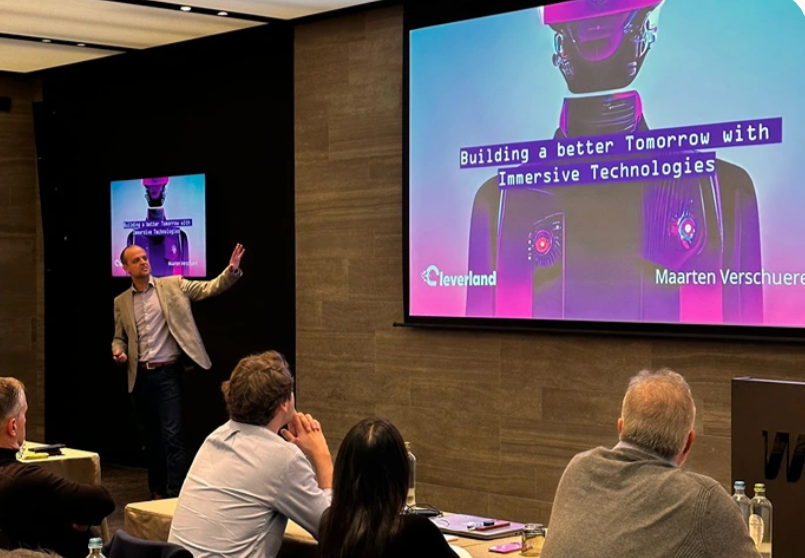
For Verschuere, a good AI keynote isn’t about applause or showing off technical skills. It’s about whether people leave ready to make a change in their own work. In his workshops, he helps people see what’s real and what’s hype, then asks them to pick one practical thing to try next.
How do you ensure a keynote moves an audience from understanding AI to acting on it?
Maarten Verschuere: “I have a clear target for my keynotes: to inspire and activate. I want to show people what is happening worldwide with AI, including what is hype and what is reality. I have always worked in companies that were interested in the business results as well as the technology itself. Also, I always focus on where the money and business value are.”
“In my keynotes and workshops, which last between 30 minutes and two hours, I take the audience on a journey. They learn what is hype and what is reality. We then examine what is happening in their sector and in comparable companies: what they are doing, where they are failing, and where they are succeeding with AI. I then ask: What are you going to do when you leave this session? What are you going to do with the new inspiration and knowledge you have gained?”
“My objective is for them to want to try something, do something, and make it happen. The anxiety is gone, and they want to embrace the opportunity that AI offers.”
His approach shows a bigger lesson for companies using AI: just knowing about AI isn’t enough to change how people work. Real value comes when employees feel confident to try new things, understand where AI can help, and have the support they need to put what they learn into practice.
Browse all articles →
People, not platforms, will determine AI adoption
The conversation keeps coming back to one main point: technology can be very advanced, but organizations may still not be ready to use it well. No matter if the issue is cybersecurity, workforce readiness, or AI transformation, Verschuere believes people’s behavior is what really makes the difference.
He isn’t saying companies should spend less on AI. Instead, they should invest just as much in teaching people about AI, building a strong leadership culture, and boosting employee confidence. That’s how AI can move from small trials to something that really adds value across the business.
From AI research to business strategy
Nearly 20 years in AI, data, analytics, and enterprise innovation, Maarten Verschuere has spent his career helping organizations turn business uncertainty into scalable AI opportunity. His work sits at the intersection of enterprise AI strategy, workforce readiness, and human-AI collaboration.
Before moving into academia, Verschuere worked with global brands including Tesco, Carrefour, and Procter & Gamble, applying data, analytics, and AI to solve complex business challenges. He later founded the conversational AI company Clever, which was acquired by Zoovu in 2019.
Today, he leads the AWARE cybersecurity research programme at VIVES University of Applied Sciences, where his research focuses on strengthening the human firewall by aligning leadership, employee behavior, and AI literacy. As the creator of the AI Navigator Framework, he also advises organizations on moving from AI experimentation to enterprise-wide adoption through practical, people-centric AI strategy.
In brief
- AI adoption succeeds when organizations prepare people before scaling technology.
- The human firewall remains one of the biggest cybersecurity vulnerabilities because cognitive overload influences employee behavior.
- HR has a strategic role in improving AI literacy and reducing workforce anxiety.
- Verschuere’s AI Navigator framework follows three stages: inspire, enable, then scale.
- Leaders must create psychological safety before expecting enterprise-wide AI adoption.