
AI in Manufacturing: Why Manufacturers Are Betting Future on AI

Today, AI in manufacturing is moving beyond pilot programs and becoming part of everyday industrial operations. Manufacturers are using AI to improve production planning, monitor equipment health, detect defects, optimize inventory, reduce energy consumption, and coordinate increasingly complex supply chains.
The shift is being driven by growing operational pressure across the industry. Rising costs, supply chain instability, labor shortages, and tighter delivery expectations are forcing manufacturers to rethink how factories operate and make decisions in real time. Many traditional systems were not designed to handle this level of complexity.
As a result, manufacturers are accelerating AI investments across both factory floors and enterprise operations. The bigger shift, though, is happening inside the factory operations.
Why are manufacturers moving faster with AI in manufacturing?
Factory operations have changed significantly over the last decade.
Production environments are now connected to global supplier networks, digital procurement systems, automated logistics, and customer demand signals that are constantly shifting. A delay in one area can affect scheduling, inventory, and delivery timelines across multiple locations almost immediately.
Many manufacturers discovered that traditional reporting systems were simply too slow for that kind of environment.
This is where AI is starting to make a difference in manufacturing.
Instead of waiting for weekly reviews, companies can now monitor production continuously and respond quickly to issues as they arise. Leaders want quicker insights into equipment performance, inventory, bottlenecks, supplier risks, and quality issues, without relying only on manual reports.
The main benefit is not just automation, but also better visibility.
Most AI projects still struggle with poor operational data
One of the less talked-about issues with industrial AI is that many factories still use disconnected systems.
Maintenance logs may sit on one platform, while inventory records live elsewhere. Production data may be stored separately from supplier information or quality reports.
That fragmentation creates problems for AI systems.
Even advanced software struggles when operational data is inconsistent or incomplete.
This is why many companies now spend more time fixing data quality and system integration before expanding AI initiatives further.
For manufacturers, the hard part is often not the AI itself. It is organizing operations well enough for AI systems to understand what is happening inside the business.
That is becoming a major focus area across AI in Industry 4.0 initiatives.
AI in manufacturing adoption continues to grow globally
Manufacturing companies are adopting AI at very different speeds, but the overall direction is clear.
| Manufacturing AI trends | Industry figures |
|---|---|
| Global market size by 2030 | $155+ billion |
| Expected CAGR | 35%+ |
| Manufacturers using AI in at least one function | 63% |
| Organizations viewing AI positively | 94% |
| Germany’s adoption rate | 54% |
The automotive, heavy machinery, electronics, and industrial equipment sectors remain among the most active adopters because operational efficiency directly affects margins in those industries.
Predictive maintenance became one of the first clear wins
Among all current manufacturing AI use cases, maintenance monitoring is probably the easiest to explain operationally.
Factories lose significant money when machines fail unexpectedly. Production stops, schedules get delayed, and repair costs increase quickly.
Traditional maintenance approaches were usually reactive or calendar-based. Equipment either ran until failure or got serviced on fixed schedules regardless of actual condition.
That approach creates waste.
This is where predictive maintenance AI began to gain attention.
AI systems continuously monitor machine conditions using sensors that track temperature, vibration, pressure, and operating patterns. When the system notices unusual behavior, maintenance teams receive alerts earlier.
That allows factories to address problems before breakdowns happen. The results can be meaningful.
| Predictive maintenance impact | Typical outcome |
|---|---|
| Lower maintenance costs | Up to 30% |
| Less unplanned downtime | Up to 45% |
| Faster issue detection | Significant improvement |
| Better equipment lifespan | Long-term benefit |
For production-heavy industries, preventing downtime often creates immediate operational value.
AI in smart factory environments is improving quality checks
Another area changing quickly is factory inspection.
Manual quality control still matters, but human inspection becomes difficult at high production speeds. Fatigue and inconsistency affect results over time.
This is why AI in smart factory environments is increasingly using computer vision systems for inspection tasks.
Cameras combined with AI models can monitor production lines continuously and identify:
- Surface defects
- Missing components
- Packaging problems
- Alignment issues
- Structural inconsistencies
The biggest advantage is consistency.
AI systems do not get distracted during long production cycles, and they can process thousands of visual checks much faster than manual inspection alone.
Manufacturers are also using this data to understand why defects happen repeatedly, not just where they occur.
AI in industrial automation is becoming more flexible
Older automation systems were usually rigid. Machines followed predefined instructions repeatedly, but adapting those workflows often required significant reprogramming.
Modern AI in industrial automation environments is becoming more adaptive.
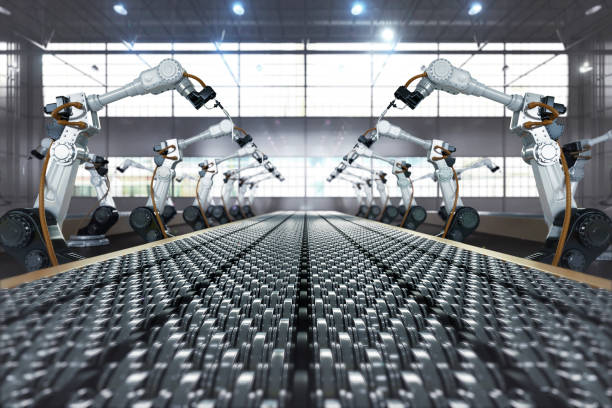
Factories are increasingly deploying collaborative robots that work alongside employees rather than replacing them completely. These systems help with repetitive assembly work, packaging operations, material movement, and precision positioning tasks.
The goal is usually not full automation.
Instead, manufacturers are combining human oversight with AI-powered automation in factory operations to improve consistency while reducing physical strain on workers. That balance tends to work better operationally than trying to automate everything at once.
Machine learning in manufacturing is helping supply chains react faster
Supply chain instability has forced manufacturers to rethink operational planning.
Many factories struggled over the last few years with delayed shipments, material shortages, and unpredictable transportation timelines.
This is one area where machine learning in manufacturing is proving useful.
AI systems can analyze inventory movement, supplier performance, transportation delays, and production demand simultaneously. That allows manufacturers to adjust procurement and production plans more quickly.
The systems are not perfect, but they help reduce reaction time.
For industries operating on tight schedules, even small forecasting improvements can reduce inventory pressure and scheduling disruption.
AI ROI in manufacturing depends on realistic implementation
One reason some AI projects disappoint companies is that expectations are often unrealistic early on.
Manufacturers sometimes expect big changes before they have fixed basic process issues. In reality, successful AI ROI in manufacturing usually comes from small improvements that grow over time.
Companies that get the best results often start with focused areas like:
| Typical outcome | Operational value |
|---|---|
| Predictive maintenance | Less downtime |
| Visual quality monitoring | Fewer defects |
| Inventory forecasting | Better stock control |
| Energy monitoring | Lower utility costs |
| Production planning | Faster scheduling |
The strongest results usually happen when AI supports existing operational teams rather than trying to replace entire workflows immediately.
AI implementation ROI in manufacturing is becoming easier to measure
Earlier digital transformation projects sometimes struggled because it was hard to measure the benefits.
That is changing.
Manufacturers can now track measurable AI implementation ROI in manufacturing through operational metrics such as:
- Downtime reduction
- Faster inspections
- Lower defect rates
- Reduced waste
- Improved energy efficiency
- Better inventory accuracy
- Faster scheduling decisions
This kind of visibility makes it easier for operations leaders to make investment decisions.
AI optimization best practices for visibility products are becoming more important
Operational visibility is still one of the top priorities for industrial businesses.
Factories generate huge amounts of production data every day, yet many companies still struggle to connect information across departments.
This is why AI optimization best practices for visibility products are getting more attention.
Manufacturers increasingly want connected systems so production teams, maintenance staff, procurement, and logistics can all work from the same real-time information.
The more connected these systems are, the more valuable AI insights become.
In brief
A few years ago, AI in manufacturing still seemed optional for many businesses. Now, more factories are making it part of their regular planning.
The shift is no longer about hype; it is about being able to respond quickly. Manufacturers need systems that help them identify operational problems earlier, react faster to disruptions, reduce waste, and maintain production quality under increasing pressure.
That is why AI in manufacturing is steadily moving from isolated innovation projects into long-term operational strategy across the industrial sector.