

PwC Leaders’ Frontline View of Enterprise AI Transformation
Enterprise AI isn’t suffering from a lack of ambition. Organizations have spent the past few years launching pilots, deploying copilots, and testing generative AI across business functions. The harder challenge is making AI part of how the business actually operates. Why do some initiatives become embedded into day-to-day decision-making while others remain impressive demonstrations that never scale?
The answer rarely lies in the model alone. Scaling AI exposes deeper organizational realities; it’s a business transformation challenge. It demands modern data foundations, production-ready engineering, leadership and workforce reinvention, and an inclination to rethink how work itself is designed. Organizations that recognize this can bridge the gap between AI experimentation and real business value.
Few organizations have had a closer view of that transition than PwC. Drawing on their experience working with enterprises across industries, Patrick Pugh, Global and US Alliance & Ecosystems Leader and TMT Relationship Leader, and Rima Safari, US Data, Analytics and AI Practice Leader, share what they are seeing on the front lines of enterprise AI. Together, they discuss the obstacles that keep organizations in pilot mode and the decisions that help AI become a durable business capability.
From pilots to production: Building the foundation for enterprise AI transformation
Successfully scaling AI requires far more than powerful models. It demands the right data, engineering discipline, governance, and execution strategy.

Many enterprises are stuck in pilot mode with AI. From an engineering standpoint, what are the most common barriers preventing AI from scaling into production?
Safari: What tends to hold organizations back is not the model itself, but its execution. Most organizations can build a successful pilot. But the challenge is integrating AI into real business processes, operationalizing it at scale, and delivering measurable outcomes.
Organizations often build AI pilots in isolation, without establishing a clear path into core systems, workflows, or production environments. They work with fragmented data, unclear integration points, and supporting architectures that are not designed to scale.
Businesses also pursue too many disconnected use cases instead of focusing on high-impact business priorities. As a result, successful pilots often fail to scale across the business.
Likewise, many still treat AI as a separate initiative rather than integrating it into the way work gets done. But scaling AI requires both top-down focus on high-value business outcomes and bottom-up adoption, where employees are actively using and learning from AI tools in their day-to-day work. When those efforts are disconnected, pilots often remain disconnected from the business as well.
Building the right data foundation
It is also important to remember that AI is only as effective as the data it can access. Many organizations still face challenges of data readiness, like fragmented, poorly governed, or hard-to-reach data. In addition to integrating data sources, businesses can adopt a context layer that captures business meaning, relationships, policies, and semantics. This enables AI to understand not only the data itself but also its significance within the enterprise. Without this foundation, scaling AI can hit a roadblock.
Engineering AI for enterprise scale
In practice, organizations must apply the same engineering discipline to AI that they use for other enterprise systems. This includes testing, monitoring, versioning, governance, and operational resilience.
The organizations making the most progress are the ones building for production and business outcomes from the beginning. And not simply proving that a model works in a controlled environment. Without that, pilots remain disconnected from real workflows and struggle to generate meaningful business value.
How important is data architecture modernization in enabling enterprise-wide AI adoption, and where do most organizations fall short?
Safari: It’s foundational. To scale AI successfully, organizations must build a consistent, accessible, and trusted data architecture. However, many still struggle with fragmented data and architectures that don’t support enterprise-wide AI adoption. As a result, organizations struggle to move beyond isolated pilots and scale AI across core business processes and workflows.
The organizations making progress are the ones that treat data as a core platform capability. They simplify the architecture, improve governance, and continuously evolve it as new use cases emerge. They are also intentional about building a data foundation that supports their most important business priorities. This makes it easier to integrate AI into the systems and workflows where it can deliver measurable value.
Modern data architecture is ultimately what fosters execution at scale. Without a trusted, connected, and well-governed data foundation, organizations can demonstrate what’s possible with AI. But they often struggle to operationalize it across the enterprise and realize sustained business impact.
When integrating AI into core systems like ERP and cloud platforms, what technical and organizational trade-offs do leaders need to be aware of?
Safari: The trade-offs are typically between integration depth, flexibility, and risk. Embedding AI directly into core systems can unlock more value, particularly where decisions need to happen in-line. However, it also increases complexity. It requires greater discipline around governance, reliability, and operational resilience in systems that are already business-critical.
A more modular approach can enable faster iteration and reduce risk. But it may also limit how deeply AI can be integrated into the workflows and business processes where value is ultimately created.
The organizations making the most progress are deliberate about where they embed AI. Rather than trying to integrate it everywhere at once, they focus on the highest-value business priorities and align engineering, data, and business teams around those outcomes. This approach accelerates execution and ensures AI integrates in ways that generate measurable business value.
MLOps, governance, and pipelines are often discussed but not fully implemented. What does a mature AI operating stack actually look like in practice?
Safari: In practice, a mature AI stack is less about individual tools. And more about having a connected system that supports the full lifecycle.
That includes integrated pipelines for data ingestion, model training, deployment, and monitoring, with clear controls for validation, governance, and auditability. Everything is versioned and reproducible, and performance is continuously tracked in production.
This model and agent lifecycle management involves standardized processes for model selection, evaluation, deployment, monitoring, and continuous improvement. It also includes platform engineering and reusable services. Such as shared AI platforms, APIs, orchestration frameworks, and accelerators, which enable teams to scale AI consistently instead of rebuilding capabilities for each individual use case.
What differentiates mature environments is their ability to move from experimentation into production repeatedly and reliably, across multiple use cases and business functions.
Many organizations have pieces of the stack in place, but they are often disconnected. The organizations seeing the greatest value have integrated engineering, governance, and operational processes that allow them to scale AI consistently rather than rebuilding capabilities for every new use case.
Based on your expertise, what differentiates organizations that are successfully embedding AI into end-to-end workflows from those stuck experimenting?
Safari: The biggest difference is whether they are building for production and outcomes from the beginning. Organizations that scale – focus on a smaller number of high-value business priorities. They take those use cases all the way through to production, with a clear path into core systems, workflows, and measurable outcomes. That is what makes AI part of how the business operates rather than something that exists on the sidelines as a series of disconnected pilots.
They also align business, engineering, and data teams early. Hence, decisions around integration, governance, and reliability are addressed from the outset. It’s not just about proving the model works. It’s about delivering something that can run at scale and hold up in a live environment.
Where organizations get stuck is pursuing too many disconnected experiments without a clear path to operationalization. There’s often a great deal of activity. But without integration into business processes, disciplined execution, and a focus on measurable outcomes, that activity rarely translates into meaningful enterprise impact.
Looking ahead 3 – 5 years, what will a truly AI-native enterprise look like?
Safari: A truly AI-native enterprise will have AI embedded into the core of how systems and workflows operate, rather than layered on top.
Technology becomes AI-native
From a technology standpoint, this requires integrated platforms. Data, models, applications, and workflows must operate as one connected system. Real-time feedback loops and continuous improvement should be built in. As a result, AI becomes part of the organization’s operating fabric. It is embedded in how work gets done, rather than treated as a separate capability.
AI fluency becomes the new baseline
From a talent perspective, AI fluency will become a foundational expectation across the workforce. Engineers will increasingly work across software, data, and AI disciplines. Business teams will also use AI tools to innovate, make better decisions, and improve day-to-day outcomes. Organizations that succeed will treat AI as a long-term capability, not a short-term initiative. They will build it into their architecture, governance, operating model, and workforce strategy. They will also balance strong leadership with broad employee adoption. This will create a culture of innovation and continuous improvement.
A new way of working
The defining characteristic of an AI-native enterprise is a shift in how people work. Human talent moves from doing the work to directing it. Employees use AI to scale their expertise, accelerate decision-making, and achieve outcomes that were previously difficult to deliver or scale.
Where leadership, talent, and AI converge
As AI reshapes how work gets done, technology alone won’t determine success – leadership, workforce readiness, and organizational design will.
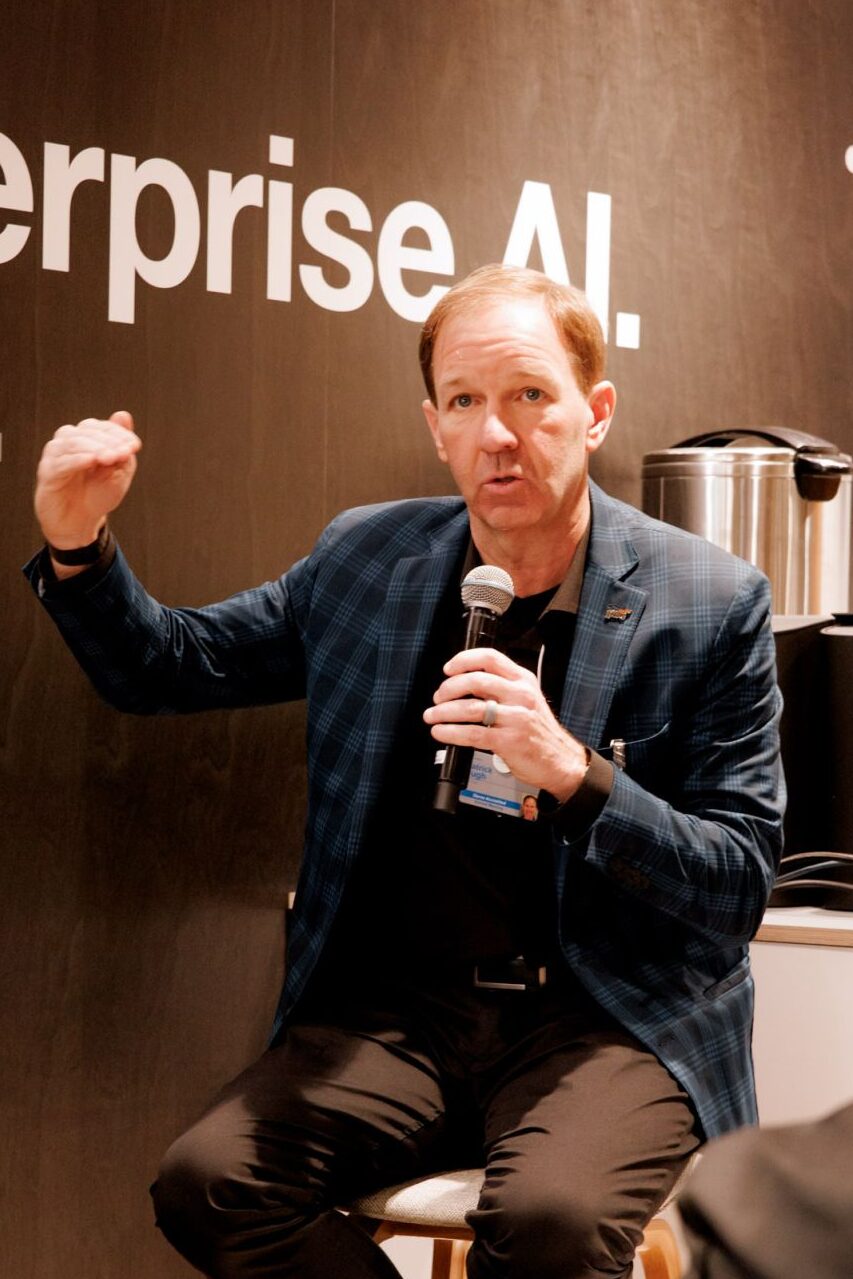
AI is reshaping not just roles but entire operating models. What are the biggest mindset shifts leadership teams need to make when redesigning work for human + AI collaboration?
Pugh: AI is moving beyond process automation to reshape how work gets done across the enterprise. The shift is from automation to augmentation. Its not what AI replaces, but how it enhances human capability at scale and improves outcomes.
For leadership teams, that means moving away from fixed roles executing a linear process towards non-linear workflows, decisions, and value creation across the business. Previous organizational and role boundaries need to be rethought and redesigned to unlock this value. It also brings a sharper focus on trust in the technology, the data, and the responsible application of AI as it becomes embedded in core processes.
At the same time, there is a shift from optimization to reinvention, with leading organizations rethinking operating models in a way that is practical, governed, and scalable, rather than treating AI as a layer on top.
Many organizations talk about reskilling, but few achieve it at scale. What distinguishes companies that are successfully reskilling their workforce from those that are not?
Pugh: Organizations succeeding at reskilling tend to have a few things in common. First, they connect it directly to business priorities. They are clear on the capabilities that matter most. And they tie those skills to the workflows and outcomes that drive value, rather than taking a broad or generic approach.
They also create a culture that supports innovation and continuous improvement, while putting AI-enabled tools into the hands of employees so they can build new skills through day-to-day experience. Our Global CEO Survey shows that organizations seeing the most progress with AI are the ones aligning workforce transformation closely to broader business reinvention and value creation.
Just as importantly, leadership teams help create momentum by aligning around the most important business priorities and creating sponsorship at the highest levels.
There is a level of discipline behind it as well. If a skill is critical, it is expected, measured, and reinforced through leadership and performance. That combination of focus, enablement, and accountability is what separates one-off training initiatives from reskilling that actually sticks.
As workflows become more AI-driven, how should organizations rethink job design and accountability? Are we moving toward entirely new role structures?
Pugh: We are starting to see a shift in how work gets done. Jobs are becoming less about defined tasks and more about orchestrating across AI tools, data, and people. That is where value is increasingly created in more digital and AI-enabled environments.
At the same time, accountability should remain a human function. As AI becomes more embedded, the need for judgment, oversight, and responsible use becomes even more important. This is particularly important where risk, compliance, or client impact are at stake. Human expertise becomes more critical in these environments because people still need to understand context, apply judgment, and make informed decisions.
New roles will emerge, especially around governance and oversight. But the more immediate shift is existing roles being redesigned around this human-and-AI dynamic.
You have a strong ecosystem perspective. How are partnerships – across technology vendors, academia, and platforms – changing how companies build workforce capabilities?
Pugh: The pace of change has made it clear that few, if any, organizations can build these capabilities alone. That is driving a more integrated, ecosystem-based approach, where technology providers, academic institutions, and platforms all play a role in shaping skills, learning models, and the future of industries and professions. There’s also a growing collaboration with leading academic institutions as organizations look to better understand how AI will reshape workforce needs and the future of work itself.
We are also seeing partnerships evolve beyond traditional technology alliances into more operational and managed service models. Recent collaborations across the market, including partnering with academic institutions, as well as PwC’s work with OpenAI, Anthropic, Microsoft, and Google Cloud, reflect how AI, cloud, engineering, and industry expertise are increasingly being brought together in more connected ways to help organizations operationalize these technologies at scale.
Whether through AI-native operating models, managed services, workforce transformation, or industry-specific solutions, the common thread is a much deeper level of integration across the ecosystem.
What makes these ecosystems effective is alignment around trust, innovation, and outcomes. When that alignment is in place, organizations scale capability building faster, access broader talent pools, and respond to change with greater agility.
In your experience, what is the biggest organizational bottleneck to AI adoption today? Is it talent, leadership alignment, or operating design, and why?
Pugh: The most common bottleneck is leadership alignment. It is not because organizations lack technology or ambition. But because execution becomes difficult without clarity on priorities, pace, and where value will be created first.
The organizations moving fastest tend to do two things in parallel. They put AI-enabled tools directly into the hands of employees so people can build fluency and begin applying the technology in practical ways. At the same time, leadership teams align around a smaller number of high-impact business priorities and focus on those areas to drive measurable outcomes. That focus then needs to carry through into IT and engineering execution, particularly around integration, governance, and operationalizing these capabilities at scale.
That combination creates momentum. It helps organizations move beyond pilots, build confidence in the value of the technology, and create a clearer path to ROI. From there, it becomes easier to rethink operating models, address talent gaps, and scale AI in a way that drives sustained impact across the business.
Any advice you would like to give to future leaders navigating the AI age?
Pugh: The leaders who will distinguish themselves in this moment are those willing to lean in and learn by doing. Building fluency in AI matters. It’s not to master the technology, but to understand how it is changing the way work gets done and where value can be created within your organization.
At the same time, the fundamentals don’t change. Trust, accountability, and a focus on people are critical, especially as AI becomes more embedded in decision-making and day-to-day work. The opportunity is there. What determines whether organizations realize it is the judgment leaders bring to the technology, not the technology itself.
Key takeaway
The organizations leading the AI era won’t necessarily be those with the most advanced algorithms – they’ll be the ones that successfully unite technology, data, leadership, and people around a shared business vision. Enterprise AI transformation is no longer an isolated technology initiative; it is an overall reinvention of how organizations operate, innovate, and create value. As Patrick Pugh and Rima Safari highlight, the real winners will be those who treat AI as a core business capability – not just a technology initiative.
Tip: The real advantage lies in how effectively organizations connect technology, people, and purpose to turn innovation into measurable impact.